
As of 12 October 2026 (26 Asoj 2083). Checked against the Income Tax Act, 2058 (with the Finance Act, 2082 amendments) as published by the Inland Revenue Department, IRD’s notices and its booklet on the Finance Act, 2083. This is general information, not tax advice for your case.
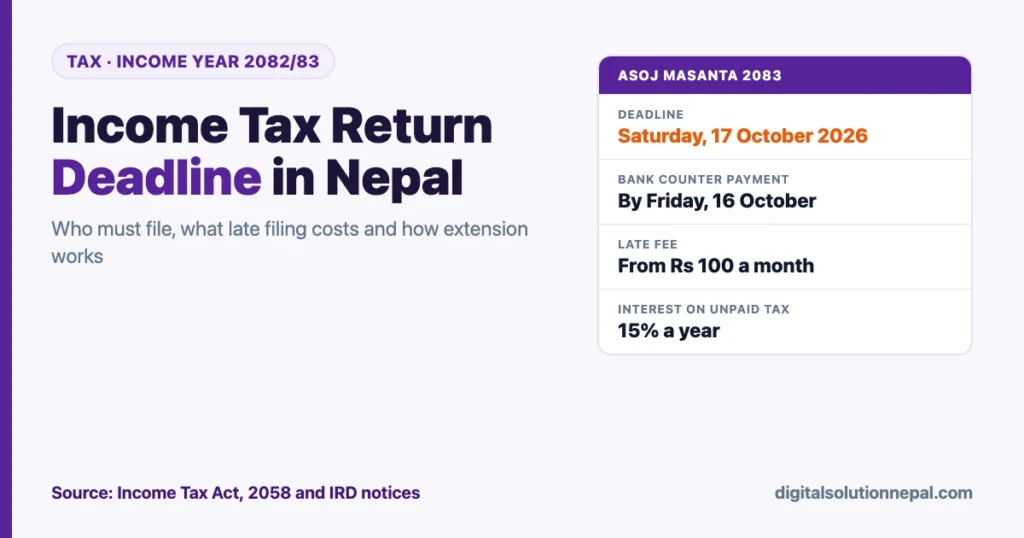
The income tax return deadline in Nepal for income year 2082/83 is Asoj masanta (असोज मसान्त, the last day of Asoj). This year that is Saturday, 17 October 2026. It is five days away, and it lands at the start of the main Dashain holiday.
The date comes straight from the law. Section 96 of the Income Tax Act says every person must file the return within three months of the end of the income year. The income year ends on the last day of Ashadh, so the three months run out at the end of Asoj.
Here is who has to file by then, who does not, what it costs to be late, and what the holiday changes in practice.
Quick answers
| Question | Answer |
|---|---|
| Return for which year? | Income year 2082/83, from 1 Shrawan 2082 to Ashadh end 2083 |
| Deadline | Asoj masanta 2083, Saturday 17 October 2026 |
| Legal basis | Income Tax Act, 2058, section 96(1) |
| Extension | Up to three months in total, only if requested before the deadline, section 98 |
| Late-filing fee | From Rs 100 a month; details below, section 117 |
| Interest on unpaid tax | 15% a year, charged per month, section 119 |
| Where to file | IRD Taxpayer Portal |
| IRD notice moving the date for Dashain | None found on IRD’s website as of 12 October |
Who must file by the income tax return deadline in Nepal
IRD’s guidance note describes three return forms. Which one you file depends on your turnover and income.
| Form | Who files it |
|---|---|
| D-01 | A sole proprietor with business turnover up to Rs 30 lakh and taxable income up to Rs 3 lakh |
| D-02 | A sole proprietor with turnover above Rs 30 lakh and up to Rs 1 crore, and taxable income up to Rs 10 lakh |
| D-03 | Every partnership, private or public company, association, joint venture and other entity; also proprietors above the D-01 and D-02 limits, or with employment or investment income as well |
Two points on D-02. It is not open to doctors, engineers, auditors, lawyers, players, artists and consultants for their professional service income. Those earners file D-03.
One more group must file whatever the source. Under section 97(2), a natural person whose income is above Rs 40 lakh in the year has to submit a return.
Who does not have to file
Section 97(1) lists people who need not file a return unless IRD orders them to. In plain terms they include:
- a person with no tax to pay for the year;
- a resident employee whose only income is a salary from one resident employer at a time, with tax already deducted by the employer and only the limited claims the Act allows;
- a person whose income is only of the kind taxed finally at source;
- a vehicle owner, other than a proprietorship firm, who pays the fixed vehicle tax under Schedule 1;
- a person whose only income is a gain on non-business assets such as land or shares, and who chooses not to file.
The Rs 40 lakh rule overrides this list. If your income is above that, you file.
A caution for anyone holding a business PAN. Do not assume the “no tax to pay” line covers a registered firm that did nothing this year. IRD’s own notices treat entities with no transactions as filers, and they file a nil return.
17 October is a Saturday in Dashain: what changes
Nothing in the Act changes. The practical side does.
- The portal works on holidays. You can submit a return online on any day.
- Bank counters do not. IRD’s guidance says a D-01 return is submitted when its voucher is paid. If you plan to pay at a bank counter, your real deadline is Friday, 16 October.
- Online payment avoids that. The same guidance says the voucher can be paid through connectIPS.
- Tax offices will be closed. A written request or a correction that needs a counter cannot wait until the last day.
We looked for an IRD notice shifting the date because of the holiday. As of 12 October there is none on IRD’s notice or press pages. Do not plan around a carry-over to the next working day. If IRD publishes one, we will update this page.
Can you get an extension?
Yes, but only within limits, and only if you ask in time.
Section 98 lets a person apply in writing, before the deadline, for more time. IRD may extend the date once or several times, up to three months in total. That puts the outer limit at Poush masanta, in mid-January 2027.
How it has worked in practice is worth knowing. An IRD notice of 6 Asoj 2081 explained that its Integrated Tax System grants the extension automatically when a taxpayer requests it. The same notice then restricted it for that year:
| Taxpayer group, 2081 notice | Extension allowed |
|---|---|
| Sole proprietorships with turnover up to Rs 1 crore, and entities with no transactions | None |
| Entities and others with turnover up to Rs 25 crore | To Mangsir masanta |
| Turnover above Rs 25 crore | To 20 Poush |
A later notice that year let taxpayers with turnover above Rs 1 crore extend to Poush masanta.
Those were decisions for that year’s returns. We found no equivalent notice for 2083. The safe reading is this: if you file D-01 or D-02, do not count on an extension. If you file D-03, request it in the portal before 17 October and check what date the system gives you.
One thing an extension never does is stop interest. Section 119(2) says interest is not waived for the extended period. More time to file is not more time to pay.
What it costs to miss the deadline
Two separate charges apply, and you can owe both.
| Charge | Rule | Section |
|---|---|---|
| Late-filing fee, D-01 filers | Rs 1,200 per return; Rs 100 a month if the delay is under a year | 117(1) |
| Late-filing fee, other filers | 0.1% a year of assessable income, or the D-01 amount above, whichever is higher | 117(1) |
| Interest on unpaid tax | 15% a year, counted for each month and part of a month | 119(1) |
Two examples, as our own arithmetic:
- A business with assessable income of Rs 20 lakh files one full year late. The fee is 0.1% of Rs 20 lakh, which is Rs 2,000, because that is higher than Rs 1,200.
- A taxpayer pays Rs 50,000 of tax three months late. Interest is Rs 50,000 × 15% × 3/12, which is Rs 1,875.
The assessable income used for the fee is worked out before deductions. It is usually a larger figure than taxable income.
Already behind on old returns? The 2083 relief window
The Finance Act, 2083 opened a one-time window that runs to Poush masanta 2083. IRD’s booklet on the Act describes three cases under section 40.
- Earned income without a PAN. Take a PAN, file returns for 2079/80 to 2082/83 and pay the tax by Poush masanta 2083. The fee and interest are waived, and earlier years are not pursued.
- Took a PAN but never did business. File the 2082/83 return, pay what it shows, and apply by Poush masanta 2083 either to cancel the registration or to resume business. Returns for earlier years are then not required. If no application is made, the booklet says the PAN is cancelled automatically by the system.
- Have a PAN, earned income, but returns and tax are pending. File the returns and pay the tax plus an additional 1% by Poush masanta 2083. The fee and interest are waived.
The booklet’s own worked example for the third case includes the 2082/83 return. Whether your situation fits is for your tax office to confirm. This window is a reason to clear old years now. It is not a reason to skip this week’s deadline.
How to file D-01 online
These steps are from IRD’s guidance note on the return forms.
- Open ird.gov.np and choose Taxpayer Portal.
- In the Integrated Tax System menu, expand Income tax and select D-01 Return Entry.
- Fill in the registration form and click register. Note the Submission Number the system gives you.
- Enter the fiscal year, your turnover and the deductible amount.
- Choose the bank for the revenue payment and submit.
- Pay the voucher online through connectIPS, or print it and pay at the bank.
- After payment, log in under Taxpayer Login and print your tax clearance for the year.
D-02 and D-03 follow the same portal with more schedules. Our step-by-step guide to filing an income tax return online covers them, and the income tax rates for 2083/84 are on a separate page.
A plan for the five days left
| Day | Do this |
|---|---|
| Tuesday 13 October | Confirm which form applies. Collect sales totals, purchase bills and TDS certificates. |
| Wednesday 14 October | Log in to the portal. Reset the password now if it fails. |
| Thursday 15 October | Enter the return. D-03 filers who cannot finish should request the extension today. |
| Friday 16 October | Pay the voucher. This is the last day for a bank counter. |
| Saturday 17 October | Deadline. Online submission and connectIPS payment only. |
After filing, download the acknowledgement and the tax clearance certificate. Banks and tender documents ask for it. If tax was deducted from your income during the year, our TDS rate guide explains how to claim it.
Filing for the first time, or behind on returns?
Tell us your case and we will help with the paperwork. आय विवरण र कागजातका लागि सम्पर्क गर्नुहोस्।
Frequently asked questions
What is the income tax return deadline in Nepal for FY 2082/83?
Asoj masanta 2083, which is Saturday, 17 October 2026. Section 96 of the Income Tax Act sets it at three months after the income year ends.
Do salaried employees have to file a return?
Not if the salary from one resident employer at a time is the only income and the employer has deducted the tax. A person with income above Rs 40 lakh in the year must file.
Can I file after 17 October without a fee?
Only if IRD has granted an extension that you requested before the deadline. Interest on unpaid tax still runs during the extension.
What is the fine for filing a D-01 return late?
Rs 1,200 per return, or Rs 100 a month where the delay is under a year, under section 117. Interest at 15% a year applies to any unpaid tax.
Has IRD extended the deadline because of Dashain?
No notice to that effect was on IRD’s website as of 12 October 2026. The online portal stays open on holidays.
What is the difference between D-01, D-02 and D-03?
D-01 is for small proprietors up to Rs 30 lakh turnover, D-02 for proprietors from Rs 30 lakh to Rs 1 crore, and D-03 for all entities and everyone else.
Conclusion
The income tax return deadline in Nepal this year is Saturday, 17 October 2026, and the holiday makes it tighter than it looks. If you pay at a bank, you have until Friday. If you file D-01 or D-02, plan as if there is no extension. If you file D-03 and need time, ask in the portal before the deadline, and pay what you owe anyway, because interest does not pause.
If older returns are also pending, note the second date: Poush masanta 2083, when the Finance Act’s relief window closes.
Sources
- Inland Revenue Department, Income Tax Act, 2058 with amendments, sections 2, 4, 96, 97, 98, 117 and 119: https://ird.gov.np/content/13405/income-tax-act–2058–as-amended-by/
- Inland Revenue Department, guidance note on filling the income return forms D-01, D-02 and D-03: https://ird.gov.np/content/8699/sopfinal-aayakar/
- Inland Revenue Department, notice on extension of the return filing deadline, 6 Asoj 2081: https://ird.gov.np/content/12011/notice-regarding-extension-of-deadline-for-filing/
- Inland Revenue Department, notice on extension of the return filing deadline, 25 Mangsir 2081: https://ird.gov.np/content/12490/notice-17338226262/
- Inland Revenue Department, Finance Act, 2083: information booklet on tax exemptions, concessions and other provisions (revised edition): https://ird.gov.np/content/13670/economic-act–2083-information-manual-on-tax/
- Inland Revenue Department, notices page, checked 12 October 2026: https://ird.gov.np/category/notice/
- IRD Taxpayer Portal: https://taxpayerportal.ird.gov.np/taxpayer/app.html
Digital Solution Pvt. Ltd. is an independent publisher and is not affiliated with the Inland Revenue Department. Section references are to the Act as published by IRD. The examples are our own arithmetic. Tax positions differ; confirm yours with your tax office or a registered auditor.

Rabin Paudel
Rabin Paudel is the Founder of Digital Solution, a Content Creator, and an AI Trainer. He shares practical and easy-to-understand content on Artificial Intelligence, Digital Literacy, Online Services, FinTech, and Technology. His mission is to make technology simple, accessible, and useful for everyone.
View all posts by Rabin Paudel →