
Filing an income tax return in Nepal is not hard. Missing the deadline is expensive, and the way the extension works contains a trap that costs people money even when they think they are safe. Here is the process, the dates and the penalties.
The Deadline
Under Section 96 of the Income Tax Act, the return is due within three months of the end of the income year — so for FY 2083/84 that is end of Ashoj. Section 98 allows the Department to extend, once or several times, up to a maximum of three months in total, taking the outer limit to end of Poush.
Which Form You Need
| Form | Who it is for |
|---|---|
| D-01 | Presumptive taxpayers — small taxpayers assessed on a presumptive basis |
| D-02 | Turnover- or transaction-based taxpayers |
| D-03 | The general self-assessment return — the main form for anyone not on a presumptive or turnover scheme |
Do You Actually Have to File?
Below that, the long-standing practice is that a salaried person with a single employer who withheld correctly and filed the annual salary statement does not need to file separately. We could not verify that against the statute — Section 97 exempts specific categories and points onward to provisions we could not read. So we are flagging it rather than asserting it: if you are salaried and unsure, ask your employer’s finance section whether they filed on your behalf, and get the answer in writing.
Two categories are exempt from filing: persons whose only income is a gain on disposal of a non-business chargeable asset (they may opt out), and non-sole-proprietors whose income is solely from a vehicle on hire.
How to File Online
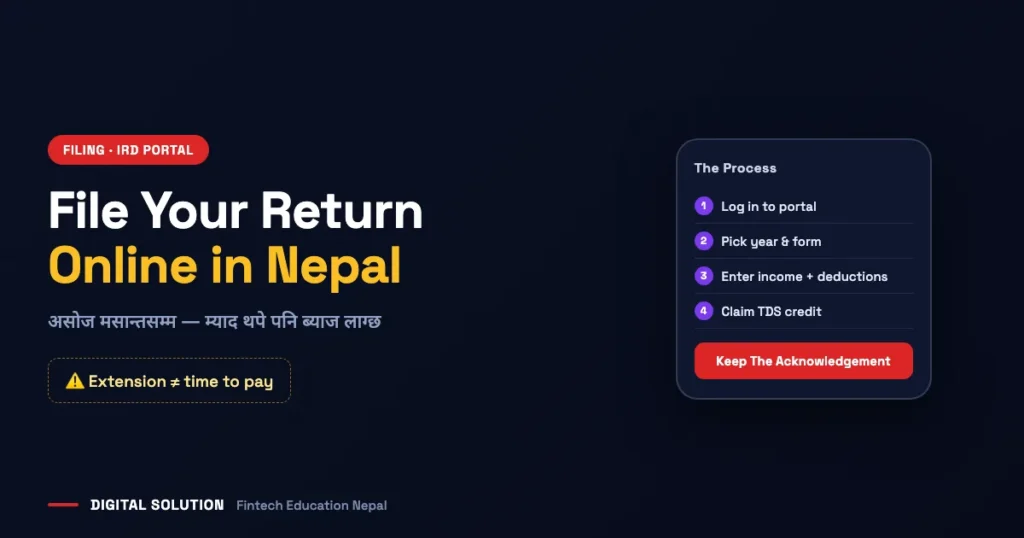
- Go to the IRD taxpayer portal at taxpayerportal.ird.gov.np. This is the official system — type the address yourself rather than following a link from an email or advertisement.
- Log in with your PAN credentials. If you have never used the portal, you will need to set up access first.
- Select the income year you are filing for and the correct form (usually D-03).
- Enter your income and deductions. Have your salary statement, TDS certificates, insurance receipts and retirement contribution records in front of you before you start.
- Claim your TDS credit against the tax already withheld on your behalf during the year.
- Submit, pay any balance, and save the acknowledgement. Keep it — it is your proof of filing.
What It Costs to File Late
| Charge | Amount | Provision |
|---|---|---|
| Late-filing fee (natural person) | 0.1% per year of assessable income less final-withholding income, or Rs 1,200 per year, or Rs 100 per month if the delay is under a year | Sec 117(1) |
| Interest on unpaid tax | 15% per year | Sec 119(1) |
| Interest on missed instalments | 15% per year | Sec 118(1) |
These are unchanged from last year. Note that the late-filing fee and the interest are separate charges — you can incur both on the same return.
🤝 Filing for the first time, or behind on returns?
Tell us your situation — salaried, freelance, business, or catching up on past years. Digital Solution will explain what you need to gather and when you genuinely need a registered practitioner rather than doing it yourself.
Before You Start: The Document Checklist
Income records
Salary statement from your employer, business accounts, rental receipts, interest statements.
TDS certificates
From every party that withheld tax on payments to you. Without these you cannot properly claim the credit.
Deduction proof
Insurance premium receipts, retirement fund statements, donation receipts, education fee receipts.
Bank statements
For the year, particularly if you have foreign-sourced income where tax was withheld at the bank.
Frequently Asked Questions
When is the income tax return deadline in Nepal?
Within three months of the end of the income year — end of Ashoj, roughly mid-October.
Can I get an extension?
Yes, up to three months in total under Section 98. But interest is calculated as if no extension were granted.
Which form should I use?
D-03 is the general self-assessment return. D-01 is for presumptive taxpayers and D-02 for turnover-based taxpayers, and from FY 2083/84 you may opt to use D-03 instead.
Do salaried employees have to file?
Anyone with taxable income over Rs 40 lakh must file. Below that, ask your employer whether they filed the annual statement covering you — we could not verify the general exemption against the statute.
What is the penalty for filing late?
A fee of 0.1% per year of assessable income less final-withholding income, or Rs 1,200 a year, or Rs 100 a month for shorter delays — plus 15% annual interest on unpaid tax.
Where do I file?
The IRD taxpayer portal at taxpayerportal.ird.gov.np.
What if I have no income to report?
From FY 2083/84 a taxpayer with no profit may choose to file D-03 rather than a presumptive form. If you are registered, do not simply skip filing.
Can I file for previous years?
Yes, but late-filing fees and interest accumulate. The sooner you regularise, the smaller the charge.
Sources
- Income Tax Act 2058 — Section 96 (filing), Section 98 (extension), Section 117 (fees), Sections 118 and 119 (interest).
- Inland Revenue Department taxpayer portal and published return forms D-01 and D-03.
- Professional firm tax summary for FY 2083/84 on filing thresholds and the new D-03 option.
Related Reading
Disclaimer: Digital Solution Nepal is an independent educational and digital-service assistance website — not a tax authority, not a chartered accountancy firm and not a law firm. Tax rates and thresholds change with every Finance Act, and individual circumstances differ. Nothing here is tax advice — the Inland Revenue Department, the current Finance Act and a registered tax practitioner are final. Verify before filing or paying.

Rabin Paudel
Rabin Paudel is the Founder of Digital Solution, a Content Creator, and an AI Trainer. He shares practical and easy-to-understand content on Artificial Intelligence, Digital Literacy, Online Services, FinTech, and Technology. His mission is to make technology simple, accessible, and useful for everyone.
View all posts by Rabin Paudel →