
As of 12 October 2026 (26 Asoj 2083). Based on the public notice issued by the Department of Transport Management on 2083/06/26, which we read in full, and on same-day press reports.
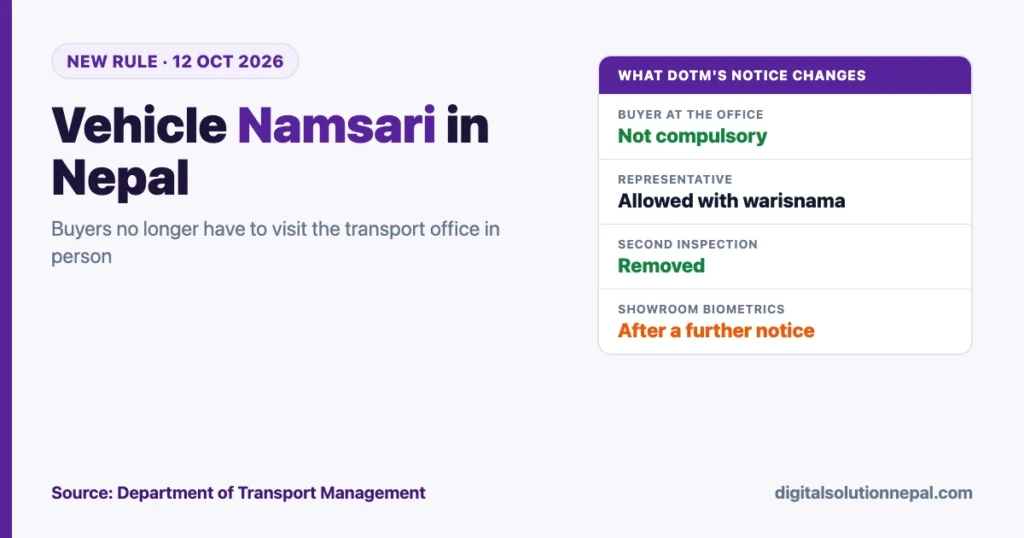
The rule for vehicle namsari in Nepal changed on 12 October 2026. Namsari (नामसारी) is the transfer of a vehicle’s ownership into the buyer’s name. Until now the buyer had to appear at the Transport Management Office in person. The Department of Transport Management (DoTM) has now said that buyers of new and used vehicles no longer have to go there compulsorily.
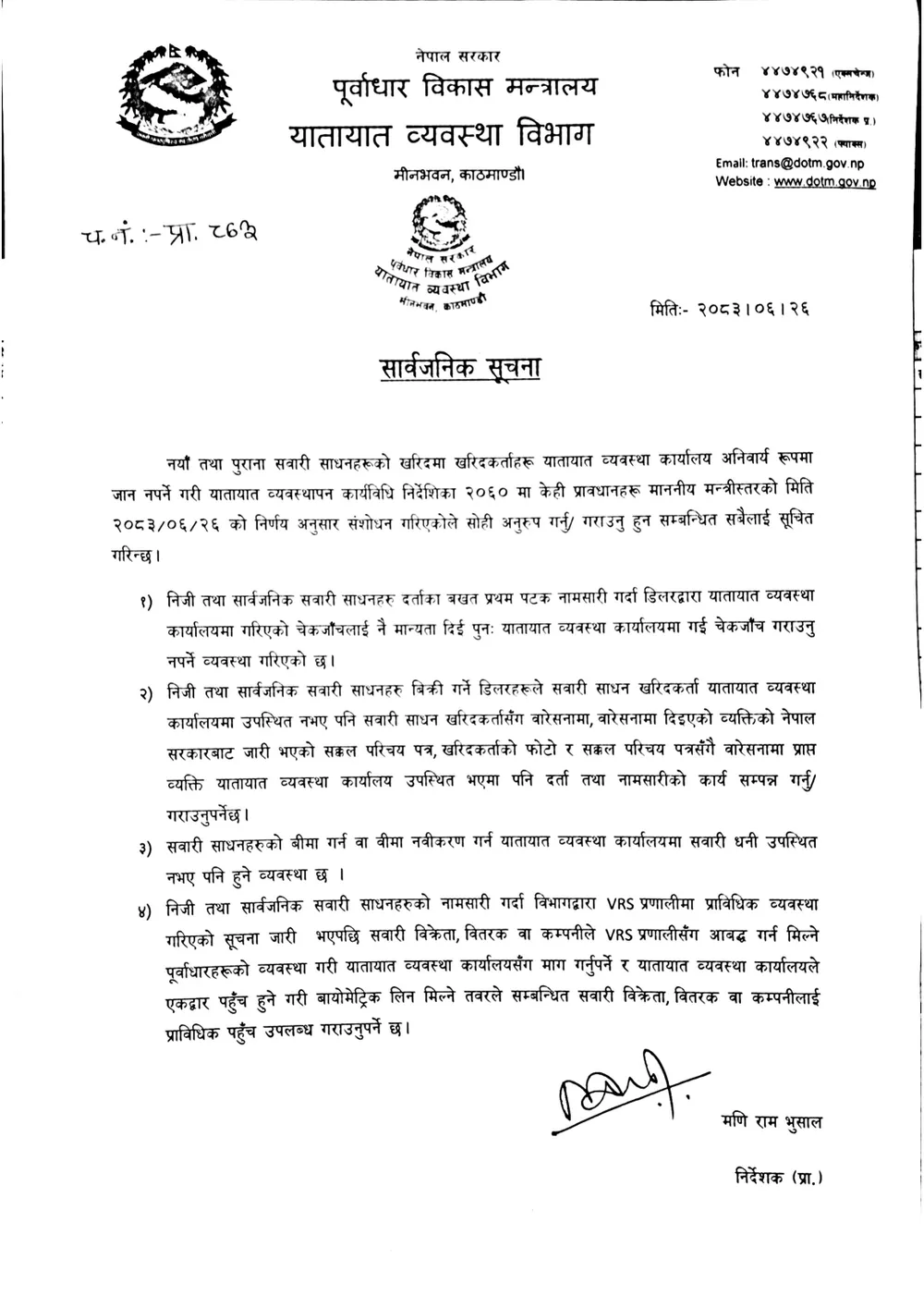
The change comes from a ministerial-level decision of the same date. It amends the Transport Management Procedure Directive, 2060 (यातायात व्यवस्थापन कार्यविधि निर्देशिका, २०६०). DoTM’s notice lists four specific changes.
Headlines have summed this up as “no more visits to the transport office”. That is close, but not exact. Someone still goes to the office. The process is not online. This article sets out what the notice says, point by point, and what it does not say.
Key takeaways
- The buyer can stay home. A person holding the buyer’s warisnama (वारेसनामा, a power of attorney) can complete registration and namsari at the office.
- One inspection is enough. The check done by the dealer at the Transport Management Office is accepted. The vehicle does not have to be taken back for a second check.
- Insurance does not need the owner. For vehicle insurance or its renewal, the owner need not be present at the office.
- Biometrics will move to showrooms, later. Sellers will be able to take the buyer’s biometrics through the Vehicle Registration System, but only after DoTM issues a further notice.
- Not changed: fees, taxes and the documents a transfer needs. The notice does not mention them.
What changed in vehicle namsari in Nepal on 12 October 2026
| Before, as reported | Now, according to DoTM’s notice | |
|---|---|---|
| Buyer’s presence | Buyer had to attend the Transport Management Office | Not compulsory; a warisnama holder can attend instead |
| Vehicle inspection | Checked through the dealer, then taken again by the buyer | The dealer’s check at the office is recognised; no repeat check |
| Insurance and renewal | Owner expected at the office | Owner need not be present |
| Biometrics | Not available at showrooms | To be taken at the seller’s premises once the system is ready |
The “before” column is the earlier practice as the notice implies it and as press reports describe it. The “now” column follows the notice itself.
The four changes, in plain language
1. One inspection is enough
The first point covers private and public vehicles at the time of registration, when the vehicle is transferred for the first time. The check carried out by the dealer at the Transport Management Office will be recognised. The notice says the vehicle does not have to be taken to the office again for another check.
In practice this removes a repeat trip for the same vehicle. A new owner collecting a bike or car from a showroom is the obvious case.
2. A representative can complete registration and namsari
The second point is the main one. It is addressed to dealers who sell private and public vehicles. Even if the buyer is not present at the office, registration and namsari must be completed when the buyer’s representative attends with these four things:
- the warisnama given by the buyer;
- the representative’s own original identity document issued by the Government of Nepal;
- the buyer’s photograph;
- the buyer’s original identity document.
The wording matters. The notice says the office “must complete” the work in that case. It is written as an obligation on the office, not as a favour.
3. Insurance and renewal without the owner
The third point is one sentence. To insure a vehicle or to renew its insurance, the vehicle owner does not have to be present at the Transport Management Office.
The notice gives no further detail. If your office has been asking for the owner in person for an insurance-related entry, this is the line to point to. Our guide to third-party vehicle insurance in Nepal explains what the cover itself includes.
4. Biometrics at the showroom, later
The fourth point is about the future. It concerns the Vehicle Registration System (VRS), the software DoTM uses for vehicle records.
The sequence in the notice is this:
- DoTM issues a notice saying the technical arrangement in VRS is ready.
- Vehicle sellers, distributors or companies set up the infrastructure needed to connect to VRS.
- They ask the Transport Management Office for access.
- The office gives them technical access, through a single window, so that the buyer’s biometrics can be taken.
Until step one happens, this part is not in use. The notice sets no date for it.
What has not changed
It is easy to read more into the news than the notice contains. These points stay as they were.
- Someone still goes to the office. The representative and the dealer attend. This is a relaxation of who must appear, not an online service.
- Fees and taxes. The notice does not mention registration fees, transfer fees or vehicle tax.
- The usual documents. The notice adds the warisnama and identity documents for a representative. It does not replace the ordinary paperwork for registration and transfer.
- Biometrics. The showroom route starts only after DoTM’s further notice.
How to use the new rule when you buy a vehicle
The notice does not give a step list for buyers. This is our practical reading of it.
- Tell the dealer early. Say that you want registration and namsari done through a representative, and ask whether their local office has started applying the notice.
- Choose your representative. A family member is the safest choice. The dealer’s staff may offer to act; decide whether you are comfortable with that.
- Prepare the warisnama. Name the person, the vehicle and the exact task. Ask the office or dealer what form they accept and whether it needs certification.
- Hand over your original identity document and a photo. The notice asks for the original, not a copy.
- Have the representative attend with their own original ID. The dealer handles the vehicle check.
- Check the bluebook when it comes back. Confirm your name, the engine number and the chassis number before you file it away.
One caution from our side. A warisnama and an original identity document are powerful things to hand to someone. Limit the warisnama to this one vehicle and this one job, and get your ID back the same day.
Who benefits most
- Buyers outside the city where the office is. A day’s travel for a signature is no longer required.
- People working abroad. A Nepali in Qatar or Malaysia buying a scooter from a dealer for family at home can ask a relative to act, provided the warisnama and the original identity document can be supplied.
- Working people. Office hours no longer have to be lost to a queue.
- Dealers. Deliveries no longer wait for the buyer’s free day.
If you are comparing models before buying, our bike price list and electric car price list carry official prices.
Questions the notice leaves open
We could not answer these from the notice. They are worth asking at your office.
- Private sales. The opening line covers buyers of new and used vehicles. The representative clause, however, is addressed to dealers. Whether a sale between two individuals, with no dealer involved, gets the same treatment is not spelled out.
- The form of the warisnama. The notice does not say whether it must be certified, or by whom.
- The biometric start date. It depends on a notice DoTM has not yet issued.
- How fast offices will apply it. Transport Management Offices are run by the provinces. The notice asks all concerned to act accordingly, but day-to-day practice can take time to catch up.
We will update this article when DoTM or the offices clarify any of these.
Where this fits
This is the second easing of transport paperwork in a short period. The government recently set out which driving licence steps move online, which we covered in our guide to the new online driving licence directive and in what is online and what still needs an office visit.
The direction is the same in both: fewer compulsory trips to the counter, and more of the identity check done through the system.
Need a warisnama, application or other document prepared?
Order online or message us. वारेसनामा, निवेदन वा अन्य कागजातका लागि सम्पर्क गर्नुहोस्।
Frequently asked questions
Do I still have to go to the transport office for vehicle namsari in Nepal?
Not compulsorily. Under DoTM’s notice of 12 October 2026, a person holding your warisnama can attend in your place with your original ID, your photo and their own original ID.
Is vehicle namsari online now?
No. The notice removes the need for the buyer to appear in person. A representative still attends the Transport Management Office.
Does the vehicle need a second inspection after the dealer’s check?
No. The notice says the check done by the dealer at the Transport Management Office is recognised and the vehicle need not be taken again.
What documents does my representative need?
Four are listed: your warisnama, the representative’s original government-issued ID, your photo, and your original ID. The ordinary registration and transfer papers still apply.
When will dealers take biometrics at the showroom?
After DoTM issues a notice that the Vehicle Registration System is technically ready. No date has been announced.
Have namsari fees or vehicle tax changed?
The notice does not mention fees or tax. Nothing in it changes what you pay.
Conclusion
Vehicle namsari in Nepal has become easier in one specific way: the buyer no longer has to stand at the counter. A trusted person with a warisnama can do it, the dealer’s inspection counts, and the owner is not needed for insurance entries. The showroom biometric step is planned but not yet live.
If you are buying this festive season, ask your dealer one question before you pay: has your Transport Management Office started accepting a representative under the 26 Asoj notice? The answer tells you whether you need to take a day off.
Sources
- Department of Transport Management, public notice dated 2083/06/26, signed by Director (Technical) Mani Ram Bhusal: https://dotm.gov.np/content/130/
- The notice as a PDF: https://giwmscdnone.gov.np/media/pdf_upload/New%20Document(42)_qqysf0l.pdf
- TechPana, report on the amendment (26 Asoj 2083): https://www.techpana.com/2026/159555/vehicle-registration-transfer-insurance-renewal-without-transport-office-visit
Digital Solution Pvt. Ltd. is an independent publisher and is not affiliated with the Department of Transport Management. The four changes are translated from the notice; the step list, the cautions and the open questions are our own. Confirm the current practice with your Transport Management Office before you rely on it.

Rabin Paudel
Rabin Paudel is the Founder of Digital Solution, a Content Creator, and an AI Trainer. He shares practical and easy-to-understand content on Artificial Intelligence, Digital Literacy, Online Services, FinTech, and Technology. His mission is to make technology simple, accessible, and useful for everyone.
View all posts by Rabin Paudel →