
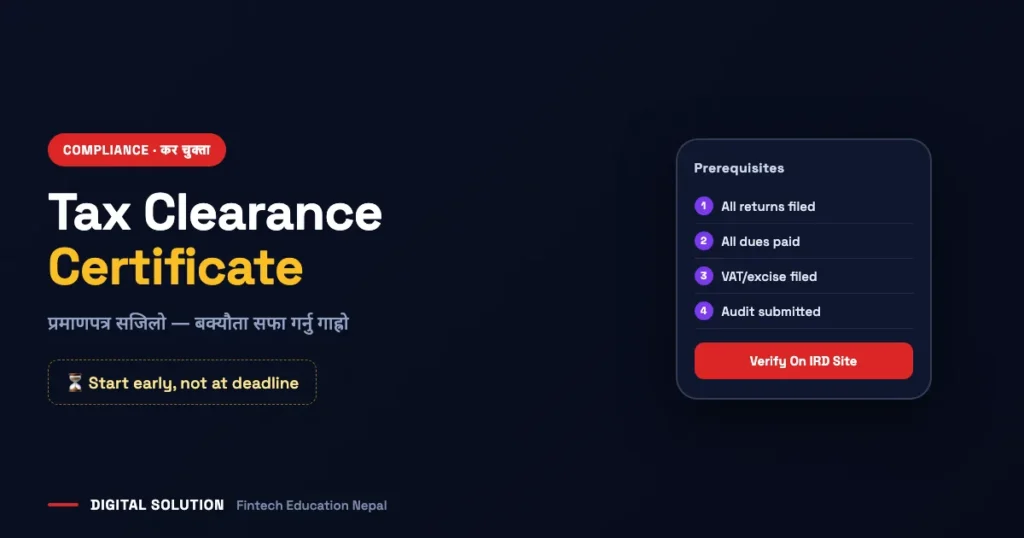
A tax clearance certificate (कर चुक्ता प्रमाणपत्र) is the document that says you owe the Inland Revenue Department nothing. You will discover you need one at the worst moment — usually days before a tender deadline — and by then it is too late to fix what is blocking it.
Who Typically Needs One
Government tenders and contracts
Public procurement processes routinely require it as part of the bid documents.
Company closure or merger
You cannot cleanly wind up or merge with tax matters outstanding.
Licence and registration renewals
Various business registrations and renewals ask for it.
Bank loan applications
Lenders commonly request it as evidence of compliance.
Foreign employees leaving Nepal
Required when a foreign employee departs permanently.
Visa and foreign investment purposes
Some visa categories and investor processes ask for it.
What You Need in Place First
- All income tax returns filed for the relevant periods. If you are behind, this is the long pole — see our filing guide.
- All tax, penalties and interest paid. An outstanding balance of any size blocks the certificate.
- VAT and excise returns filed where applicable — including nil returns, which are mandatory. See our VAT filing guide.
- Audited financial statements submitted where your entity requires an audit.
- TDS deposited and withholding returns filed if you are a withholding agent.
- Then apply — through the IRD taxpayer portal, or at your Inland Revenue Office.
Watch: How to Get a Personal Tax Clearance Certificate
The full process on screen — what to fill, where to click, and what the certificate looks like when it is issued.
From the Digital Solution YouTube channel — subscribe for more step-by-step guides.
Verifying a Certificate
🤝 Need a tax clearance certificate and not sure what is blocking it?
Tell us your entity type and where you stand on filings. Digital Solution will help you map what needs regularising and in what order — and tell you honestly when you need a registered practitioner or auditor.
Three Things We Deliberately Are Not Telling You
This is the weakest-documented topic in our tax series, and we would rather say so than guess:
- The fee. Sources directly contradict each other — some say the certificate is issued free of charge, others quote figures from a couple of hundred rupees for individuals up to a few thousand for large companies. We could not resolve it.
- The validity period. Three to six months is commonly stated, with the practical position being that it is tied to the fiscal year certified and renewed annually. Unconfirmed.
- Processing time. Reported figures range from three to seven working days up to seven to fifteen, with longer for complex cases. The sources conflict.
Ask your Inland Revenue Office these three questions directly. One phone call will give you better information than any article, this one included.
A Note on Circulars
Frequently Asked Questions
What is a tax clearance certificate in Nepal?
A document issued by the Inland Revenue Department confirming that a taxpayer has no outstanding tax liability for the period certified.
Who needs one?
Commonly required for government tenders, company closure or merger, certain licence renewals, bank loan applications, departing foreign employees and some visa or investment processes. Check with whoever is asking.
How do I get one?
Apply through the IRD taxpayer portal or at your Inland Revenue Office, once all returns are filed and all dues paid.
How much does it cost?
Sources contradict each other — some say free, others quote fees. Ask your Inland Revenue Office.
How long does it take?
Reported estimates range from a few working days to a couple of weeks. Do not leave it to the last minute.
How long is it valid?
Commonly stated as three to six months and tied to the fiscal year certified, but we could not verify this. Confirm with your IRO.
Can I get one with unfiled returns?
No. Filing and payment are the prerequisites — that is the whole point of the certificate.
How do I check whether someone else’s certificate is genuine?
Use IRD’s verification service rather than accepting a printed copy.
Sources
- Inland Revenue Department tax clearance verification service and taxpayer portal.
- Professional-services descriptions of the requirement and process — noted as unverified against an IRD publication.
- Finance Act 2083 provision making IRD public circulars binding, as set out in published professional summaries.
Related Reading
- Filing your income tax return online
- VAT return filing: process and penalties
- PAN vs VAT: when registration becomes mandatory
- PAN and VAT registration walkthrough
Disclaimer: Digital Solution Nepal is an independent educational and digital-service assistance website — not a tax authority, not a chartered accountancy firm and not a law firm. Tax rates and thresholds change with every Finance Act, and individual circumstances differ. Nothing here is tax advice — the Inland Revenue Department, the current Finance Act and a registered tax practitioner are final. Verify before filing or paying.

Rabin Paudel
Rabin Paudel is the Founder of Digital Solution, a Content Creator, and an AI Trainer. He shares practical and easy-to-understand content on Artificial Intelligence, Digital Literacy, Online Services, FinTech, and Technology. His mission is to make technology simple, accessible, and useful for everyone.
View all posts by Rabin Paudel →