Updated August 2026. Based on Nepal Rastra Bank’s amended digital lending guideline as covered in our video report. Each bank applies its own credit assessment, rates and fees on top of these ceilings — confirm exact terms with your bank before borrowing.
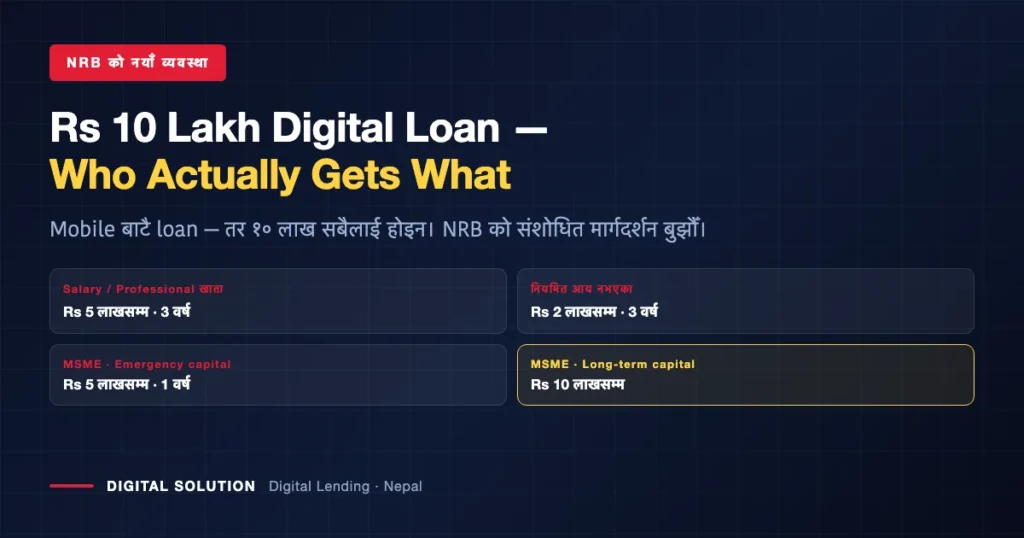
You can now take a loan of up to Rs 10 lakh entirely through mobile or online banking in Nepal — no branch visit, no land papers. But the headline number hides the real story: NRB’s amended digital lending guideline sets different ceilings for different people, and what you personally qualify for is decided by an algorithm reading your transaction history.
Here is who gets what, what the banks actually look at, and the two warnings that belong next to every “instant loan” headline.
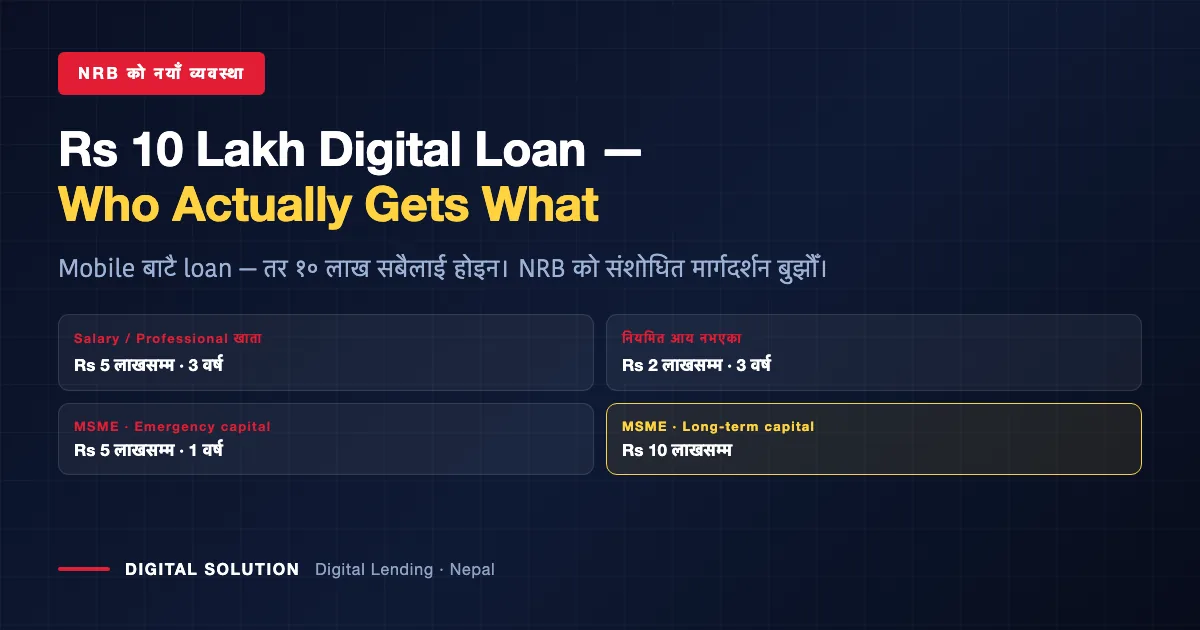
The Limits: Who Can Borrow How Much
| Borrower | Maximum digital loan | Repayment window |
|---|---|---|
| Person with regular salary, professional or business income flowing into a bank/BFI account | Rs 5 lakh | Up to 3 years |
| Person without regular professional income or salary | Rs 2 lakh | Up to 3 years |
| Micro, small or medium business — emergency working capital | Rs 5 lakh | Within 1 year |
| Business — long-term working capital | Rs 10 lakh | Per the bank’s policy |
Read the ceilings correctly: these are the maximums a bank may lend digitally — not an entitlement. Your personal limit comes out of the credit assessment below, and for most people it will be well under the ceiling. In our own case, shown in the video, the bank’s app offered a pre-approved digital loan of around Rs 63,000 — calculated from real merchant QR and transaction history, not from the Rs 5 lakh headline.
No Collateral — Your Data Is the Collateral
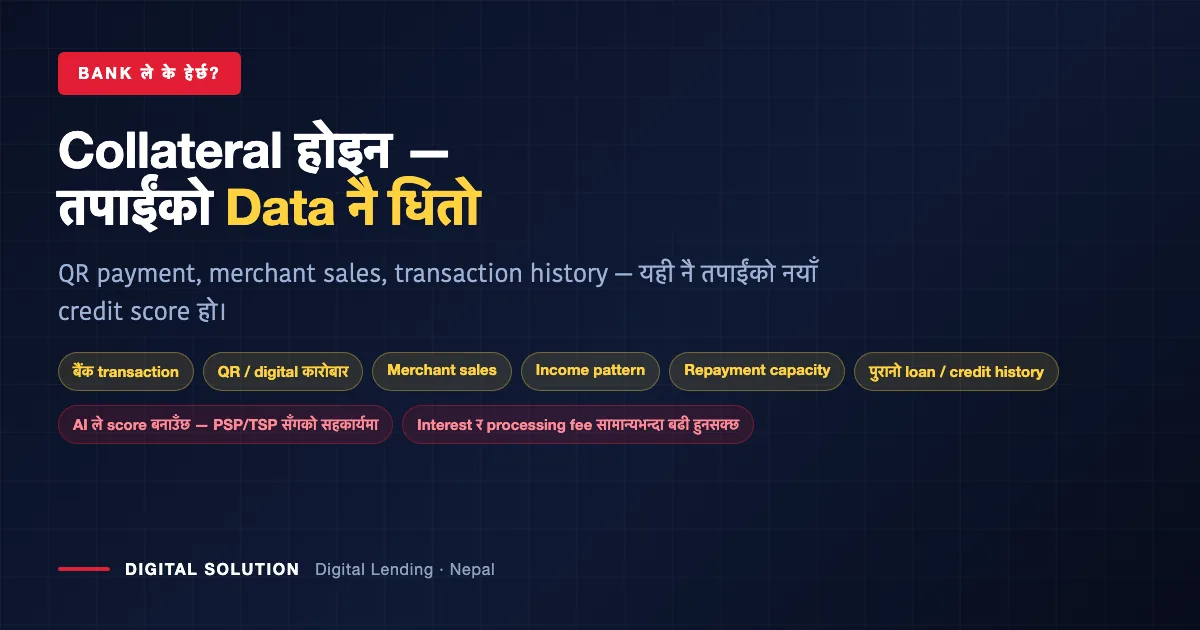
Traditional loans ask for land or gold. Digital loans ask for your transaction record. Under the guideline, banks assess:
- Bank transactions — how money moves through your account
- QR and digital payment activity — including merchant sales, if you run a shop with a QR
- Income pattern and business turnover
- Repayment capacity, existing loans and credit history
- Overall risk profile
Banks are allowed to do this in partnership with payment service providers and technology service providers, whose systems — increasingly AI-driven — turn your financial behaviour into a score. The bank lends against the score.
Every QR payment you accept at your pasal is now also a line in your loan application. Cash sales build nothing.
That is the quiet incentive in this system: a shopkeeper who takes payments on a merchant QR (which costs nothing) is simultaneously building the digital sales record that qualifies them for working-capital loans. The informal-cash shop next door, with identical revenue, qualifies for far less — the algorithm cannot see money it was never shown.
Before You Tap “Accept”: The Two Warnings
1. Convenient is not cheap. These loans are collateral-free, and lenders price that risk in: interest rates can run above the market rate, and processing fees can be higher than for normal loans — plus late-payment charges. Read the interest rate, processing fee, penalty schedule and EMI before accepting. A loan you can take in two minutes deserves at least ten minutes of reading.
2. The fake loan-app trap. “Loan पाइन्छ” apps circulating on Facebook and WhatsApp — unverified APKs that ask for your OTP, PIN or password — are not digital lending. They are data theft and extortion wearing a loan’s clothes. Legitimate digital loans come only from banks and financial institutions licensed and regulated by Nepal Rastra Bank, inside their official apps. The moment an “app” asks for an OTP or an advance fee to release a loan, you are looking at the same fraud family as the task-earning scams.
Digital Loan or the Alternatives?
| Need | Better fit |
|---|---|
| Emergency cash, small amount, fast | Digital loan — this is exactly its job; mind the rate |
| Business stock for the season | Digital working-capital loan (Rs 5 lakh emergency / Rs 10 lakh long-term tier) |
| House or land | A normal home loan — collateralised, far cheaper |
| You contribute to SSF | Check the SSF loan facility first — contributor loans are priced differently |
| Studying abroad | Education loan, not a consumer digital loan |
One more reason to repay on time: a defaulted digital loan follows the same path as any loan default — into the credit information bureau and potentially the bank blacklist, which then blocks your future borrowing everywhere. Small loan, same blacklist.
Watch: The Digital Loan Rules, Explained in Nepali
From the Digital Solution YouTube channel — subscribe for more coverage in Nepali.
Questions about loans, banking or documents?
Digital Solution helps Nepalis navigate banking paperwork, government services and digital finance — in plain Nepali.
Frequently Asked Questions
How much digital loan can I get in Nepal?
Under NRB’s amended guideline: up to Rs 5 lakh (3 years) if you have regular salary, professional or business income in your account; up to Rs 2 lakh (3 years) without regular income; businesses can access Rs 5 lakh emergency working capital (1 year) or up to Rs 10 lakh long-term working capital. Your personal approval depends on the bank’s credit assessment and is usually below the ceiling.
What do banks check for a digital loan?
Bank transactions, QR and digital payment activity, merchant sales, income pattern, business turnover, repayment capacity, existing loans and credit history — assessed with payment and technology service providers, often using AI-based scoring.
Do I need collateral for a digital loan?
No — that is the point, and also why interest rates and processing fees can be higher than normal loans. The lender’s security is your transaction record, not property.
Why did my bank offer me a small pre-approved amount?
The offer reflects what the algorithm sees: your account flow, QR activity and repayment history. Thin digital history means small offers regardless of your real income. Routing income and sales through your account grows the offer over time.
Are loan apps on Facebook and WhatsApp safe?
Unverified loan apps that ask for OTP, PIN, password or an advance “release fee” are scams. Take digital loans only from NRB-licensed banks and financial institutions, inside their official apps.
Can a shopkeeper get a digital loan on QR sales?
Yes — merchant QR sales are explicitly part of the assessed data, and MSMEs have their own working-capital tiers (Rs 5 lakh emergency, Rs 10 lakh long-term). A recorded digital sales history is what unlocks it.
Related Reading

Rabin Paudel
Rabin Paudel is the Founder of Digital Solution, a Content Creator, and an AI Trainer. He shares practical and easy-to-understand content on Artificial Intelligence, Digital Literacy, Online Services, FinTech, and Technology. His mission is to make technology simple, accessible, and useful for everyone.
View all posts by Rabin Paudel →