
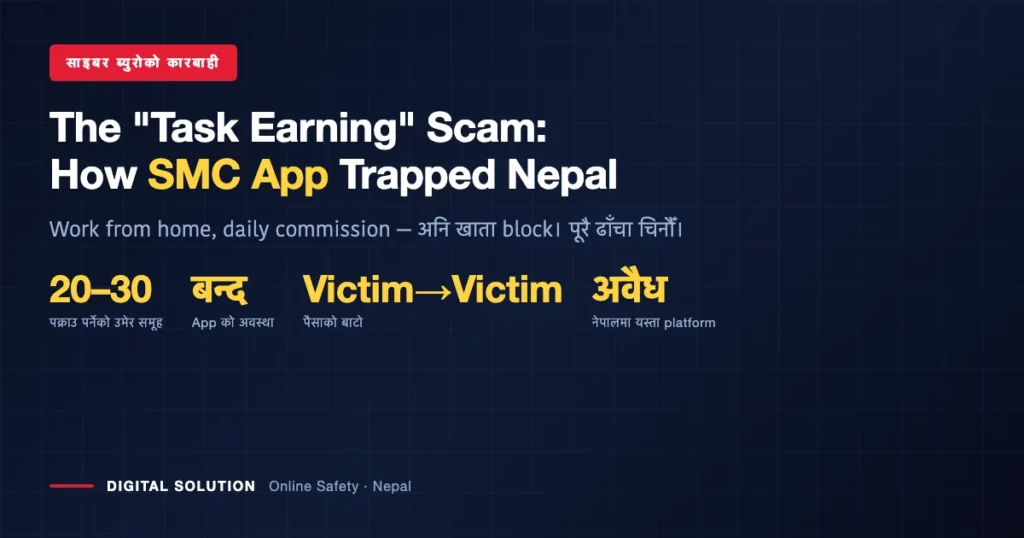
Online safety · August 2026. Based on Nepal Police Cyber Bureau’s action against the SMC app network and our video coverage of the case. The app is shut and arrests have been made; the pattern it used is still running under other names — which is why this guide focuses on the pattern.
Nepal Police’s Cyber Bureau has arrested members of the network behind the SMC app — a “task earning” platform that took lakhs from ordinary Nepalis with three magic words: work from home, daily commission, easy earning. Among those arrested: people in their 20s and 30s, some of them recruited into the scheme themselves.
The app is gone. The template is not. The same deposit-ladder fraud reappears under a new name every few months, so the useful thing is not the name SMC — it is being able to recognise the machine from any angle. Here is the whole machine.
How the Trap Actually Works: The Deposit Ladder
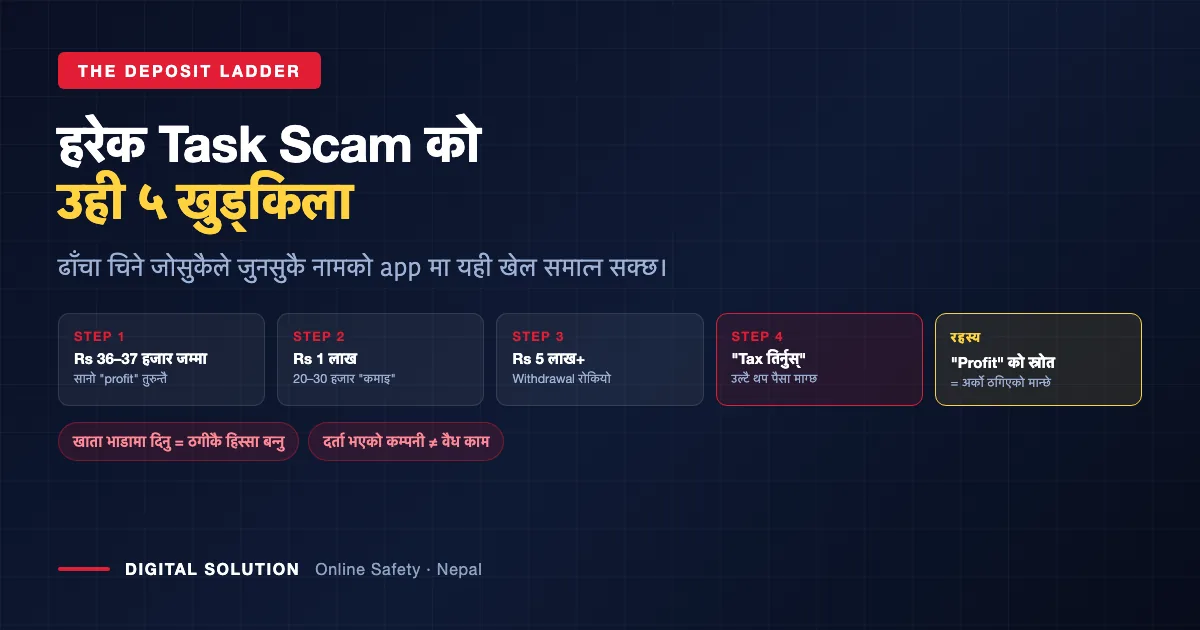
- Small deposit, real payout. You put in Rs 36–37,000. You complete simple “tasks”. A small profit lands in your account, fast. It feels verified — you saw real money.
- The trust raise. Encouraged, you deposit Rs 1 lakh. Another Rs 20–30,000 in “earnings” appears. By now you are recruiting your own relatives.
- The big deposit. Rs 5 lakh or more goes in — sometimes borrowed, sometimes pulled from a सहकारी. Suddenly, withdrawals stop.
- The reverse demand. “Pay tax to unlock your account.” You pay. Another fee appears. The account never unlocks — the demands only end when you stop paying.
- The part nobody realises until too late: the “profit” that convinced you in step one was another victim’s deposit. Money moves victim-to-victim through a circulation network. There was never a business — only a queue.
The scam does not steal your money at the start. It pays you first — with someone else’s loss — so you will hand over everything later.
Why Smart People Fell for It
This was not a fraud that only caught the careless. According to the case details, victims included army and police personnel, civil servants and bank employees — and that fact hides a second tragedy: many of them never filed complaints, out of fear that participating in an illegal platform would rebound on them. The scammers count on that silence.
The manipulation toolkit was standard social engineering:
| Technique | What it looked like |
|---|---|
| Recruitment via leaked numbers | You drop your number on a “free giveaway” post; days later a WhatsApp message arrives offering an “earning opportunity”, moving you into Telegram groups |
| Fake proof | Screenshots of “earnings” and payment confirmations, manufactured |
| Urgency | “Limited offer” framing so you deposit before thinking |
| Early payouts | Small real transfers that defeat your skepticism — “it paid, so it works” |
| A registered company | “We are registered in Nepal, we have an office” — see below for why that means nothing |
“तर कम्पनी दर्ता भएको छ!” Registration is not legitimacy. Registering a company at the Company Registrar costs a few thousand rupees and proves only that paperwork was filed. What matters is the business model — and a platform whose payouts come from newer members’ deposits is illegal in Nepal regardless of what certificates hang on its wall.
The Account-Renting Trap: How Bystanders Become Accomplices
“तेरो खाता चलाउन दे, २० हजार दिन्छु।” To cash out, these networks need bank accounts and wallet QRs that are not their own — so they rent yours, or open accounts on misused documents. Understand what renting your account means: stolen money flows through your name. When the investigation traces transactions, the trail ends at you — blacklisted account, frozen funds, and a police case in which you are not a bystander. No commission is worth becoming the money mule in someone else’s fraud. Never rent, lend or share your bank account, wallet or QR. Ever.
If Money You Don’t Recognise Lands in Your Account
One more scenario from the case worth knowing: scammers sometimes push stolen money into an uninvolved person’s account — and that person, seeing a mysterious Rs 1 lakh, stays quiet. Wrong move. Unexplained incoming money from a fraud network can freeze and blacklist your account when the trail is traced.
The protective move is to go to the police first. If unknown money appears in your account, report it to Nepal Police / the Cyber Bureau proactively: “यो पैसा कहाँबाट आयो मलाई थाहा छैन।” Reporting first puts you on record as a bystander. Silence makes you look like a participant.
If You Were Caught in It
- Stop paying immediately. Every “tax” or “unlock fee” is the same scam continuing. The account will never open.
- Report to the Cyber Bureau — even if you feel at fault. Victims who joined an illegal platform still get to report being defrauded, and cases move on the strength of reports. The shame-driven silence of police, army and bank-staff victims is exactly what protects the network.
- Preserve everything: the Telegram/WhatsApp threads, deposit receipts, account numbers you paid into, screenshots of the app.
- If you borrowed to deposit — from a cooperative or on loan — document that too; it is part of the damage record.
- Warn your circle without embarrassment. Your Rs 37,000 story, told openly, is what stops your cousin’s Rs 5 lakh.
For the wider catalogue of fraud patterns running in Nepal right now — fake job offers, trafficking-linked “opportunities” abroad — our guide to online job scam warning signs pairs with this one. If a payment dispute with a legitimate service goes wrong, the escalation path is different: how to file a digital payment complaint.
Watch: The Full SMC Case, Explained in Nepali
From the Digital Solution YouTube channel — subscribe for more online-safety coverage in Nepali.
The One-Line Filter That Beats Every Version of This Scam
Real income means someone pays you because you created value for them — a skill sold, a task genuinely needed, a product delivered. In a task-earning app, ask the only question that matters: who is paying, and for what value? If the honest answer is “newer members are paying, for nothing,” you are looking at a queue of victims, and every queue ends.
Skills are the unglamorous alternative that actually works — which is why we teach them. Money does not come easily; it comes from value.
Earn from skills, not schemes
Digital Solution’s AI Mastery Course teaches practical, income-relevant digital skills in Nepali — content, office work, freelancing workflows. 10 days live, from Rs 3,000, paid by eSewa or Khalti.
Frequently Asked Questions
What was the SMC app scam?
A “task earning” platform that promised daily commissions for completing simple tasks, funded new members’ “profits” from other victims’ deposits, then blocked withdrawals once deposits grew large. Nepal Police’s Cyber Bureau has arrested members of the network and the app is shut.
Are task-earning apps legal in Nepal?
Platforms of this kind — where returns come from recruiting deposits rather than any real business — are illegal in Nepal. A company registration certificate does not change that; registration proves paperwork, not a legitimate model.
How do these scams find victims?
Largely through numbers people drop publicly on “free offer” posts, followed by WhatsApp messages and Telegram groups, fake earning screenshots, limited-time urgency, and small early payouts that build false trust.
Is renting out my bank account really that serious?
Yes. Accounts are rented specifically to move stolen money, and the transaction trail leads to the account holder. That means blacklisting, frozen funds and potential criminal exposure — for a one-time commission.
Money I can’t explain arrived in my account. What should I do?
Report it to the police proactively before your account is flagged. Going first, with the truth, records you as a bystander; staying silent while fraud money sits in your account makes you look like part of the network.
I lost money in SMC but I’m embarrassed to report. Should I still?
Yes. Victims — including those who knowingly joined — still get to report being defrauded, and unreported losses are precisely what let the network restart under a new name. Bring your chat records, receipts and the account numbers you paid into.
Related Reading

Rabin Paudel
Rabin Paudel is the Founder of Digital Solution, a Content Creator, and an AI Trainer. He shares practical and easy-to-understand content on Artificial Intelligence, Digital Literacy, Online Services, FinTech, and Technology. His mission is to make technology simple, accessible, and useful for everyone.
View all posts by Rabin Paudel →