
Updated August 2026. Foreign-exchange limits for students are set by NRB circular and revised periodically; the No Objection Certificate process is run by the Ministry of Education. Confirm current figures with your bank and the Ministry before committing to a deadline.
The offer letter arrived. Now you need to move tuition money out of Nepal legally, and probably borrow to do it. Two things decide whether that goes smoothly — the Ministry of Education’s No Objection Certificate, and the fact that education loans in Nepal are almost always secured against property. Neither is optional, and both take longer than students expect.
The NOC Is the Gate — Everything Waits On It
Applications go to the Ministry in its prescribed format, and there is an online portal for the process. Reported figures put the fee at around Rs 2,000, with processing on the same day for a complete in-person application and one to two working days online — though we could not confirm either from an official Ministry page, so treat both as indicative.
How Much Foreign Currency You Can Send
NRB sets annual limits by destination country. The figures below come from reporting on the revised Unified Circular, and the increase for the main study destinations from USD 10,000 to USD 12,000 is the best-supported element:
| Destination | Reported annual limit |
|---|---|
| Australia, USA, Canada, European countries | USD 12,000 |
| Singapore, South Korea | USD 6,000 |
| China, Malaysia, Thailand, Philippines | USD 4,000 |
| Bangladesh, Pakistan | USD 2,500 |
| Other countries | USD 5,000 |
Why Education Loans in Nepal Are Secured
Students arriving from a Western frame often expect an unsecured loan against future earnings. That is not how it works here. Education loans in Nepal are overwhelmingly secured against land or building, with a parent or guardian as the actual borrower of record.
Collateral
Land or building, with a valuation report. This is the practical constraint for most families.
Guarantor / co-borrower
Usually a parent or guardian, whose income carries the repayment assessment.
Admission documents
Offer or admission letter and the fee structure from the institution.
The NOC
Required for the remittance side, and banks will ask for it.
Income proof
Salary certificate or business financials establishing repayment capacity.
Identity and PAN
Citizenship for borrower and guarantor, plus PAN as required for the loan size.
🤝 Planning to fund a course abroad?
Tell us the country, institution and rough fee, and Digital Solution will walk you through the NOC, the remittance route and what your bank will ask for — in the right order.
A Realistic Timeline
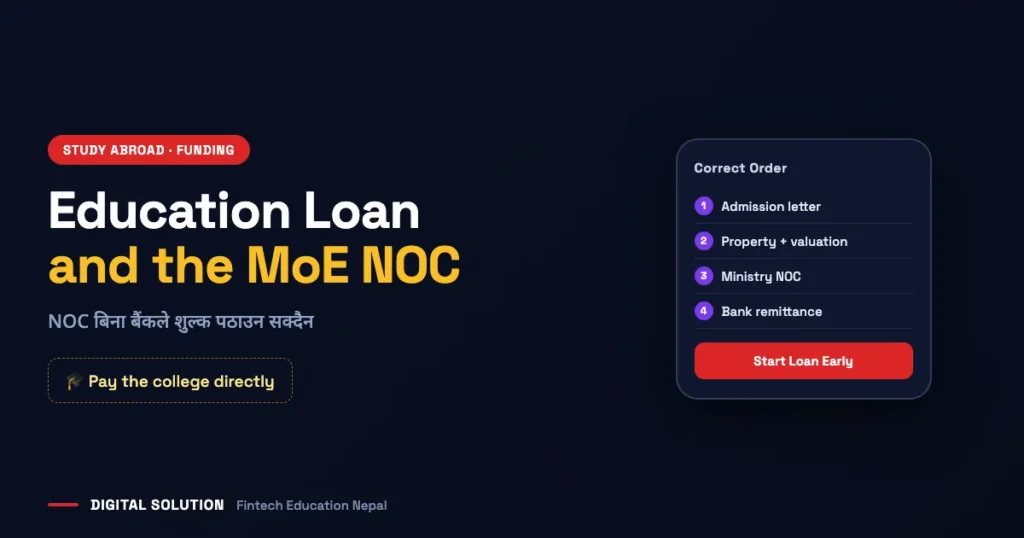
- Secure admission and get the offer letter and full fee structure in writing.
- Start the loan conversation early — ask the bank for its education loan checklist before you need the money.
- Get property papers and valuation in order: Lal Purja, Tiro Raseed, Naapi Naksa. This is usually the slowest step.
- Apply for the Ministry of Education NOC with your admission documents.
- Complete the loan sanction and arrange the remittance through the bank, directly to the institution.
- Keep every receipt and swift advice — you will need them for visa evidence, for later instalments, and for any tax or compliance question years from now.
Frequently Asked Questions
Do I need an NOC to study abroad from Nepal?
You need it to move tuition money abroad through a bank. The Ministry of Education issues it, and its function is to enable the foreign-exchange facility.
How much money can I send abroad for study?
NRB sets annual limits by country. The main study destinations were raised to a reported USD 12,000 a year. Confirm the current figure with your bank.
Can I get an education loan without collateral in Nepal?
Education loans here are overwhelmingly secured against land or building, with a parent or guardian as co-borrower. Unsecured study loans are not the norm.
Can I pay tuition through a consultancy?
Tuition should be paid directly to the institution through banking channels. Routing it through an agent leaves you without proof of payment.
How long does the NOC take?
Reported as same-day in person with complete documents, or one to two working days online. We could not confirm this officially — allow more time than the minimum.
What does the NOC cost?
Reported at around Rs 2,000, unconfirmed from an official page. Verify at the Ministry before paying anyone.
What documents does the bank want?
Admission letter, fee structure, the NOC, property and valuation documents, guarantor income proof, citizenship and PAN.
Can I send money for living expenses too?
Families may remit living costs alongside tuition against verified institutional documents. The applicable amount sits within the country limit — confirm with your bank.
Sources
- Ministry of Education foreign study permit / No Objection Certificate process and portal.
- Reporting on the revised NRB Unified Circular raising student foreign-exchange limits, including the increase to USD 12,000 for major destinations.
- Legal commentary on the NRB circular permitting a limited one-time maintenance transfer to students abroad without an NOC.
Related Reading
- How to receive international payments in Nepal
- Dollar account in Nepal: who can open one
- SWIFT codes of all banks in Nepal
- How bank interest rates work in Nepal
Disclaimer: Digital Solution Nepal is an independent educational and digital-service assistance website — not a bank, not a government body, and not a law firm. Banking rules, fees and NRB directives change through circulars, and each bank sets its own tariff. Nothing here is financial or legal advice — your bank, Nepal Rastra Bank and a qualified professional are final.

Rabin Paudel
Rabin Paudel is the Founder of Digital Solution, a Content Creator, and an AI Trainer. He shares practical and easy-to-understand content on Artificial Intelligence, Digital Literacy, Online Services, FinTech, and Technology. His mission is to make technology simple, accessible, and useful for everyone.
View all posts by Rabin Paudel →
Pingback: Travel Insurance for Visa from Nepal: The Rules