Updated August 2026. Fee figures are from Fonepay’s own published Fees & Charges page and NRB’s Payment System Unified Directives. Banks set their own POS and card rates — always confirm yours in writing before signing.
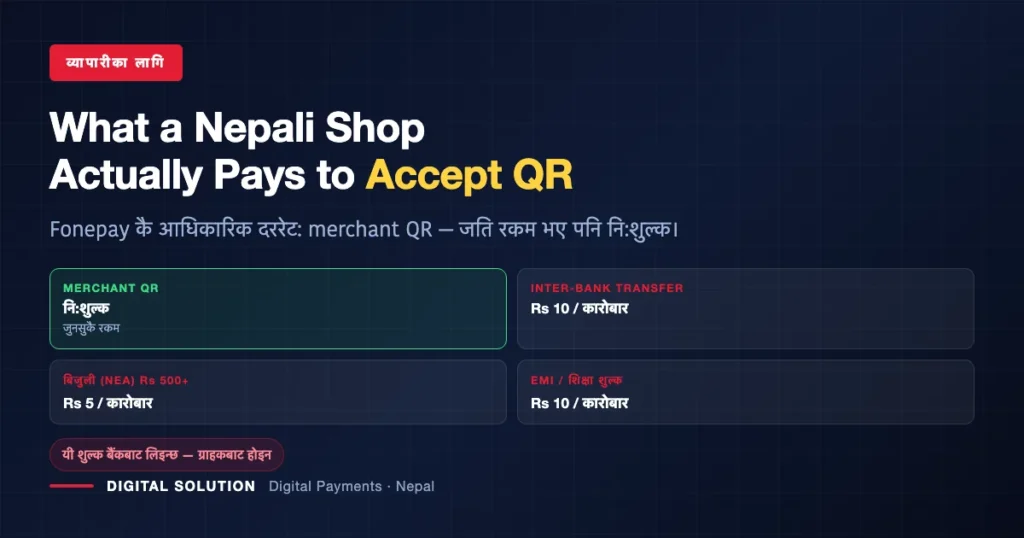
Every Nepali shopkeeper has heard some version of “digital payment ma commission katchha.” Here is what Fonepay actually publishes: QR payments at merchant outlets are free — for any transaction amount. Not discounted, not capped. Free.
That single line reshapes the maths for a tea shop, a kirana pasal, a salon or a restaurant deciding whether to accept QR. This guide covers what you really pay, where charges do appear, and the NRB rule that stops you from doing the one thing most merchants instinctively try.
The Published Fee Schedule
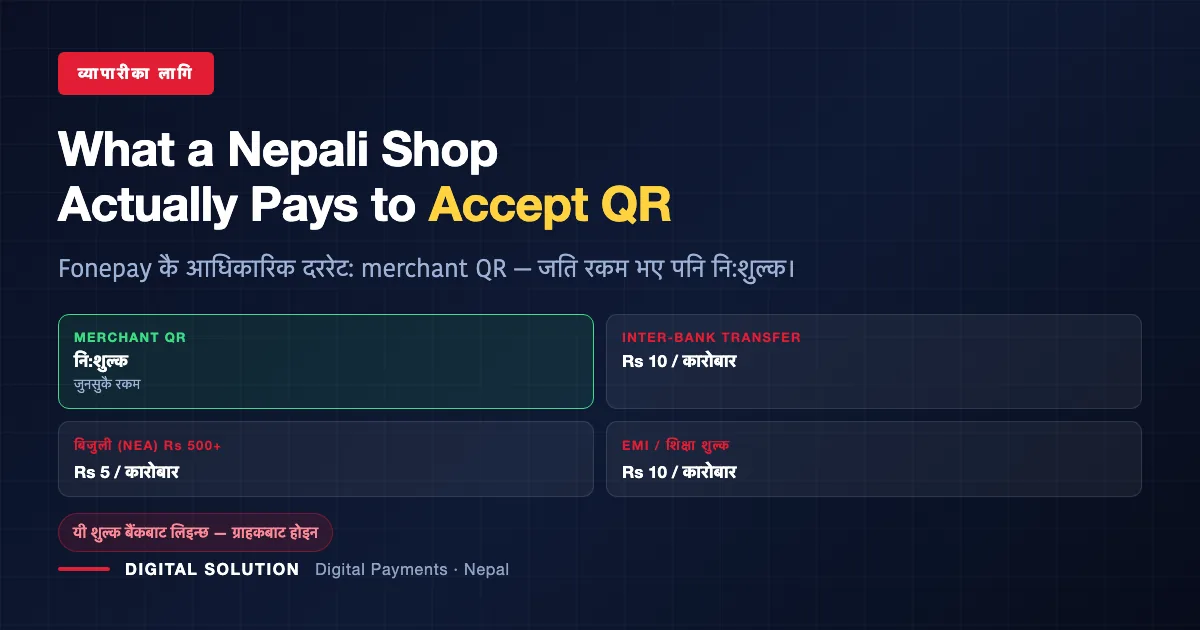
| Service | Charge per transaction |
|---|---|
| QR payments at merchant outlets — any amount | Free |
| Inter-bank fund transfer (IBFT), Rs 1 and above | Rs 10 |
| Education fees | Rs 10 |
| EMI payments | Rs 10 |
| Electricity (NEA), Rs 500 and above | Rs 5 |
| Khanepani (water) vendors, Rs 1 and above | Rs 5 |
| Capital payments | Rs 2 |
The line most merchants miss, printed on the same page: “All the above-mentioned fees are charged from the member banks and financial institutions.” These are interchange charges settled between the network and your bank — not a bill sent to your shop. Whether your bank passes anything on to you is a separate conversation to have with your branch, in writing.
Money from a merchant QR scan lands directly in your bank account in real time. There is no settlement window to wait through and no machine to reconcile at closing.
QR or a POS Machine? The Honest Comparison
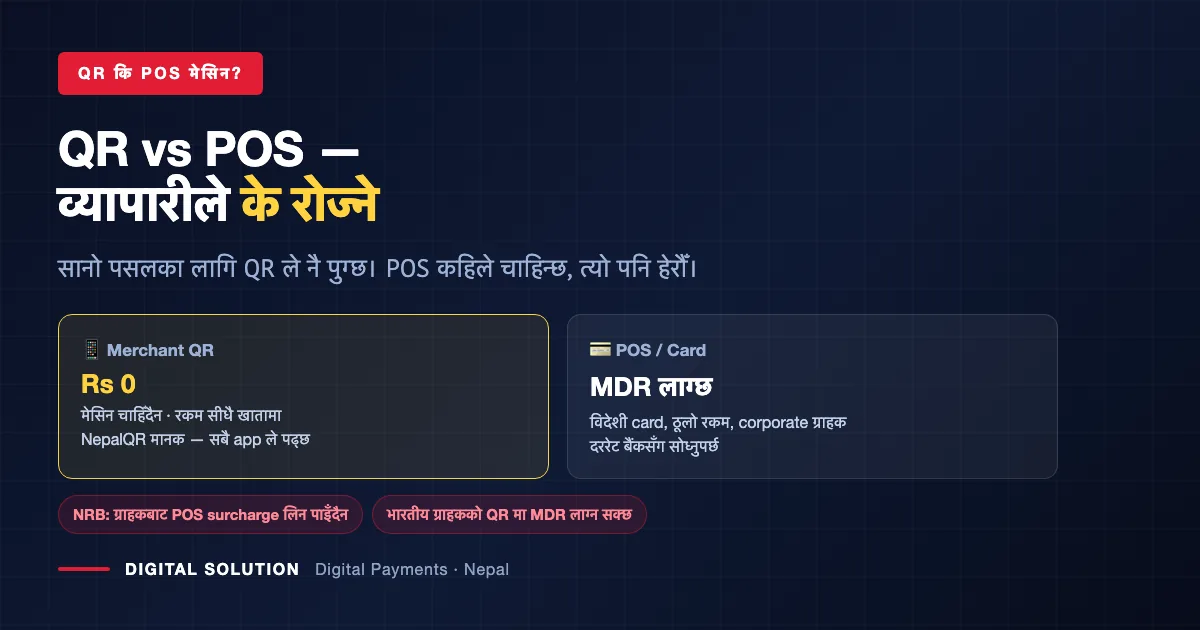
| Merchant QR | POS / card terminal | |
|---|---|---|
| Per-transaction cost | Free (Fonepay published rate) | MDR applies — rate set by your acquiring bank |
| Hardware | None — a printed sticker | Terminal, power, paper roll, maintenance |
| Settlement | Real time to your account | Batch settlement per your bank’s cycle |
| Works with | Any app on the NepalQR standard — mobile banking and wallets | Debit and credit cards, including international cards |
| Best for | Everyday retail, food, services, small tickets | Foreign card-carrying customers, hotels, high-value or corporate sales |
QR is not a downgrade from POS — it is a different tool. NepalQR is the national standard published by Nepal Rastra Bank and operated through the National Payment Switch, which is why one sticker works across banks and wallets instead of needing a separate code per app.
Where Charges Genuinely Do Appear
“Free” applies to the standard domestic merchant QR transaction. Four situations are different:
- Cross-border customers. NMB Bank publishes a 1.95% MDR on transactions made by Indian nationals using its merchant QR. If a large share of your customers are Indian visitors, ask your bank specifically about cross-border MDR — it is not the domestic rate.
- Card and POS acceptance. MDR on cards is commercial and set per merchant. Get the exact percentage, by card type, in your agreement.
- Your bank’s own account charges. Current-account fees, statement charges and SMS alerts are separate from the payment network.
- Bill-payment style services — education fees, EMI, utilities — carry the small per-transaction fees in the table above.
The rule that catches merchants out: you cannot add a surcharge to the customer. NRB’s Payment System Unified Directives prohibit charging customers extra for paying by card at a POS. “Card ma 3% extra” is not a business decision you are allowed to make — and it is the fastest way to get a complaint filed against your merchant account. Price your goods once, and accept every payment method at that price.
Watch: SoftPOS vs Merchant QR — Real Cost Breakdown
From the Digital Solution YouTube channel — subscribe for more step-by-step guides.
Setting Up: What to Ask Your Bank
Getting a merchant QR is straightforward — most banks issue one against a current account with your business registration and PAN. The questions worth asking before you sign:
- “Is there any charge to me on domestic merchant QR transactions?” Get the answer in writing, not verbally.
- “What is the cross-border MDR if an Indian customer scans my QR?” This is where rates differ sharply by bank.
- “Is my QR on the NepalQR standard?” It should be — that is what makes it readable by every app.
- “What are the current-account charges?” The account, not the QR, is usually where the monthly cost sits.
- “How do I get a transaction statement for tax filing?” Every QR sale is a recorded sale. That is a feature, not a problem — see below.
One thing to think through before you switch: digital payments create a permanent record of your turnover. For a registered business that is simply good bookkeeping, and it makes VAT and income-tax filing far easier. If your business is not registered yet, registering it first is the sensible order. Going digital and staying informal do not sit comfortably together.
The commission most shopkeepers fear does not exist on the standard domestic QR. The cost that does exist is the paperwork honesty that comes with a recorded transaction.
What Your Customers Pay
Nothing extra at the counter. Wallet and mobile-banking limits set by NRB do apply to them, and those matter if you sell high-value items — our guide to mobile banking and wallet transaction limits covers the daily caps, and how eSewa, Khalti, connectIPS and Fonepay differ explains which rails your customers are actually on.
Need help setting up digital payments or registration?
Digital Solution helps Nepali businesses with registration, PAN and VAT paperwork, and getting set up to accept digital payments properly.
Frequently Asked Questions
Does a merchant pay commission on QR payments in Nepal?
Fonepay’s published fee schedule lists QR payments at merchant outlets as free for any transaction amount, and states those network fees are charged to member banks rather than to merchants. Confirm with your own bank whether it passes anything on.
What is MDR and when does it apply?
Merchant Discount Rate is the percentage an acquiring bank charges a merchant on a transaction. It applies to card and POS acceptance, and to some cross-border cases — NMB Bank, for example, publishes a 1.95% MDR on transactions by Indian nationals using its merchant QR.
Can I charge customers extra for paying by card?
No. NRB’s Payment System Unified Directives prohibit surcharging customers for POS payments. Prices must be the same regardless of payment method.
How fast does QR money reach my account?
Merchant QR payments transfer directly to the merchant’s bank account in real time, with no separate settlement batch to wait for.
Do I need a POS machine at all?
Only if you need to accept physical cards — foreign visitors’ cards, corporate cards, or high-value sales where customers prefer credit. For everyday domestic retail, a QR sticker covers every mobile banking app and wallet on the NepalQR standard.
What do I need to get a merchant QR?
Generally a current account with the bank, your business registration and PAN. Requirements vary slightly by bank, so confirm the document list with your branch before visiting.
Related Reading

Rabin Paudel
Rabin Paudel is the Founder of Digital Solution, a Content Creator, and an AI Trainer. He shares practical and easy-to-understand content on Artificial Intelligence, Digital Literacy, Online Services, FinTech, and Technology. His mission is to make technology simple, accessible, and useful for everyone.
View all posts by Rabin Paudel →