
Updated August 2026. Based on the Credit Information Bureau’s own published FAQ, Nepal Rastra Bank’s guidance on credit information, and reporting on the July 2025 amendment to NRB’s Unified Directive. Rules change by circular — confirm with your bank and CIB.
Your loan application is rejected and the officer says one word: blacklist. No letter arrived, nobody warned you, and now nothing will move. Here is how Nepal’s credit blacklist actually works — who runs it, what really puts you on it, how to check, how to get off it, and which widely-repeated consequences are simply not true.
Who Actually Runs the Blacklist
It is not Nepal Rastra Bank, and it is not your bank. The list is maintained by Karja Suchana Kendra Ltd. (कर्जा सूचना केन्द्र), the Credit Information Bureau of Nepal — a company owned roughly 90% by banks and financial institutions and 10% by NRB, based at Heritage Plaza, Kamaladi, Kathmandu.
It operates under the Nepal Rastra Bank Act 2058 and the Credit Information Regulation 2059, with the working rules set out in NRB’s Unified Directive No. 12 on credit information and blacklisting. Your bank reports to it; it does not decide on its own.
What Actually Gets You Blacklisted
These are the grounds published by CIB itself:
| Ground | What it means in practice |
|---|---|
| Principal and interest past due by a year with an outstanding balance | The classic default route — not a missed payment or two |
| Bankruptcy or the borrower disappearing | The lender cannot trace or recover |
| Misuse of credit facilities | Loan taken for one declared purpose and used for another |
| Inadequate or inappropriate security | The collateral position turns out not to hold |
| An auction notice issued for loan recovery | Recovery proceedings have formally begun |
| Court conviction for forgery, or failure to repay after a court notice | A judicial finding, not a bank decision |
| Issuing a bounced cheque | The fastest-growing route, and the one that catches people who never took a loan at all |
The reporting thresholds
How to Check Whether You Are Blacklisted
So there are three realistic routes:
- Ask your bank. The fastest route in practice. Any BFI you hold an account with can pull the report as part of a credit assessment.
- Apply to CIB in writing. CIB publishes an individual declaration form on its downloads page for exactly this.
- Check the published blacklist file. CIB puts a downloadable blacklist document on its website and refreshes it periodically. It is a large file and awkward to search, but it is public.
How to Get Off the Blacklist
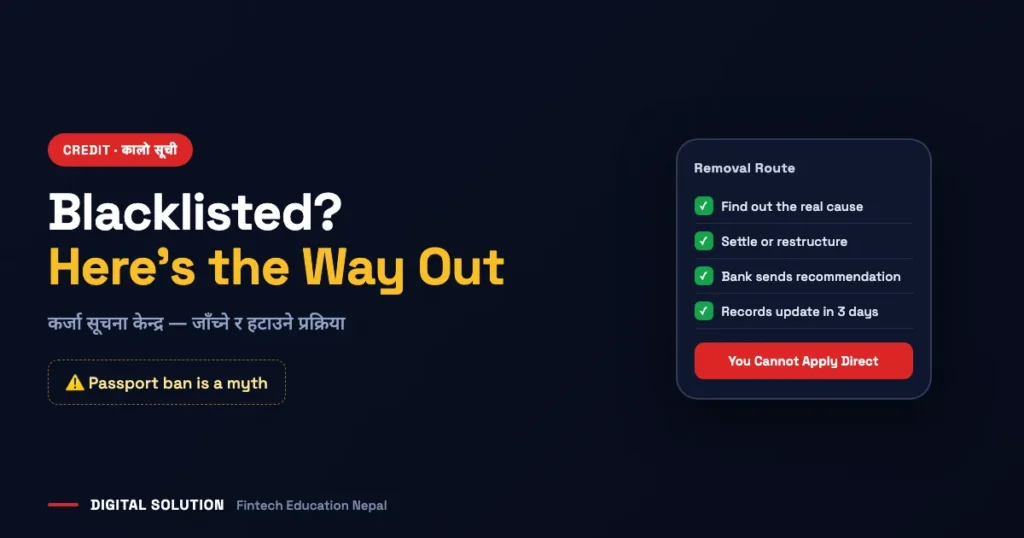
The single most important thing to understand: you cannot apply to CIB to be removed. CIB lists and delists only on the written recommendation of the bank or financial institution concerned. Your entire effort goes to the BFI, not the Bureau.
The grounds for removal
- The loan account is settled.
- The facility is rescheduled or restructured under prudential norms.
- The liabilities are accepted by another person acceptable to the board.
🤝 Blacklisted and not sure what to do next?
Tell us which bank, which loan or cheque, and what stage you are at — Digital Solution will map the exact removal route and what to put in writing.
What Blacklisting Actually Does — and Three Myths
| Claimed consequence | Reality |
|---|---|
| No new loan at any bank or financial institution | True. CIB is checked system-wide; this is the core effect. |
| Cannot be a promoter or director of a bank | Reported. Attributed to banking legislation with a stated multi-year bar. We could not open the official statutory text, so treat the exact term with caution. |
| Cheque book and account restrictions | Reported. The strongest version found is that repeated dishonour of the same cheque can lead to account and borrowing restrictions. |
| Ineligible for some government contracts | Reported, not verified against a primary source. |
| Your passport will be denied or seized | Myth as an automatic effect. Nothing connects a CIB listing to passport issuance. A travel ban or passport seizure can arise from a court order in a criminal banking case — that is a judicial step in a prosecution, not a consequence of being on the list. |
| You cannot go for foreign employment | Myth — a confusion of two different lists. The Department of Foreign Employment maintains a blacklist of foreign employers. It is not the credit blacklist and has nothing to do with your loan. |
If You Are Blacklisted: The Practical Sequence
- Find out why. Loan default, wilful default, or a bounced cheque produce different fixes.
- Get the figure in writing — principal, interest and any penalty as of a stated date.
- Settle, restructure, or transfer the liability. Those are the three published grounds; there is no fourth.
- Get the settlement letter and ask the branch in writing to send the removal recommendation to CIB.
- Hold them to the 3-working-day timeline and follow up until it is confirmed.
- Re-verify after a week before you apply for anything, so you do not collect a fresh rejection on a stale record.
Frequently Asked Questions
How do I check if I am blacklisted in Nepal?
There is no public self-check portal. Ask a bank you deal with to pull your credit report, apply to CIB in writing, or look through the blacklist file CIB publishes on its website.
How long does blacklisting last?
It is not time-based. It ends when the underlying cause is resolved — settlement, restructuring, or transfer of liability — and the BFI recommends removal. Reporting on the July 2025 amendment indicates no cooling-off period is specified.
Can a bounced cheque get me blacklisted even without a loan?
Yes. Issuing a bounced cheque is one of CIB’s published grounds, and it catches people who have never borrowed.
Does blacklisting stop me getting a passport?
No, not as an automatic effect. Travel restrictions can come from a court order in a criminal banking case, which is a different thing entirely.
Does it stop me going abroad for work?
No. The foreign-employment blacklist is a list of employers maintained by a different department.
Can I apply to CIB myself to be removed?
No. Only the bank or financial institution can recommend removal in writing.
What if I am blacklisted by mistake?
Raise it in writing with the reporting institution first, with evidence. They are the only party that can correct the record with CIB.
Will a small overdue amount get me blacklisted?
Blacklist reporting is tied to loan-size thresholds — but a wilful defaulter can be listed regardless of amount, and cheque dishonour has its own route.
Sources
- Credit Information Bureau of Nepal (Karja Suchana Kendra Ltd.) — published FAQ on blacklisting grounds, report access and removal.
- Nepal Rastra Bank — guidance on credit information reporting and thresholds; Unified Directive No. 12.
- Reporting on the July 2025 amendment to the Unified Directive covering blacklisting and removal timelines.
Related Reading
- How to complain about a bank or digital payment problem
- Mobile banking limits and charges in Nepal
- Opening a bank account through the Nagarik App
Disclaimer: Digital Solution Nepal is an independent educational and digital-service assistance website — not a bank, not a government body, and not a law firm. Banking rules, fees and NRB directives change through circulars, and each bank sets its own tariff. Nothing here is financial or legal advice — your bank, Nepal Rastra Bank and a qualified professional are final.

Rabin Paudel
Rabin Paudel is the Founder of Digital Solution, a Content Creator, and an AI Trainer. He shares practical and easy-to-understand content on Artificial Intelligence, Digital Literacy, Online Services, FinTech, and Technology. His mission is to make technology simple, accessible, and useful for everyone.
View all posts by Rabin Paudel →