
Updated August 2026. The loan-to-value and ceiling figures below come from Monetary Policy 2082/83 (announced July 2025). Monetary policy is revised annually and amended by circular — confirm current limits with your bank before planning a purchase.
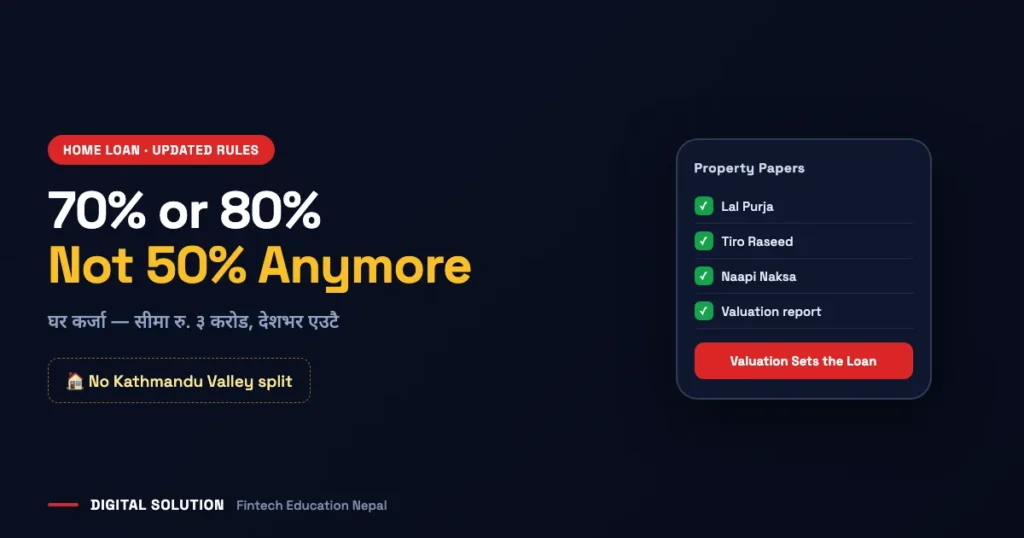
If your idea of home loan rules in Nepal is “banks lend 50%, and less inside Kathmandu Valley”, that is out of date by a year. The limits were raised substantially in July 2025, and the Valley-versus-outside split no longer applies. Here is where the rules actually stand.
What Changed — and What Most Articles Still Get Wrong
| Old position | Current | |
|---|---|---|
| Loan-to-value, general | 50% | 70% |
| Loan-to-value, first home | — | 80% |
| Loan ceiling | Rs 2 crore | Rs 3 crore |
| Kathmandu Valley separate limit | Yes (from 2017) | No — the limits are national |
How Much You Can Actually Borrow
Two limits apply at once, and the smaller one wins:
A worked example
Property valued at Rs 1 crore, and it is your first home:
- Maximum loan at 80% LTV — Rs 80 lakh
- Your own contribution — Rs 20 lakh, plus registration, valuation and legal costs
- Well under the Rs 3 crore ceiling, so the LTV is the binding limit
- Whether the bank actually sanctions Rs 80 lakh then depends entirely on your documented income
Documents You Will Need
Identity
Citizenship certificate and passport-size photographs for the borrower and any joint applicant.
Income proof
Salary certificate and bank statements for the salaried; audited financials and typically two years of operating history for the self-employed.
Property papers
Lal Purja (land ownership certificate), Tiro Raseed (land tax receipt) and Naapi Naksa (survey map / blueprint).
Valuation report
Prepared by a valuator the bank accepts. This drives the LTV calculation, so it drives the loan size.
PAN
Commonly required once the loan is Rs 25 lakh or more.
Approvals
For construction, the municipal building permit and approved drawings — disbursement is usually staged against progress.
🤝 Working out whether you qualify for a home loan?
Tell us the property value, whether it is your first home and your income situation — Digital Solution will help you estimate the realistic loan size and spot the paperwork problems before the bank does.
Tenure and Rate
Tenure is set by the bank, not by NRB — we found no regulatory maximum. In practice the published products run long: some banks offer up to 30 years, and at least one product runs to 35.
On pricing, a home loan is quoted as base rate plus premium. The base rate moves monthly; the premium agreed at sanction cannot be increased for the remaining tenure. That distinction matters more over 20 years than a small difference in the headline rate — see our guide to how bank interest rates actually work in Nepal.
Before You Apply: A Realistic Sequence
- Check your credit standing first. A blacklist entry or an old unresolved default stops everything — see our blacklist guide.
- Get the property papers examined before you pay any advance to a seller.
- Ask two or three banks for base rate and premium separately, not just the headline rate.
- Establish whether you qualify as a first-home buyer — the difference between 70% and 80% is 10% of the property value in cash.
- Budget the costs outside the loan: registration, valuation, insurance, service fees.
- Confirm the current limits at the branch on the day — monetary policy changes annually.
Frequently Asked Questions
How much home loan can I get in Nepal?
Up to 70% of valuation generally, or 80% for a first home, subject to a Rs 3 crore ceiling and your repayment capacity.
Is the limit lower inside Kathmandu Valley?
No. That was a 2017 rule and is no longer the position — the current limits are national.
What is the maximum home loan amount?
Rs 3 crore, raised from Rs 2 crore in Monetary Policy 2082/83.
What documents are required?
Citizenship and photos, income proof, Lal Purja, Tiro Raseed, Naapi Naksa, a valuation report, and PAN for larger loans. Construction cases add municipal approvals.
What is the maximum tenure?
Bank-set rather than NRB-set. Published products run up to 30 years, with at least one to 35.
Can the bank raise my interest rate later?
The base rate component moves monthly. The premium agreed at sanction cannot be increased for the remaining tenure.
Does the percentage apply to the price I pay or the valuation?
The bank’s valuation. If it comes in below your purchase price, your down payment increases accordingly.
Sources
- Monetary Policy 2082/83, announced July 2025 — loan-to-value ratios raised to 70% general and 80% first-home, and the residential loan ceiling raised to Rs 3 crore, as reported in summaries of the policy.
- Historical reporting on the 2017 introduction of a Kathmandu Valley-specific loan-to-value ratio, now superseded.
- Published home loan product pages of Nepali commercial banks for tenure and documentation practice.
Related Reading
Disclaimer: Digital Solution Nepal is an independent educational and digital-service assistance website — not a bank, not a government body, and not a law firm. Banking rules, fees and NRB directives change through circulars, and each bank sets its own tariff. Nothing here is financial or legal advice — your bank, Nepal Rastra Bank and a qualified professional are final.

Rabin Paudel
Rabin Paudel is the Founder of Digital Solution, a Content Creator, and an AI Trainer. He shares practical and easy-to-understand content on Artificial Intelligence, Digital Literacy, Online Services, FinTech, and Technology. His mission is to make technology simple, accessible, and useful for everyone.
View all posts by Rabin Paudel →