
Updated August 2026. Rules below are from Nepal Rastra Bank’s Unified Directives; the rates quoted are each bank’s own published figures effective Shrawan 1, 2083 (17 July 2026). Deposit rates change monthly — check the current notice before you commit.
A fixed deposit looks like the simplest product a bank sells. It is, until you need the money early, or your interest arrives smaller than you calculated, or you wonder what actually happens if the bank fails. Those three questions have clear answers in Nepal — and one of them is not what most people assume.
The Rules NRB Actually Sets
| Rule | What it means |
|---|---|
| Minimum tenure | 3 months for an individual fixed deposit; 6 months for an institutional one. |
| Institutional early withdrawal | Not permitted at all before 6 months have passed. |
| “Withdraw anytime at the same rate” products | Prohibited. A bank cannot accept a fixed deposit on terms that let you pull out whenever you like while keeping the pre-agreed rate. |
| Linked savings account | When a bank takes a fixed deposit from an individual it must open a savings account and credit the interest and maturity proceeds there. |
| Dormant account | Interest still has to be paid to the depositor even if the account has gone dormant. |
| Rate changes | Deposit rates change monthly only, published before the Nepali month begins. |
Breaking an FD Early: There Is No National Penalty Rate
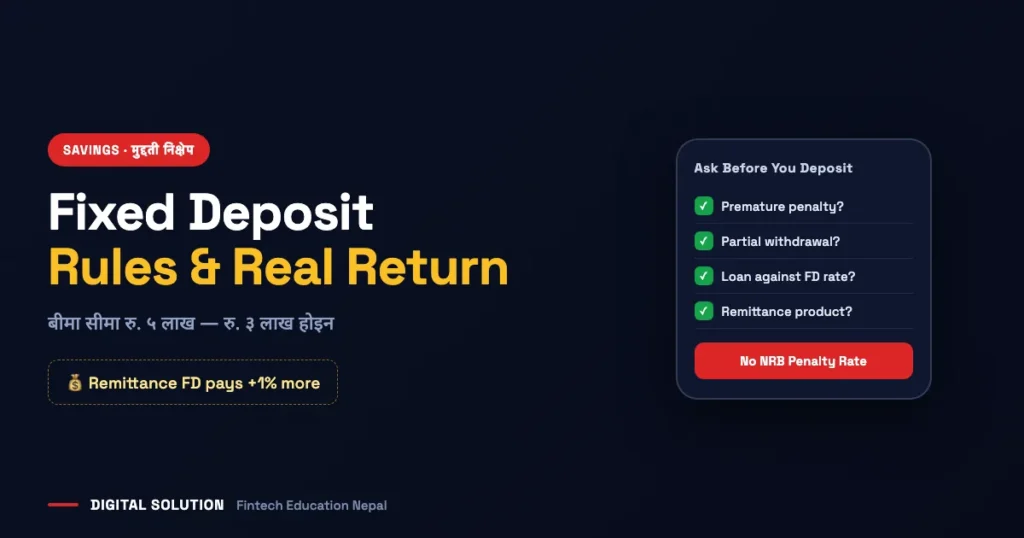
The practical consequence: two banks offering the same headline rate can treat an early exit completely differently. Ask, before you sign:
- What is the penalty for premature withdrawal, stated as a number or a formula?
- Is any interest paid at all for the period held, or forfeited?
- Is partial withdrawal possible, or is it all or nothing?
- Is a loan against the deposit available instead — often cheaper than breaking it?
Tax on Your Interest
Tax is deducted at source by the bank, so the interest credited is already net. If you budgeted the gross figure, your maturity will look short — it is not an error.
What Happens If the Bank Fails
What this means for a large saver: the coverage is per institution. Someone holding Rs 20 lakh in one bank has Rs 5 lakh guaranteed; the same money split across four institutions is fully covered. Whether that is worth the administrative hassle is your judgement — but it is the reason people split large deposits.
🤝 Comparing fixed deposit offers?
Send us the tenure and amount you have in mind and Digital Solution will help you read past the headline rate — penalty terms, remittance uplift and what actually lands after tax.
Published Rates: A Snapshot
Both sets below are the banks’ own published individual NPR fixed deposit rates, effective Shrawan 1, 2083. They are a snapshot to show the shape of the market, not a recommendation — and they will change.
| Tenure | Nabil Bank | NMB Bank |
|---|---|---|
| 3 months to under 6 months | 2.80% | 2.75% (3 months to under 3 years) |
| 6 months to 1 year | 2.85% | |
| Over 1 to 2 years | 3.00% | |
| Over 2 to 5 years | 3.25% | 3.50% (3 to under 5 years) |
| Over 5 years | 4.00% (to 10 yrs) 4.55% (over 10 yrs) | 4.50% (5 yrs+) |
Notice also the shape: rates climb steeply with tenure. The gap between a 6-month and a 5-year deposit at these banks is larger than the gap between the two banks at any single tenure — choosing the right tenure matters more than choosing the right bank.
Frequently Asked Questions
What is the minimum fixed deposit period in Nepal?
Three months for an individual, six months for an institution. Institutional deposits cannot be withdrawn before six months at all.
What is the penalty for breaking an FD early?
There is no NRB-mandated penalty. Each bank sets it in its own filed deposit rules — ask for the figure in writing before depositing.
How much tax is deducted on FD interest?
5% TDS for a resident individual, deducted by the bank before crediting. Companies and non-residents are reported at 15%.
Are my deposits insured in Nepal?
Yes — up to Rs 5 lakh per natural-person depositor per member institution, through the Deposit and Credit Guarantee Fund. NRB’s own FAQ still shows an outdated Rs 3 lakh.
Can I get a higher rate on a remittance deposit?
Yes. Remittance-linked savings and fixed deposits must pay at least one percentage point more. Ask for the product by name.
Do I still earn interest if my account goes dormant?
Yes. The directives require interest to be paid to the depositor even where the account has become dormant.
Can I borrow against my fixed deposit instead of breaking it?
Most banks offer this, and it is often cheaper than surrendering accrued interest. Compare the two before deciding.
How often do FD rates change?
Monthly. Banks publish deposit rates before the Nepali month begins and cannot move them mid-month.
Sources
- Nepal Rastra Bank Unified Directives 2082 — deposit tenure, premature withdrawal, linked savings account, dormant-account interest and monthly rate publication.
- Deposit and Credit Guarantee Fund — published guarantee limit and membership.
- Nabil Bank and NMB Bank published interest rate notices, effective Shrawan 1, 2083.
- Professional tax summaries for TDS rates on deposit interest.
Related Reading
- How bank interest rates work in Nepal
- Dollar account in Nepal: rules and rates
- SSF vs EPF vs CIT compared
Disclaimer: Digital Solution Nepal is an independent educational and digital-service assistance website — not a bank, not a government body, and not a law firm. Banking rules, fees and NRB directives change through circulars, and each bank sets its own tariff. Nothing here is financial or legal advice — your bank, Nepal Rastra Bank and a qualified professional are final.

Rabin Paudel
Rabin Paudel is the Founder of Digital Solution, a Content Creator, and an AI Trainer. He shares practical and easy-to-understand content on Artificial Intelligence, Digital Literacy, Online Services, FinTech, and Technology. His mission is to make technology simple, accessible, and useful for everyone.
View all posts by Rabin Paudel →