
Updated August 2026. Commission rates below are reported from the Insurance Regulation 2081 schedule via trade press — the Nepal Insurance Authority website has a broken TLS certificate and we could not open the regulation directly. Product terms are quoted from insurers’ own pages. Verify with your insurer before deciding.
Almost every life insurance policy sold in Nepal is an endowment plan — the kind where “your money comes back”. Almost nobody is offered term life, where it does not. There is a documented reason for that, and it is not that term life is unavailable.
The Two Products, Honestly
✓ Term life (म्यादी जीवन बीमा)
Pure protection. A large payout if you die during the term, nothing if you survive it. Small premium, big cover. No maturity amount, no bonus, no surrender value — and that is the design, not a defect.
⚠ Endowment
Protection bundled with saving. Pays out on death or at maturity, with bonus. Premium is many times higher for the same cover, and the savings portion earns very little.
Why Your Agent Never Mentioned It
Here is the commission structure reported from the regulation’s schedule. Read the last row against the first.
| Policy type / term | Year 1 | Year 2 | Years 3–10 |
|---|---|---|---|
| Endowment, 20+ years | 25% | 25% | 5% |
| Endowment, 15–19 years | 15% | 15% | 5% |
| Endowment, 10–14 years | 15% | 15% | 5% |
| Endowment, 8–9 years | 10% | 10% | 5% |
| Endowment, 5–7 years | 10% | 5% | 5% |
| Term life (myadi) | 10% cap | — | — |
| Single premium | 6% cap | — | — |
The Return Nobody Explains Properly
Endowment is sold on the bonus. For FY 2081/82, Nepal Life declared bonus rates of roughly Rs 55–85 per thousand sum assured, and LIC Nepal roughly Rs 49–65 per thousand.
What matters is the effective return on the money you actually handed over across the whole term — and that is where the comparison with inflation becomes uncomfortable. Ask your agent to show you the total premiums you will pay against the guaranteed maturity amount, then judge it against what that money buys in twenty years.
🤝 Not sure which type of policy you actually hold?
Send us what your policy document says — type, term, sum assured and annual premium. Digital Solution will explain in plain language what you are actually buying. We do not sell insurance and take no commission from any insurer.
How to Compare Them Properly
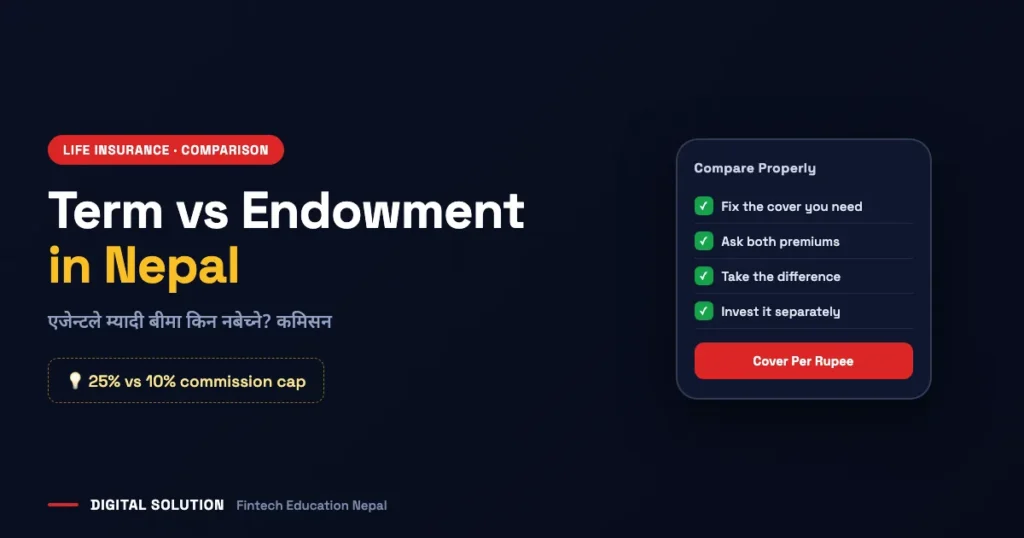
Do not compare premiums. Compare cover per rupee of premium, then handle the savings separately:
- Decide the cover your family actually needs — not what fits a premium you were quoted.
- Ask each insurer the premium for that exact sum assured, as term and as endowment.
- Take the difference between the two premiums. That is the amount endowment is charging you to save on your behalf.
- Ask what that difference would earn elsewhere — a fixed deposit, for instance. See our fixed deposit guide.
- Then decide. If the savings portion earns less than a plain deposit, you are paying a premium for the convenience of not deciding.
When Endowment Is Actually the Right Choice
This is not a case against endowment in every situation. It is a case against endowment being the default. Endowment can make sense if:
- You genuinely will not save unless the payment is compulsory, and you know that about yourself.
- You want a disciplined long-horizon commitment with a guaranteed floor and are content with a modest return for it.
- Your protection need is small and the savings goal is the actual point.
Frequently Asked Questions
Is term life insurance available in Nepal?
Yes. Several licensed life insurers sell term products, including renewable individual term and group term plans.
Why do agents push endowment instead of term?
Commission. Reported schedules give up to 25% first-year commission on a long endowment against a 10% cap on term, on a much smaller premium.
Does term life have any surrender value?
No, and it is not supposed to. Insurers state plainly that their term plans carry no surrender value, no paid-up value and no bonus.
What does “bonus Rs 70 per thousand” mean?
It is declared per thousand of sum assured, not as a return on premiums paid. It is not a percentage yield.
Can I claim tax deduction on term life premium?
Yes — life insurance premium is deductible up to Rs 40,000 a year, and term qualifies.
Should I surrender my endowment policy and buy term?
Not automatically. Surrendering early can lose a great deal, and once surrendered a policy cannot be revived. Understand the surrender value first — see our guide on lapse, surrender and revival.
Is my insurance agent allowed to give this advice?
An agent is a licensed, commission-based representative of an insurer — not an independent adviser. That is worth remembering when comparing products.
Sources
- Sun Nepal Life and SuryaJyoti Life published term product pages; Rastriya Jeewan Beema product listing.
- Commission schedule reported from the Insurance Regulation 2081 schedule via insurance trade press.
- Nepal Life and LIC Nepal declared bonus rates for FY 2081/82.
- Finance Act 2079 raising the life insurance premium deduction to Rs 40,000.
Related Reading
- The podcast where this argument is made from experience
- Fixed deposit in Nepal: rules, tax and real return
- Health insurance vs SSF medical benefits
Disclaimer: Digital Solution Nepal is an independent educational and digital-service assistance website — not an insurer, not an insurance agent or broker, and not a law firm. We do not sell insurance and receive no commission from any insurer. Policy terms, premiums and regulations differ by company and change over time, and nothing here is financial, legal or insurance advice — your policy document, your insurer and the Nepal Insurance Authority are final.

Rabin Paudel
Rabin Paudel is the Founder of Digital Solution, a Content Creator, and an AI Trainer. He shares practical and easy-to-understand content on Artificial Intelligence, Digital Literacy, Online Services, FinTech, and Technology. His mission is to make technology simple, accessible, and useful for everyone.
View all posts by Rabin Paudel →
Pingback: Insurance Lapse & Surrender in Nepal: Your Options
Pingback: Verify an Insurance Agent in Nepal Before Paying