
Updated August 2026. These terms are set by each insurer within a framework approved by the Nepal Insurance Authority — there is no single national formula. Figures below come from a licensed insurer’s own published FAQ. Read your own policy document.
You stopped paying. Maybe money got tight, maybe you realised the policy was not what you thought. What happens next depends on how many full years of premium you had already paid — and the threshold is higher than most people assume.
The Grace Period
The Three-Year Line
Stopped before 3 years
The policy lapses with no surrender value. The premiums paid are generally gone. This is the most painful and most common outcome — people buy a long endowment, struggle by year two, and lose everything paid in.
Stopped after 3 years
You have options: surrender for a value, convert to a paid-up policy with reduced sum assured, or revive it later by paying arrears with interest.
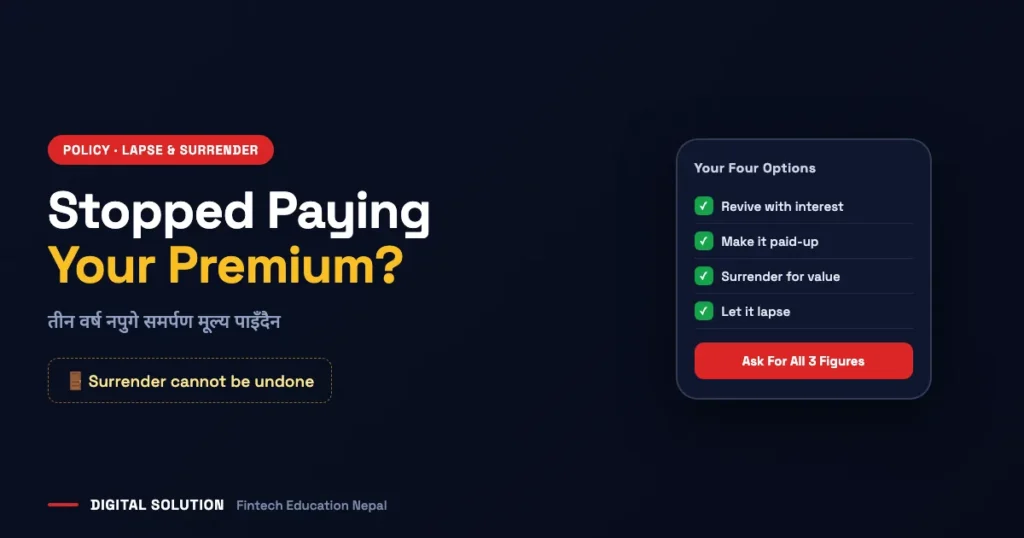
Your Four Options After a Lapse
| Option | What it means | Best when |
|---|---|---|
| Revive | Pay the outstanding premiums with interest — reported at 10% compound — and restore the policy. Policies missed for even four to five years can often be revived with a lump sum. | You still want the cover and can find the arrears |
| Make it paid-up | Stop paying; the sum assured is reduced in proportion to premiums paid, and the reduced cover continues. | You cannot continue but want some cover to survive |
| Surrender | Take the surrender value and end the contract. | You need the money, or the product was wrong for you |
| Let it lapse | Do nothing. Before three years this is usually total loss. | Almost never the best choice — check the other three first |
How Surrender Value Is Calculated
There is no single national formula. Each product carries its own guaranteed-surrender-value formula, approved by the Authority per product — so NIA approves the method rather than publishing one universal calculation. We looked for a published formula and could not find one.
The inputs that drive it are consistent: sum assured, policy term, years of premium actually paid, accrued bonus, and years remaining to maturity.
🤝 Struggling with a premium, or thinking of surrendering?
Tell us the policy type, start year and premium paid so far. Digital Solution will help you compare revive, paid-up and surrender before you take a decision you cannot reverse. We sell no insurance and take no commission.
Before You Decide
- Find out exactly how many full years you have paid. Everything turns on the three-year line.
- Ask for three figures in writing: surrender value today, paid-up sum assured, and the cost to revive.
- Ask about medical requirements for revival. Insurers may re-underwrite — if your health has changed since you bought, reviving may be harder than paying. We could not verify when fresh medical evidence is demanded, so ask directly.
- Check whether you still need the cover at all. If your dependants have changed, the honest answer may be no.
- If you do still need cover, price a term policy first before surrendering anything — and do not cancel the old policy until the new one is actually issued.
Frequently Asked Questions
What is the grace period for insurance premium in Nepal?
Reported as 30 days for annual and other modes, and 15 days for monthly mode. After that the policy lapses.
When does a policy get surrender value?
Generally after three full years of premiums paid and three full years elapsed. Not two.
What if I stop paying before three years?
The policy typically lapses with no surrender value, and the premiums paid are generally lost.
Can I revive a lapsed policy?
Yes, by paying outstanding premiums with interest — reported at 10% compound. Policies lapsed for several years can often still be revived.
Can I revive after surrendering?
No. Surrender is final.
What is a paid-up policy?
You stop paying and the sum assured reduces in proportion to premiums already paid, with the reduced cover continuing.
Does term life have surrender value?
No. Term plans state plainly that they carry no surrender value, no paid-up value and no bonus.
Is there a standard surrender value formula?
No national formula is published. Each product has its own guaranteed formula approved by the Authority — ask your insurer for the figure in writing.
Sources
- Published FAQ of a licensed Nepali life insurer — grace periods, surrender-value qualification, revival interest and paid-up treatment.
- Sun Nepal Life term product terms confirming that pure term plans carry no surrender or paid-up value.
- Income Tax Act 2058 — 5% withholding on investment-insurance benefit payments.
Related Reading
- Term life vs endowment in Nepal
- Why insurance claims get rejected
- How much life insurance you actually need
Disclaimer: Digital Solution Nepal is an independent educational and digital-service assistance website — not an insurer, not an insurance agent or broker, and not a law firm. We do not sell insurance and receive no commission from any insurer. Policy terms, premiums and regulations differ by company and change over time, and nothing here is financial, legal or insurance advice — your policy document, your insurer and the Nepal Insurance Authority are final.

Rabin Paudel
Rabin Paudel is the Founder of Digital Solution, a Content Creator, and an AI Trainer. He shares practical and easy-to-understand content on Artificial Intelligence, Digital Literacy, Online Services, FinTech, and Technology. His mission is to make technology simple, accessible, and useful for everyone.
View all posts by Rabin Paudel →