
Updated August 2026. Verification links below are Nepal Insurance Authority e-services. Note that nia.gov.np currently serves a broken TLS certificate chain, so some browsers show a security warning on the regulator’s own site — that is a site defect, not a sign the link is fake.
Someone offers you a policy, takes your premium in cash, and hands you a receipt. Months later there is no policy. Nepal has a licence register that would have caught it in two minutes — and almost nobody uses it.
Check the Agent Before You Pay
Know what an agent legally is, because it explains a great deal:
Five Checks, in Order
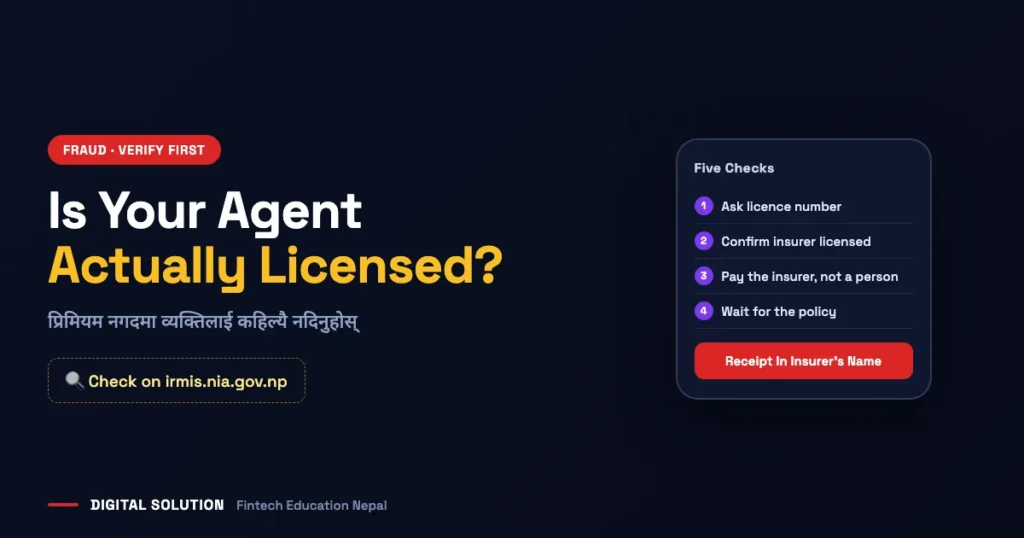
- Ask for the licence number and check it on the Authority’s system. A genuine agent will not be offended; an impostor will deflect.
- Confirm the insurer is licensed. The Authority licenses insurers, and has publicly warned that any business of an insurance nature must be registered with it — which is the hook for “insurance-like” schemes that are not insurance at all.
- Never pay premium in cash to an individual. Pay the insurer, through a traceable channel.
- Demand the official receipt in the insurer’s name — not a handwritten slip, not a personal bank transfer confirmation.
- Wait for the actual policy document and check the policy number, sum assured, term and nominee against what you were promised. If it does not arrive, call the insurer directly on a number you looked up yourself.
Frauds That Are Documented
Fake rescue and evacuation claims
A helicopter-evacuation insurance racket led to prosecution being recommended against 33 people in March 2026 — reported as exposing a substantial fraud network.
Staged-accident death claims
A reported case involved a claim of around Rs 7.5 crore on a staged accidental death, allegedly involving family and professionals.
Fake motor insurance documents
Investigations found photoshopped insurance documents shown as phone-screen images being accepted at transport offices — see vehicle insurance in Nepal.
Unregistered “insurance-like” schemes
Arrangements that promise protection without being registered insurance. The Authority has issued a public notice on exactly this.
🤝 Not sure if the person selling you a policy is genuine?
Send us the agent’s name, licence number and the insurer they claim to represent, and Digital Solution will help you verify before you pay anything. We sell no insurance and take no commission.
How Many Insurers Are There?
Widely reported figures after the merger-driven consolidation are roughly 14 life insurers, 14 non-life insurers, 2 reinsurers and 7 micro-insurers.
How to Report a Problem
The Nepal Insurance Authority accepts complaints at its central office and at province offices in Koshi, Madhesh, Gandaki, Lumbini, Karnali and Sudurpashchim. It publicly invited claim-payment complaints in a notice dated July 2026.
| Include in your complaint |
|---|
| Your name, address and contact number |
| The insurer’s name |
| A clear description of the problem |
| The claim number and policy number |
| Supporting evidence — documents, photographs, correspondence |
Contact: info@nia.gov.np · +977-1-5421079 / 5428604
Frequently Asked Questions
How do I check if an insurance agent is licensed in Nepal?
Through the Nepal Insurance Authority’s licensing system at irmis.nia.gov.np, which handles agent licence issuance and renewal. Ask the agent for their licence number first.
Is my insurance agent an employee of the company?
No. The Authority defines an agent as a licensed, commission-based representative — explicitly not a salaried employee.
Should I pay premium in cash to an agent?
No. Pay the insurer through a traceable channel and insist on the official receipt in the insurer’s name.
Why does the Authority’s website show a security warning?
Its TLS certificate chain is misconfigured. That is a defect on their side, not an indication that the address is fake.
How many insurers are licensed in Nepal?
Reported as roughly 14 life, 14 non-life, 2 reinsurers and 7 micro-insurers, but this comes from secondary sources and changes with mergers. Verify a specific company directly.
Where do I report a fake agent?
To the Nepal Insurance Authority, centrally or at a province office, with as much documentary evidence as you can provide.
What if a scheme is not registered as insurance at all?
The Authority has warned that any business of an insurance nature must be registered with it. An unregistered protection scheme is a warning sign in itself.
Is there an insurance ombudsman?
No. Escalation runs through the Authority and then the courts.
Sources
- Nepal Insurance Authority e-services for agent and surveyor licence verification, and its published FAQ defining an insurance agent.
- NIA public notices — the complaint invitation of July 2026, and the notice that any insurance-nature business must be registered.
- Reported fraud cases: the helicopter-evacuation racket prosecution recommendation, a staged-accident death claim, and fake motor insurance documents at transport offices.
- Reported NIA complaint caseload and resolution rate for FY 2082/83.
Related Reading
- When an insurance claim is rejected
- Term life vs endowment in Nepal
- What to do after online fraud in Nepal
Disclaimer: Digital Solution Nepal is an independent educational and digital-service assistance website — not an insurer, not an insurance agent or broker, and not a law firm. We do not sell insurance and receive no commission from any insurer. Policy terms, premiums and regulations differ by company and change over time, and nothing here is financial, legal or insurance advice — your policy document, your insurer and the Nepal Insurance Authority are final.

Rabin Paudel
Rabin Paudel is the Founder of Digital Solution, a Content Creator, and an AI Trainer. He shares practical and easy-to-understand content on Artificial Intelligence, Digital Literacy, Online Services, FinTech, and Technology. His mission is to make technology simple, accessible, and useful for everyone.
View all posts by Rabin Paudel →