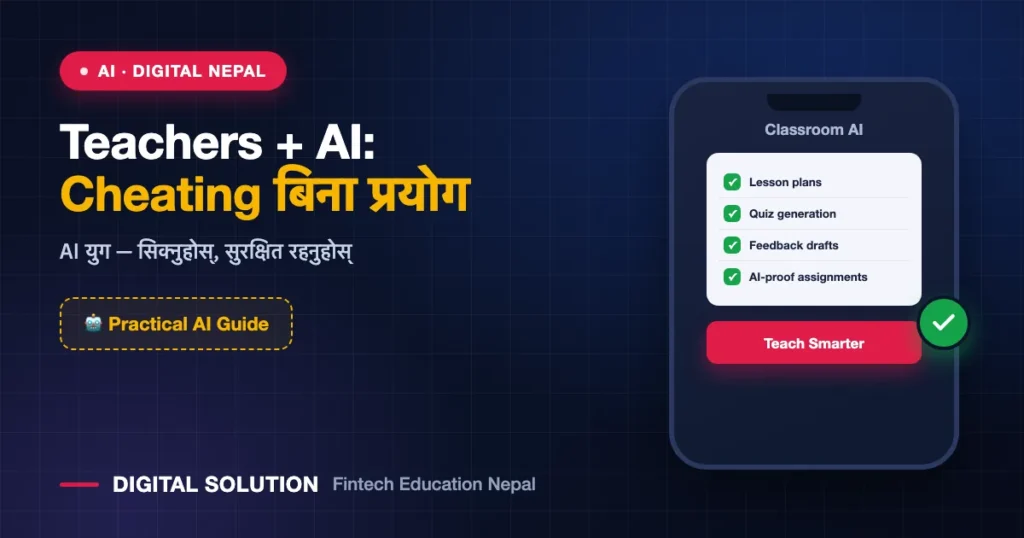
AI is now in every classroom — whether teachers plan for it or not. Students in Nepal already use ChatGPT, Gemini and other tools for homework. The real question for teachers is not “how do I ban AI?” but “how do I use it to teach better while keeping learning honest?” This guide gives Nepali teachers practical ways to use AI for planning, feedback and creativity, without encouraging copying.
Quick answer: Teachers can use AI to save time on lesson planning, quiz creation and feedback, while protecting integrity by redesigning assignments to focus on process, in-class work, oral defence and personal reflection — things AI cannot fake for a specific student.
Key facts: AI in the classroom
- AI is a tool, not a replacement for teaching or thinking.
- Banning AI completely is hard to enforce; guiding its use works better.
- AI is most powerful for teachers in preparation and feedback, not grading final judgement.
- Assignment design — not detection software — is the most reliable way to protect honesty.
How teachers can use AI productively
1. Lesson planning
Ask AI to draft lesson outlines, real-life examples and activities, then adapt them to your Nepali classroom and curriculum.
2. Quiz and worksheet creation
Generate practice questions and answer keys in seconds, then review for accuracy before using them.
3. Differentiated explanations
Ask AI to explain one concept at three levels — simple, medium and advanced — to support mixed-ability classes.
4. Faster feedback
Use AI to draft feedback comments, then personalise them. The teacher stays the final decision-maker.
Step-by-step: designing cheat-resistant assignments
- Focus on process: ask students to submit drafts, notes or outlines, not just a final answer.
- Localise tasks: require examples from the student’s own town, family or school.
- Add oral defence: ask students to explain their work aloud for a few minutes.
- Use in-class writing: keep some work handwritten and supervised.
- Ask for reflection: “What was hard? What did you learn?” — AI cannot answer this for a specific student.
Teaching students to use AI honestly
- Explain the difference between using AI to learn and using AI to cheat.
- Allow AI for brainstorming and checking, but require original final work.
- Ask students to disclose when and how they used AI.
- Model good use yourself so students see AI as a study partner, not a shortcut.
Common problems and solutions
- Students submit AI text as their own: shift to process-based and in-class tasks.
- AI gives wrong facts: teach students to verify with textbooks and official sources.
- Over-reliance on AI: set clear “AI-free” tasks alongside “AI-allowed” tasks.
Safety and privacy considerations
- Never enter students’ personal data (full names, ID numbers, addresses) into AI tools.
- Always fact-check AI content before teaching it.
- Remind students not to share private information in prompts.
How Digital Solution can help
Digital Solution Pvt. Ltd., founded by Rabin Paudel, trains teachers and students in practical, responsible AI use. Explore structured courses on the Digital Solution learning platform and more guides on the main website.
Frequently asked questions
Should teachers ban AI in schools?
A full ban is difficult to enforce. Guiding responsible use and redesigning assignments is usually more effective than banning AI outright.
Can AI help teachers save time?
Yes. AI is excellent for drafting lesson plans, quizzes and feedback, which the teacher then reviews and personalises.
How can I stop students from cheating with AI?
Focus on process, in-class work, oral explanation and reflection tasks that are personal to each student.
Is it safe to put student data into AI?
No. Avoid entering personal details of students into AI tools to protect their privacy.
Conclusion
AI can make Nepali teachers more effective without harming learning — if it is used for preparation and feedback while assignments are designed around process and personal understanding. Guide students, model honest use, and always keep the teacher as the final judge.
Want to train your school staff on responsible AI? Explore practical courses on the Digital Solution learning platform.
Sources and official references
- UNESCO — Guidance on AI in education unesco.org
- OpenAI — Educator resources openai.com
Disclaimer: This article is for general educational purposes. AI tools and school policies change over time. Confirm current rules with your school and relevant authorities.

Rabin Paudel
Rabin Paudel is the Founder of Digital Solution, a Content Creator, and an AI Trainer. He shares practical and easy-to-understand content on Artificial Intelligence, Digital Literacy, Online Services, FinTech, and Technology. His mission is to make technology simple, accessible, and useful for everyone.
View all posts by Rabin Paudel →