Last updated: July 31, 2026 (Shrawan 2083). Procedures and requirements change through government notices — DONIDCR and the Citizen Portal are final.
Nepal’s National Identity Card, commonly known as Rastriya Parichaya Patra or राष्ट्रिय परिचयपत्र, is becoming an important part of the country’s digital public-service infrastructure. It is designed to provide every eligible Nepali citizen with a secure and unique identity that can be verified electronically.
The National ID system is managed by the Department of National ID and Civil Registration (DONIDCR), under Nepal’s Ministry of Home Affairs. It is governed primarily by the National Identity Card and Civil Registration Act, 2076 and the related Regulations, 2077.
This guide explains the National ID Number, physical card, eNID, eligibility, required documents, application process, biometric registration, status checking, correction, replacement, use in passport applications and other essential information.
What Is the National Identity Card?
The National Identity Card is a biometric smart identity card containing a citizen’s demographic and biometric information. It includes an electronic chip and security features intended to make identity verification more reliable and reduce duplication, impersonation and fraudulent use of personal records.
According to DONIDCR, the card contains both:
Demographic information — full name, date of birth, gender, permanent and temporary address, citizenship number and type, nationality, father’s and mother’s names, grandparents’ names, spouse’s name where applicable, and the National Identity Number.
Biometric information — photograph, fingerprints of ten fingers, iris information, and electronic signature.
Applicants who cannot provide certain biometric information because of disability, missing fingers or visual impairment can still be registered by recording the relevant condition in the system.
What Is the National Identity Number?
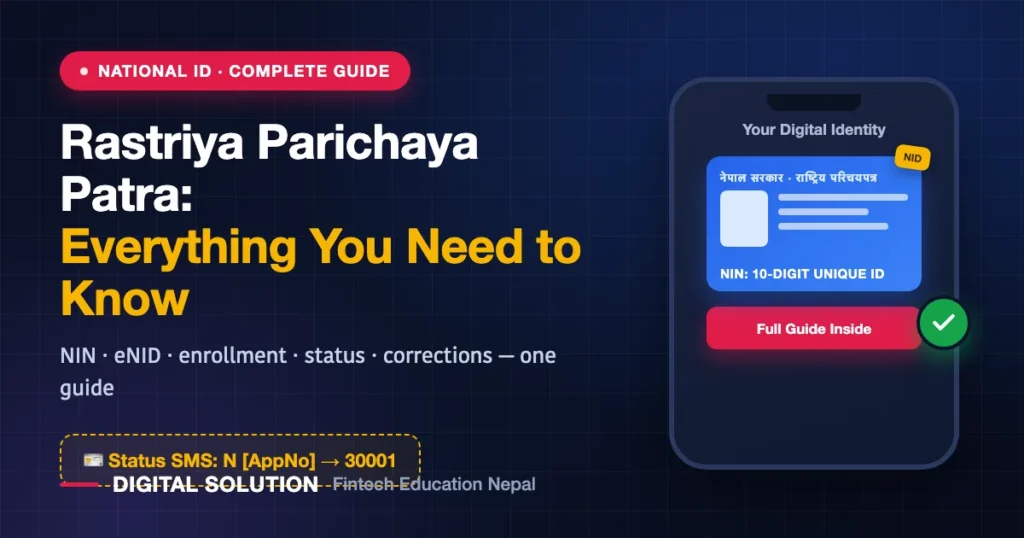
The National Identity Number, also called NIN, is a unique number assigned to an individual after successful National ID registration. DONIDCR describes it as a 10-digit, non-repeating identification number issued to identify each registered person uniquely. Once issued, the NIN generally remains unchanged — including when the person corrects personal information or receives a replacement card.
The NIN is often more immediately useful than the physical card because it may be generated before the card is printed.
NIN, National ID Card and eNID: What Is the Difference?
These three terms are related but not identical:
- National Identity Number (NIN) — the unique 10-digit number assigned after demographic and biometric registration.
- Physical National ID Card — the chip-based smart card printed and distributed by the government. Physical card production and delivery may take longer than the issuance of the NIN.
- eNID (Provisional NID) — a downloadable provisional digital National ID document. DONIDCR formally introduced the eNID download service in June 2026; the official Citizen Portal allows eligible users to download it by entering the requested citizenship details.
The availability of an eNID does not necessarily mean the physical card has been printed — it provides a digital identity document while the physical card is pending. For a deeper comparison with real-world scenarios, see our dedicated guide: NIN vs eNID vs Physical National ID Card.
Who Is Eligible to Apply?
Currently, a person can apply for a National Identity Card when the person:
- Is a Nepali citizen
- Has completed 16 years of age
- Has received a Nepali citizenship certificate
The current registration system is primarily based on the citizenship certificate. DONIDCR’s FAQ indicates that separate arrangements for minors, NRNs and certain foreign residents may be introduced through future government notices. People below 16 generally use a Minor Identity Card (Nabalak Parichaya Patra) for services requiring identification.
Documents Required for National ID Registration
Applicants should normally carry the original documents, not only photocopies. The principal document is the original Nepali citizenship certificate. Additional documents may be required depending on the applicant’s records:
- When the permanent address has changed: the original migration certificate or another officially accepted document confirming the current permanent address.
- For married applicants: when the spouse’s name is already in the citizenship certificate, that certificate may be used; otherwise a marriage registration certificate, marriage verification document, or relationship verification certificate may be needed.
- When the citizenship certificate does not show a complete date of birth: an official document showing the date of birth — birth registration certificate, academic certificate, passport, or pension document.
Applicants should also carry any other original document necessary to verify differences in name, date of birth, address, marital status or family details. DONIDCR states that unclear, damaged, self-corrected, altered or photocopied documents may not be accepted as the basis for registration. (Have mismatched records? Fix them first — our document correction guide.)
How to Apply for the National ID Card
The application generally involves two stages: (1) submission or preparation of personal information, and (2) in-person biometric registration. Completing an online form alone does not complete the process — biometric information must be captured in person.
Step 1: Complete the Online Pre-Enrollment Form
Applicants can access the National ID Online Application through the official DONIDCR website. During pre-enrollment, applicants provide details such as citizenship information, full name in Nepali and English, date of birth, gender, address, parents’ and grandparents’ details, spouse’s details where applicable, mobile number, and preferred enrollment location.
After completing the form, the applicant receives an Application ID, QR code or registration receipt — print or save it clearly and take it to the selected registration station for biometric enrollment.
Important Update for People With Newly Issued Citizenship Certificates
Nepal has begun interconnecting the Centralized Citizenship Information Management System (CCIMS) with the National Identity Management Information System (NIDMIS). Following this integration, administration offices have issued notices stating that citizens receiving a new citizenship certificate after 2082/12/08 BS may be able to visit the National ID section directly without completing a separate online pre-enrollment form.
Because implementation procedures can differ between offices, newly issued citizenship holders should confirm the process with their District Administration Office or Area Administration Office before visiting.
Step 2: Visit a National ID Registration Station
National ID details can generally be registered at District Administration Offices, Area Administration Offices with registration stations, designated enrollment centres, and ward-level registration campaigns when conducted. Applicants are not necessarily required to wait for a campaign in their permanent ward — but the appropriate location and document requirements should be confirmed in advance, particularly when applying from a district different from the citizenship-issuing district.
Step 3: Submit Original Documents for Verification
At the enrollment centre, an operator verifies the applicant’s information against the original citizenship certificate and supporting documents. Carefully inspect: Nepali and English spelling of the name, date of birth in BS and AD, citizenship number, issue date and issuing district, permanent address, parents’ names, spouse’s name, gender and other details.
Any mistake should be corrected before the registration is finalized. A small spelling or date error can later create problems while linking the National ID with a passport, bank account, government database or digital service.
Step 4: Complete Biometric Enrollment
The operator will normally capture a live facial photograph, fingerprints, iris information, and electronic signature. Avoid wearing items that obstruct facial recognition — DONIDCR’s guidance says applicants should not use heavy cosmetic makeup, caps, hats, face-covering items or jewellery that prevents a clear photograph meeting the required standards. Reasonable arrangements are recorded for applicants who cannot provide standard biometric information because of a physical condition or disability.
Step 5: Receive the Registration Confirmation
After biometric enrollment, the applicant receives an application or request number. Applicants registering at permanent stations such as District Administration Offices may receive their NIN quickly; people registered through ward-level campaigns may receive it later through SMS after their records are processed. Preserve the registration receipt until the NIN and physical card have been received.
How to Check Your National ID Number
There are several official methods:
- DONIDCR Citizen Portal: enter your request number in the National ID status service to check application and card status.
- SMS: send
N [space] Application Numberto 30001 — for example,N 123456789012345. The format or number can change; check the latest notice on the official DONIDCR website if the service does not respond.
Full walkthrough with screenshots of every method: How to Check National ID Card Status Online.
How to Check Whether the Physical Card Has Been Printed
The Citizen Portal allows applicants to check card status using the request number. When the card is printed and ready for collection, the registered mobile number should receive an SMS informing where to collect it. Do not assume that receiving the NIN means the card is ready — NIN generation and card printing are separate stages.
Where Do You Collect the National ID Card?
The physical card is normally collected from the location where biometric registration was completed — a District Administration Office registration is distributed through that office; campaign registrations follow the relevant office or campaign arrangement.
The cardholder must normally appear personally because biometric verification may be required during distribution — a family member cannot ordinarily collect the card on behalf of the applicant. Wait for the official SMS or verify the status before visiting.
How to Download the eNID
The official Citizen Portal now includes an eNID Download section. The general process:
- Open the official DONIDCR Citizen Portal.
- Select the eNID download option.
- Enter the citizenship details requested by the portal.
- Complete the verification process.
- Download and securely save the provisional eNID.
The portal may return “Data Not Found” when entered information does not exactly match the government database, when the record has not been synchronized, or when NIN processing remains incomplete — the portal specifically advises users whose NIN status is “in progress” to check the available status information. Step-by-step with troubleshooting: How to Download eNID in Nepal.
Do not upload an eNID, citizenship certificate or National ID image to random websites or send it to unknown people.
Is the National ID Mandatory for Passport Applications?
For most adult passport applicants applying from within Nepal — yes. The Department of Passports states that applicants aged 16 or above applying through the Department of Passports, District Administration Offices or Area Administration Offices must include the National Identity Number in their passport application.
The NIN is not mandatory for applicants below 16 or, under currently published guidance, for applicants applying through Nepali diplomatic missions abroad. The physical card does not necessarily need to have arrived — in many cases the NIN is sufficient.
Where Can the National ID Be Used?
The National ID is designed as a foundational identity for government and regulated services. DONIDCR identifies service areas such as passport services, social security benefits, government relief and grants, banking and financial transactions, SIM card registration, property-related transactions, personal-event registration, and voting and public-service verification.
Implementation is phased through government notices — the card or NIN should not automatically be assumed mandatory for every listed service everywhere at once. Recent milestones we’ve covered: NID becoming mandatory for digital wallets (Asoj 2083 deadline), bank accounts opening via Nagarik App eKYC, the driving license form asking for NIN, and even a proposal to accept the NID for India entry. Check the latest instruction from the particular bank, office or provider before visiting.
Does the National ID Replace the Citizenship Certificate?
Not immediately. The National ID and citizenship certificate are different legal documents, and DONIDCR states that both continue to be used according to applicable laws. The citizenship certificate remains the primary proof of Nepali citizenship in many legal and administrative procedures; the National ID provides a secure, biometric, electronically verifiable identity linked to the citizen’s records. Keep your original citizenship certificate safe even after receiving the National ID Card.
How to Correct a Mistake in the National ID
When registered information is incorrect, visit a National ID registration station at a District Administration Office or Area Administration Office, submit a correction request, and provide supporting original documents proving the correct information.
Depending on the error, the office may require correcting the source document first — for example, when the citizenship certificate itself contains the incorrect name, the citizenship record may need correction before the National ID can be updated (how source-document corrections work). Correcting demographic information does not normally change the NIN.
Name and Surname Changes After Marriage
A person cannot generally add a spouse’s surname to the National ID when that surname is not legally established in the citizenship record. DONIDCR’s guidance states the citizenship certificate should first be amended; the National ID can then be prepared or corrected on that basis. Using different names across citizenship, passport, educational certificates and National ID records creates verification problems.
What Happens When the Date of Birth Is Incomplete?
Some older citizenship certificates show the person’s age at issue instead of a complete date of birth. DONIDCR may rely on official supporting documents — educational certificates, passport, pension record, birth registration certificate, or the citizenship issue date and recorded age. Carry the strongest available official evidence and verify the final date carefully before approving the enrollment.
What Should You Do If the Card Is Lost or Damaged?
Apply for a replacement through the relevant District Administration Office or an Area Administration Office with a registration station. The authority verifies the existing record before processing. The officially published replacement fee is NPR 500, and the Citizen Portal provides an online replacement-payment facility. The permanent NIN remains the same on a replacement card.
Is the First National ID Card Free?
Initial registration has generally been provided without a card fee. Costs may arise for replacement of a lost or damaged card, correction of source documents, obtaining supporting certificates, and photocopying, printing or transportation. Do not pay unauthorized agents for registration appointments or faster card delivery — no agent can legally accelerate government processing.
Data Privacy and Security
National ID registration involves highly sensitive information — fingerprints, iris details, family records. DONIDCR states that National ID data is stored within government-controlled systems, protected through encryption and access controls, with authorized institutions receiving only the level of information required for their approved purpose and system access being logged.
Citizens should still follow strong personal-security practices:
- Never share an OTP with anyone.
- Do not send a full National ID image to unknown individuals.
- Avoid posting the NIN publicly on social media.
- Do not upload identity documents to unverified websites.
- Use only official government portals.
- Verify calls claiming to be from a bank or government office.
- Cover unnecessary information when submitting a copy.
- Report suspicious identity-verification requests.
A bank or government office does not need your mobile-banking PIN, password or OTP to update your National ID details. If you’ve been targeted, our fraud recovery guide covers what to do.
What Happens If Someone Submits False Information?
Submitting false information to obtain a National ID is a serious offence. DONIDCR’s published FAQ states that a person who obtains a National ID using false information may face imprisonment from two to five years and a fine ranging from NPR 20,000 to NPR 50,000, under the applicable law. A National ID may also be cancelled when it was obtained using false details, obtained contrary to the Act, or when the holder is no longer a Nepali citizen.
Common National ID Problems and Solutions
- The NIN has not arrived by SMS — check via the Citizen Portal with your request number, use the official SMS format, or contact DONIDCR through the latest published numbers.
- The portal shows “Data Not Found” — confirm every detail is entered exactly as recorded (BS/AD dates, old district formats cause mismatches). If correct but persisting, the record may not be synchronized — contact the enrollment office. (Same family of errors as Nagarik App verification failures.)
- The card has not arrived for a long time — NIN ≠ printed card; check card status before visiting.
- The registered mobile number is no longer active — contact the registration office or DONIDCR; do not register again without official instruction, as duplicates create complications.
- The name or date of birth is incorrect — visit an authorized station with original supporting documents; correct the source record first if it’s wrong.
- The card was printed but no SMS was received — check status online and contact your enrollment location.
- The fingerprint could not be captured — the operator records the physical condition and completes registration with available biometric and demographic information.
Frequently Asked Questions
Can I apply completely online?
No. The personal-information form may be prepared online, but you must visit an enrollment centre for document verification, photograph, fingerprints, iris capture and signature.
Can someone else apply on my behalf?
No — biometric enrollment requires your physical presence.
Can someone else collect my physical card?
Normally no — personal attendance is required because biometric verification may be conducted during distribution.
Do I need the physical card to apply for a passport?
For most adult applicants, the National Identity Number is the essential requirement — the physical card may not need to have been delivered.
Can I apply from a district different from my permanent address?
Services are available through designated registration stations, but applicants with address changes or records issued by another district may need additional verification documents. Confirm with the selected office before visiting.
Does the NIN change after correcting information?
Normally no — the unique NIN remains the same.
Can I register twice when the first application is delayed?
Do not submit a second biometric registration without official instruction — first check the existing application using the request number or contact the registration office.
Is an agent required?
No. Applicants can complete the process themselves through official channels. Assistance may be useful for filling out the form, but no private agent can legally guarantee faster government approval or card printing.
Can I use the National ID as proof of citizenship?
The National ID is an official identity document, but it does not automatically eliminate the need for a citizenship certificate in every legal procedure. Carry the document requested by the specific authority.
Practical Checklist Before Visiting the Enrollment Centre
- ✅ Original citizenship certificate
- ✅ Online application receipt or QR code, when required
- ✅ Migration certificate when the permanent address has changed
- ✅ Marriage or relationship certificate when required
- ✅ Official proof of date of birth when the citizenship record is incomplete
- ✅ Other original documents supporting corrections or differences
- ✅ An active mobile number
- ✅ Photocopies for office use, while keeping the originals available
Before leaving the centre, verify every detail shown in the registration form.
Final Advice
The National Identity Card is more than another plastic identity card — it is intended to become a core digital identity through which public and regulated services can verify citizens accurately. However, the system is still evolving: card printing, database synchronization, online status services and integration with other institutions may not always progress at the same speed. Preserve your request number, NIN, citizenship certificate and enrollment documents carefully.
Use only the official DONIDCR website, Citizen Portal, District Administration Offices, Area Administration Offices and formally announced enrollment centres. Most importantly, never share an OTP, banking password or sensitive identity document with an unknown caller claiming to update or activate your National ID.
For the broader ecosystem this identity plugs into — Nagarik App, KYC, digital services — see our Nepal Digital Identity Guide and the 32 most-asked NID questions.
🤝 Stuck anywhere in the National ID process?
Form confusion, “Data Not Found,” document mismatches, eNID problems — send us your situation and Digital Solution will point you to the correct step.
Disclaimer: Digital Solution Nepal is an independent educational/digital-service assistance website, not a government body. National ID procedures, mandatory-use requirements, service locations and digital facilities may be changed through government notices. Verify the latest instructions from DONIDCR or the relevant service-providing authority before applying.

Rabin Paudel
Rabin Paudel is the Founder of Digital Solution, a Content Creator, and an AI Trainer. He shares practical and easy-to-understand content on Artificial Intelligence, Digital Literacy, Online Services, FinTech, and Technology. His mission is to make technology simple, accessible, and useful for everyone.
View all posts by Rabin Paudel →