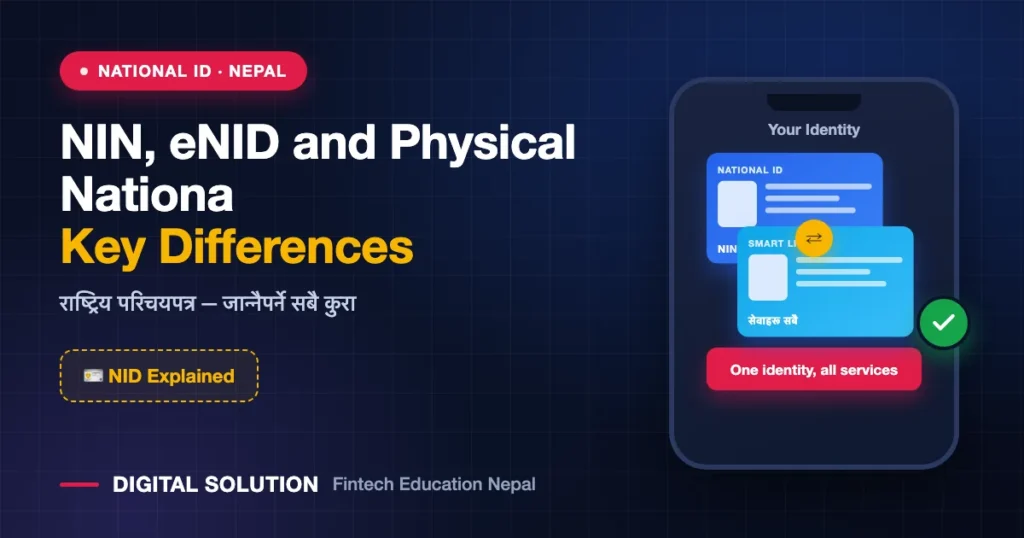
NIN, eNID and the physical National ID card sound like the same thing—and people use the words interchangeably—but they are three different things that serve different purposes. Knowing the difference saves you time when a bank, SIM shop or office asks for “your National ID.”
Quick answer: The NIN (राष्ट्रिय परिचय नम्बर) is your permanent identity number. The eNID is an official digital copy of your National ID you can download. The physical card is the printed version. All three come from the same enrollment, but they are not interchangeable in every situation.
Last updated: 12 July 2026. Reviewed by Digital Solution’s digital-service research team.
Side-by-Side Comparison
Scroll the table sideways on a small phone if needed.
| Item | What it is | Format | Primary purpose | Usable online? |
|---|---|---|---|---|
| NIN | Unique National Identity Number | 10-digit number | Permanent identity reference across services | Yes |
| eNID | Official digital copy of the National ID | Downloadable digital file | Digital proof where accepted | Yes |
| Physical card | Printed biometric identity card | Physical card | Physical proof of identity | No (physical) |
What Is the NIN?
The National Identity Number is a unique 10-digit number generated after your biometric enrollment (fingerprints, photograph and iris) is processed. It is your permanent identity reference—it does not change even if you get a duplicate physical card. Each citizen is designed to have a single NIN.
What Is the eNID?
The eNID is an official digital copy of your National ID that you can download from the DONIDCR Citizen Portal once your record is ready. It is not the same as a phone photo of a printed card. Acceptance can vary by institution, so it is widely useful but not guaranteed everywhere.
What Is the Physical Card?
The physical National ID card is the printed, biometric-based card issued by DONIDCR. It is printed and distributed in phases after enrollment. Some offices still ask for the physical card even when the NIN or eNID would otherwise work.
NIN vs Card Number
A common mix-up: the NIN is your permanent identity number, while a card number is a detail printed on a specific physical card. If you replace a lost or damaged card, the NIN stays the same—a new number is not created.
Which One Do You Need?
- Online services: the NIN or eNID is often enough, where accepted.
- In-person verification: some offices require the physical card.
- Always confirm with the specific service what they accept before you go.
🤝 National ID process मा अल्झिनुभयो?
Status check, enrollment, विवरण मिलेन — जे समस्या भए पनि हामी step-by-step guide गरिदिन्छौं।
Frequently Asked Questions
Is the NIN the same as the card number?
No. The NIN is your permanent identity number; the card number is a detail on a physical card. The NIN stays the same across card replacements.
Can I use the eNID instead of the physical card?
Often yes, where the institution accepts it. But some offices still require the physical card, so confirm before relying on the eNID alone.
Do I get a NIN before the physical card?
Yes. The NIN is generated after processing, before the physical card is printed and distributed, so you may have the NIN and eNID while you wait for the card.
For the complete picture—including Nagarik App and Online KYC—read our pillar guide: Nepal Digital Identity Guide 2026. See also where the National ID is mandatory and our National ID FAQs.
Need help? Digital Solution publishes practical guides for Nepali users. Contact us through our official website or WhatsApp: +977 9766597181.
Disclaimer: Digital Solution is an independent educational and digital-service assistance company. We are not affiliated with DONIDCR or any government agency. Procedures may change—always verify through the official National ID Citizen Portal.

Rabin Paudel
Rabin Paudel is the Founder of Digital Solution, a Content Creator, and an AI Trainer. He shares practical and easy-to-understand content on Artificial Intelligence, Digital Literacy, Online Services, FinTech, and Technology. His mission is to make technology simple, accessible, and useful for everyone.
View all posts by Rabin Paudel →