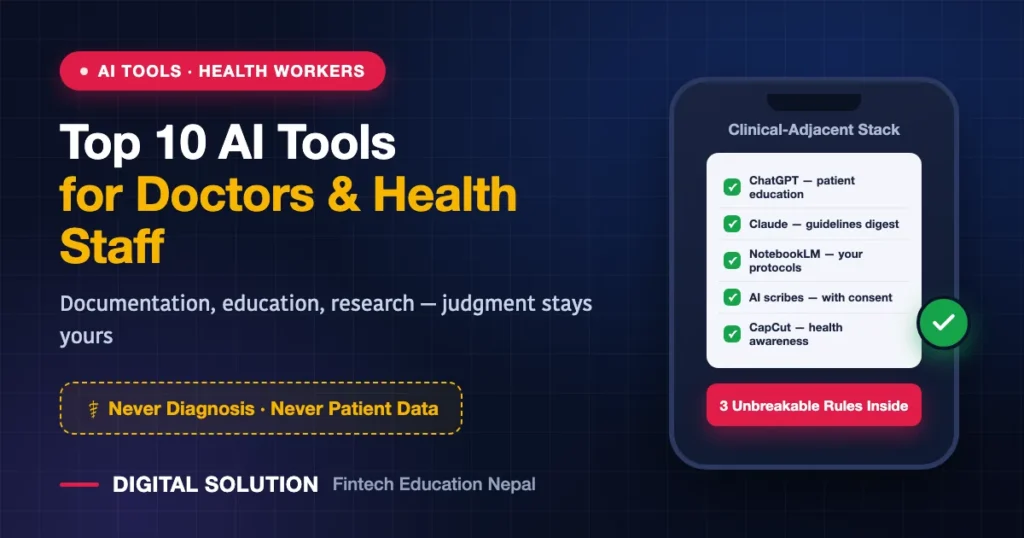
Last updated: July 2026 (Shrawan 2083). AI in healthcare demands extra care — these tools support administration, education and research, never diagnosis or treatment decisions. Part of our AI-by-profession series (general list).
Nepali doctors, nurses and health workers lose hours daily to documentation, patient education and keeping up with literature — exactly the work AI handles well. These are the 10 best AI tools for doctors and health workers in Nepal, chosen with a hard rule stated upfront: AI assists the professional; it never replaces clinical judgment, and patient-identifiable data never enters a chatbot.
The 10 at a Glance
| # | Tool | Clinical-Adjacent Superpower |
|---|---|---|
| 1 | ChatGPT | Patient-education drafts, letters, simplified explanations |
| 2 | Claude | Long-document analysis — guidelines, papers, reports |
| 3 | NotebookLM | Query protocols and guidelines you upload — answers stay source-bound |
| 4 | Perplexity | Literature lookups with citations |
| 5 | Whisper/Otter-class transcription | Dictate notes, transcribe teaching sessions |
| 6 | AI medical scribes (Heidi/Freed-class) | Consultation documentation — check data policies first |
| 7 | Canva | Health-education posters and camp materials |
| 8 | Gemini | Free research layer + translation for patient materials |
| 9 | CapCut | Short health-awareness videos — Nepal’s doctors are underrepresented online |
| 10 | Grammarly | Referrals, abstracts, applications in polished English |
1. ChatGPT — The Communication Engine
Draft diabetic-diet instructions at a Class-8 reading level in Nepali; explain a procedure to an anxious family in plain words; generate discharge-advice templates. Communication is half of care, and it’s the half AI drafts brilliantly — you verify medical accuracy before anything reaches a patient.
2. Claude — For the Long Reads
Feed it a 60-page guideline update or three papers and ask what changed for your practice. Claude’s long-document strength and careful summarization suit clinical reading loads — treat outputs as a first pass, not a conclusion.
3. NotebookLM — Your Protocols, Queryable
Upload the treatment protocols, formularies and standing guidelines your institution actually uses; NotebookLM answers only from them — “what does OUR protocol say” beats “what does the internet say” in every clinical context. Audio overviews double as teaching material for interns.
4. Perplexity — Cited, Checkable Answers
For quick literature questions, Perplexity’s citations let you jump to the actual source — the non-negotiable habit in medicine. It’s a research accelerant, not an oracle.
5. Speech-to-Text (Whisper/Otter-class) — Dictate, Don’t Type
Case summaries, teaching notes, meeting minutes — spoken and transcribed in minutes. For anything patient-related, keep identifiers out and prefer locally-processed/institution-approved options.
6. AI Medical Scribes — The Frontier, With Conditions
Heidi, Freed and similar tools draft consultation notes from conversation. Efficiency gains are real; so are the conditions: explicit patient consent, scrutiny of where audio/data goes, and institutional approval. In Nepal’s regulatory gap, the burden of diligence is yours.
7. Canva — Health Education That Gets Read
Vaccination-camp posters, hygiene infographics, OPD signage, community-program materials — professional design in minutes, Nepali text supported. Health messages compete for attention like everything else; design is not optional.
8. Gemini — The Free Layer + Translator
Solid free research tier, and genuinely useful Nepali-English translation for patient materials — translate, then have a colleague sanity-check clinical nuance.
9. CapCut — The Awareness Channel
Nepal’s health misinformation spreads in video; accurate voices need to compete in the same format. A weekly 60-second myth-buster, auto-captioned in Nepali, builds both public health and professional reputation.
10. Grammarly — When English Carries Stakes
Referral letters, conference abstracts, fellowship applications — polished English signals rigor. Grammarly’s free tier catches what matters.
The Three Unbreakable Rules
- No patient identifiers in AI tools. Ever. Names, photos, reports with details — a chatbot is not a clinical system. De-identify or don’t upload.
- AI never diagnoses your patient. Drafts, summaries, education — yes. Clinical decisions — you, your training, your protocols.
- Verify everything with stakes. AI fabricates convincingly — doses, interactions, citations. The professional who signs remains responsible for every word.
FAQ
Can doctors in Nepal use ChatGPT for patient care?
For communication drafts, education materials and admin — yes, with verification. For diagnosis or treatment decisions — no. It’s an assistant, not a clinician.
Is it legal/safe to put patient data into AI tools?
Putting identifiable patient data into consumer AI tools violates confidentiality principles regardless of Nepal’s regulatory gaps. De-identify everything; prefer institution-approved systems.
Which tool helps most with medical study (MBBS/licensing)?
NotebookLM with your actual course materials and past papers, plus Anki-style spaced repetition (see the students’ edition) — the combination built for volume memorization.
Are AI scribes available in Nepal?
The tools are accessible online; institutional policy, consent practice and data-location diligence are what’s usually missing. Pilot carefully, document consent.
🤝 Hospital or clinic team wanting structured AI training?
Digital Solution runs practical AI workshops for institutions — details here.
Disclaimer: Digital Solution Nepal is an independent educational website, not a medical organization, and not affiliated with the tools listed. Nothing here is medical advice; clinical decisions belong to licensed professionals following applicable standards. Features and free tiers change — official sites are final.

Rabin Paudel
Rabin Paudel is the Founder of Digital Solution, a Content Creator, and an AI Trainer. He shares practical and easy-to-understand content on Artificial Intelligence, Digital Literacy, Online Services, FinTech, and Technology. His mission is to make technology simple, accessible, and useful for everyone.
View all posts by Rabin Paudel →