Last updated: July 2026 — based on Nepal Rastra Bank’s amendment to the Unified Payment Systems Directive (अ.प्रा. निर्देशन नं. १५/०८२, new sub-clause 1(15)). Rules may be updated further; always confirm on the official NRB website before acting.
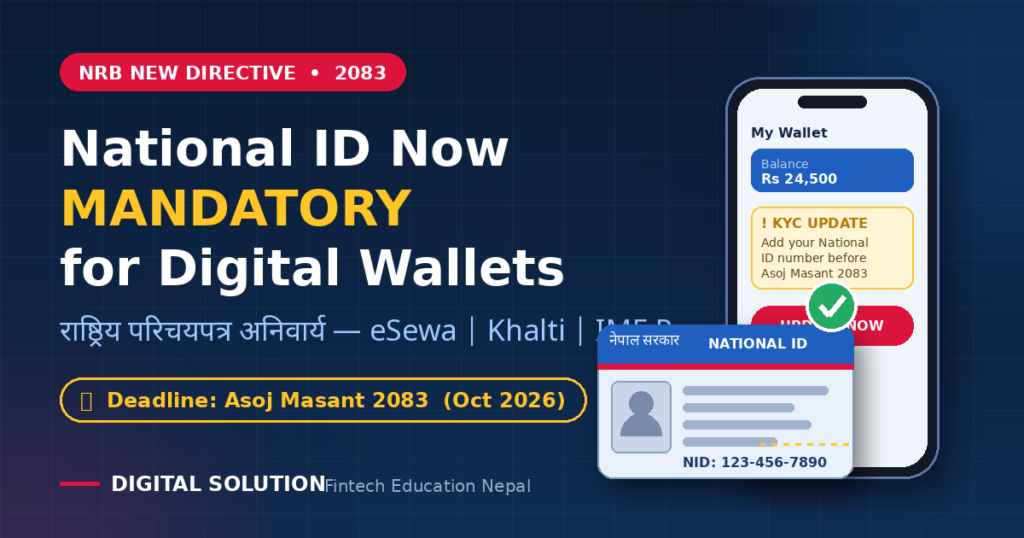
If you use eSewa, Khalti, IME Pay, or any other digital wallet in Nepal, there is one new rule you cannot ignore: Nepal Rastra Bank (NRB) has made the National Identity Card (राष्ट्रिय परिचयपत्र, or NID) the core identity document for wallet accounts. New wallets must be opened by verifying your National ID against the government’s electronic records, and existing wallet users must declare and update their NID details by the end of Asoj 2083 (mid-October 2026).
This is not a small KYC tweak. It connects Nepal’s entire digital payment ecosystem — millions of wallet accounts — to a single, biometric-backed national identity system. In this guide, we break down exactly what the new NRB directive says, what you need to do (whether you live in Nepal or abroad), what happens if you don’t have a National ID yet, and the special exceptions NRB has built in.
What the New NRB Directive Actually Says
In July 2026, NRB issued an amendment to its Unified Payment Systems Directive (भुक्तानी प्रणालीसम्बन्धी एकीकृत निर्देशन) — the master rulebook that every licensed Payment Service Provider (PSP) and Payment System Operator (PSO) in Nepal must follow. The amendment inserts a new sub-clause, 1(15), into Directive No. 15/082.
The sub-clause has six provisions, labeled (क) through (च) in the original Nepali circular. Here is the full breakdown in plain English:
| Provision | Who It Affects | What It Requires |
|---|---|---|
| (क) | New wallet users (Nepali citizens) | Wallets must be opened only after the PSP verifies your National ID details against the official electronic NID records |
| (ख) | All existing wallet users | PSPs must collect a self-declaration (स्वघोषणा) — via mobile app or other means — stating whether you have obtained a National ID, by Asoj मसान्त 2083 |
| (ग) | Existing users who already have an NID | You must update your National ID number in the wallet app by Asoj मसान्त 2083 |
| (घ) | Existing users who don’t yet have an NID | The wallet company must send you a monthly reminder through the app to obtain your NID and update your KYC |
| (ङ) | Nepali citizens living abroad (NRNs, workers, students) | You can open a wallet online from abroad using your NID, NID number, or other required documents — but if opened without NID, you must update your NID details within 35 days of returning to Nepal |
| (च) | Citizens unable to care for themselves (अशक्त तथा असहाय) | Can open wallets and transact using other required documents even without a National ID |
The single most important takeaway: राष्ट्रिय परिचयपत्र is becoming the anchor identity for digital payments in Nepal, the same way it is being rolled out for bank accounts, SIM cards, and government services.
The Key Deadline: Asoj मसान्त 2083
Mark this date. The self-declaration requirement — and the NID number update for those who already hold a National ID — must be completed within Asoj 2083, which ends in mid-October 2026 on the Gregorian calendar.
This wallet deadline runs parallel to NRB’s broader push: banks and financial institutions have been given the same Asoj 2083 window to collect NID self-declarations from existing account holders. In other words, NRB is synchronizing the entire financial system — banks and wallets together — around the National ID by the same date.
What “self-declaration” means in practice: expect your wallet app (eSewa, Khalti, IME Pay, PrabhuPay, Moru, and others) to show an in-app prompt or form asking two things:
- Have you obtained a National Identity Card? (Yes / No)
- If yes → enter your National ID number so the wallet can update your KYC profile.
You will not need to visit any office for this step if you already have your NID — the directive explicitly says this happens through the mobile application or other suitable means.
What Existing Wallet Users in Nepal Should Do Now
If you already use a digital wallet and live in Nepal, here is your simple action plan:
If you already have your National ID
- Find your NID number. It is printed on your राष्ट्रिय परिचयपत्र card. If you have completed enrollment but not received the card, you can check your status through the Department of National ID and Civil Registration (DoNIDCR) channels.
- Wait for (or find) the in-app update option. Wallet providers are required to roll out an NID update flow. Check the KYC or Profile section of your app.
- Enter and submit your NID number before Asoj मसान्त 2083.
- Keep confirmation. Screenshot the completed update — useful if any dispute arises later.
If you have NOT yet obtained a National ID
- You will still be asked to submit the self-declaration (answering “not yet obtained”).
- Your wallet will then send you a reminder every month to get your NID and update your KYC — this is mandated by provision (घ), so the notifications are not spam; they are a regulatory requirement.
- Practical advice: start your NID enrollment now. Enrollment happens through DoNIDCR enrollment centers (District Administration Offices and designated stations). Doing it early avoids the last-minute rush that always happens near government deadlines — we saw the same pattern with SIM registration and SSF (Social Security Fund) listing.
Will my wallet be blocked if I miss the deadline? The circular itself does not spell out an automatic blocking provision for users — it places the compliance obligation on the licensed institutions. However, based on how NRB has enforced KYC rules historically, wallets may restrict transaction limits or suspend services for non-updated accounts once enforcement begins. Do not test this. Update on time. (If a wallet or bank payment ever fails on you, our digital payment complaint guide covers the fix.)
The Big News for NRNs and Nepalis Abroad: Open a Wallet Without Coming Home
Provision (ङ) is arguably the most practically useful part of this directive, and it deserves attention from every Nepali working or studying abroad.
You can now open a Nepali digital wallet entirely online, from abroad, in one of two ways:
- With your National ID or NID number — the cleanest path, fully compliant from day one.
- Without an NID, using other required documents (for example, citizenship certificate and passport as specified by the wallet provider) — with one condition attached.
The 35-day rule: if you opened your wallet from abroad without NID details, the wallet provider must collect and update your National ID details within 35 days of your return to Nepal. Expect the app to prompt you, and expect this to be enforced — the obligation sits on the licensed institution, so they will chase you for it.
Why this matters for the diaspora
Until now, many Nepalis abroad struggled with a frustrating loop: they wanted to pay a family member’s bills, top up mobile balance, pay school fees, or manage utilities back home — but opening or fully verifying a wallet typically required in-person KYC steps in Nepal. This directive formally opens the remote onboarding door:
- A worker in Qatar or Malaysia can open a wallet online and manage payments for family in Nepal.
- A student in Australia can keep a verified wallet active for payments during visits home.
- NRNs planning to return can set up their digital payment life before landing in Kathmandu.
Combined with Nepal’s growing remittance-to-wallet integrations, this is a meaningful step toward genuine cross-border digital financial access for the diaspora.
Exception for Vulnerable Citizens
Provision (च) creates a humane carve-out: citizens who cannot care for themselves — the incapacitated and helpless (अशक्त तथा असहाय) — can open wallets and carry out transactions by attaching other required documents instead of a National ID or NID number.
This matters because NID enrollment requires biometric capture at enrollment centers, which is genuinely difficult for bedridden, severely disabled, or institutionalized citizens. If you manage finances for a family member in this situation, know that the wallet provider must accept alternative documentation — you do not need to force an impossible NID enrollment.
Why Is NRB Doing This? The Strategy Behind the Rule
Understanding the “why” helps you see where Nepal’s fintech ecosystem is heading:
1. One person, one verified identity. Nepal’s KYC system has historically run on citizenship certificates — paper documents with no central electronic verification and inconsistent details across offices. The National ID is biometric, centrally databased, and electronically verifiable. Provision (क)’s requirement to verify wallet users against the electronic NID records means fake and duplicate accounts become dramatically harder to create.
2. Anti-money-laundering (AML) pressure. Nepal has been working to strengthen its AML/CFT framework to satisfy international watchdogs. Tying every wallet to a verifiable national identity is a direct response — digital wallets are high-volume, small-ticket channels that regulators worldwide watch closely for fraud and layering.
3. Digital fraud control. Wallet-based scams — fake merchant QRs, mule accounts, social-engineering transfers — often rely on accounts opened with weak KYC. Electronic NID verification attacks the problem at the account-opening stage.
4. Foundation for digital public services. Once wallets, bank accounts, and SIM cards all share one identity backbone, Nepal can build toward things like direct benefit transfers, digital subsidy payments, and streamlined government fee collection — the “Digital Nepal” framework in action.
How to Get Your National ID (Quick Primer)
If this directive is your push to finally get your राष्ट्रिय परिचयपत्र, here is the short version (for the full picture, see our Nepal digital identity guide):
- Pre-enrollment: fill the online pre-enrollment form through the DoNIDCR citizen portal (donidcr.gov.np) if available for your district, or go directly to an enrollment center.
- Biometric enrollment: visit your District Administration Office (जिल्ला प्रशासन कार्यालय) or designated NID enrollment station with your citizenship certificate. They capture your photo, fingerprints, and iris scan.
- NID number issuance: after enrollment, your National ID number is generated — in many cases you can use the number even before the physical card arrives (here is how NIN, eNID and the physical card differ).
- Card collection: collect the physical card when notified, or check status via DoNIDCR.
Tip for the Asoj deadline: the directive’s update requirement centers on your NID number, so completing enrollment and obtaining the number is the critical step — don’t wait for the physical card to update your wallet.
FAQ: NRB’s National ID Rule for Digital Wallets
Is National ID compulsory to open a new wallet in Nepal now?
Yes, for Nepali citizens. Under the new sub-clause 1(15)(क), licensed wallet providers must verify your National ID details against the electronic NID records before opening your wallet. Exceptions exist for citizens abroad (temporarily) and for incapacitated/helpless citizens.
What is the deadline to update my National ID in eSewa, Khalti, or other wallets?
The end of Asoj 2083 (mid-October 2026). By then, all wallet users must submit a self-declaration about whether they hold an NID, and those who have one must update their NID number in the app.
I live abroad and don’t have a National ID. Can I still open a Nepali wallet?
Yes. The directive explicitly allows Nepalis residing abroad to open wallets online using other required documents. Your only obligation: update your National ID details within 35 days of returning to Nepal.
I don’t have a National ID yet and I live in Nepal. Will my wallet stop working?
The directive doesn’t announce automatic blocking for users. It requires wallet companies to remind you every month to obtain your NID and update KYC. That said, expect enforcement pressure to increase over time — start your NID enrollment now rather than risking future restrictions.
Does this rule apply to bank accounts too?
A parallel NRB provision gives bank account holders the same Asoj 2083 window for NID self-declaration and KYC updates. The wallet directive covered in this post is the payment-system counterpart of that same national push.
The Bottom Line
NRB’s new directive makes the National ID the identity backbone of Nepal’s digital wallet ecosystem — with electronic verification for new accounts, an Asoj 2083 deadline for existing users, a genuinely useful remote wallet-opening pathway for Nepalis abroad, and sensible exceptions for vulnerable citizens. The smart move is simple: if you have your NID, update your wallet the moment the in-app option appears; if you don’t, begin enrollment this month.
Need help navigating Nepal’s digital finance rules? Digital Solution Pvt. Ltd. creates practical, up-to-date guides on SSF, digital wallets, banking directives, and government digital services — trusted by 400K+ followers across Nepal and the diaspora.
🎥 Follow Digital Solution on YouTube, TikTok, and Facebook for Nepali-language explainers on every major fintech update.

Rabin Paudel
Rabin Paudel is the Founder of Digital Solution, a Content Creator, and an AI Trainer. He shares practical and easy-to-understand content on Artificial Intelligence, Digital Literacy, Online Services, FinTech, and Technology. His mission is to make technology simple, accessible, and useful for everyone.
View all posts by Rabin Paudel →