
As of 2 November 2026 (16 Kartik 2083). Rules are from the Collective Investment Fund Regulation, 2067 (with fourth amendment) published by the Securities Board of Nepal (SEBON), and section 88 of the Income Tax Act, 2058. Issue details and fees are from SEBON approvals and fund manager pages as reported by Sharesansar and NIC Asia Capital. NAVs change daily; check the fund manager’s site on the day you invest.
A mutual fund Nepal investors can buy is a pool of money that a licensed fund manager invests in shares, bonds and fixed deposits on behalf of thousands of small investors. You buy units, usually at Rs 10 each at launch, and the value of those units rises or falls with the fund’s investments. For a first-time investor who does not want to pick individual shares, a mutual fund is one of the simplest ways into the market, and you can start with about Rs 1,000.
This guide explains the two types of schemes, how to buy and sell units, what NAV means, what fees and tax you pay, and a simple plan to start small.
Quick answers
| Question | Short answer |
|---|---|
| Who regulates mutual funds? | Securities Board of Nepal (SEBON) |
| Main rulebook | Collective Investment Fund Regulation, 2067 (fourth amendment in force from 24 Bhadra 2077) |
| Types of scheme | Open-end (no fixed term) and closed-end (fixed term, listed on NEPSE) |
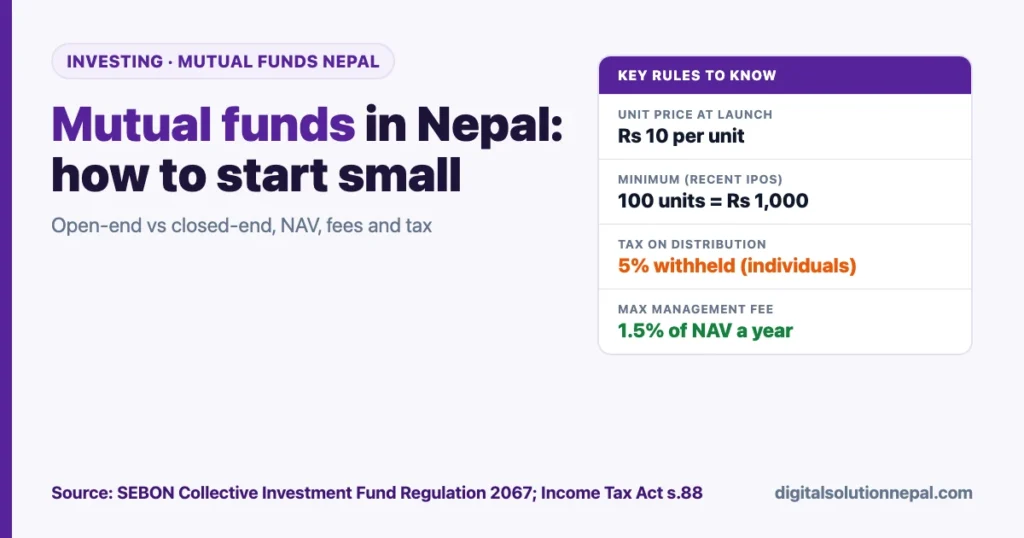
| Usual price at launch | Rs 10 per unit |
| Typical minimum | 100 units (Rs 1,000) in recent closed-end issues; about Rs 1,000 for open-end and SIP instalments |
| Accounts needed | Bank account and demat account; MeroShare for IPO applications |
| How often NAV is published | At least weekly for every scheme; daily on the website for open-end schemes |
| Tax on distributions to individuals | 5% withheld by the fund (Income Tax Act section 88(1)) |
| Maximum exit fee (open-end) | 1.5% of the redemption price; no entry fee allowed |
Mutual fund Nepal basics: how a fund works
Under the SEBON regulation, a mutual fund has four players. A fund sponsor (usually a bank or insurer) sets up the fund. A scheme manager (a merchant bank such as NIBL Ace Capital, NIC Asia Capital or Siddhartha Capital) invests the money. A depository keeps the securities safe. A group of fund supervisors watches over the manager on behalf of unit holders.
Each fund can run several schemes (योजना, yojana). When you invest, you own units of a specific scheme, and your share of profit and loss is in proportion to the units you hold. The regulation also requires the manager to put its own money in: at least 15% of the size of its first scheme as seed capital.
Open-end vs closed-end schemes
The regulation defines an open-end scheme (खुलामुखी योजना) as one run without a fixed term and a closed-end scheme (बन्दमुखी योजना) as one run for a fixed term.
| Feature | Open-end scheme | Closed-end scheme |
|---|---|---|
| Term | No fixed maturity | Fixed term (recent issues: 10 years) |
| Where you buy | Directly from the fund manager or its agents (banks, branches), any working day | IPO through MeroShare or C-ASBA banks, then on NEPSE through a broker |
| Price you pay | Daily NAV set by the manager | Market price on NEPSE, which can be above or below NAV |
| Selling | Redeem to the manager at that day’s NAV, minus any exit fee | Sell on NEPSE to another investor |
| Number of units | Changes as people buy and redeem | Fixed after the issue |
| Fees on buying | No entry fee allowed | Broker commission on secondary trades |
| At maturity | Not applicable | Scheme is wound up and assets paid out in cash |
| Examples (check current status) | NIBL Sahabhagita Fund, NIC Asia Dynamic Debt Fund, Siddhartha Systematic Investment Plan | Muktinath Mutual Fund 2, Nepal Life Samriddhi Lagani Yojana, Sanima Equity Fund II |
Most schemes in Nepal have been closed-end, but open-end schemes are growing. In July 2026, Sharesansar reported that SEBON approved 22 crore units (Rs 2.2 billion at Rs 10 par) for Siddhartha Capital’s open-end “Siddhartha Systematic Investment Plan”.
NAV vs market price
NAV (net asset value, खुद सम्पत्ति मूल्य) is the value of everything the scheme owns, minus what it owes, divided by the number of units. The regulation says the manager must publish each scheme’s NAV at least once a week, and open-end schemes must post NAV, sale and repurchase prices daily on their website. A monthly report with investments, market value, income and NAV must be published in a national newspaper within 15 days of each month’s end.
For an open-end scheme, you buy and sell at a price based on that day’s NAV, so NAV is your price.
For a closed-end scheme, NAV and the NEPSE price are different things. The market price depends on demand, and closed-end units in Nepal have often traded below NAV. Here is a simple illustration (our calculation, not a real fund):
| Item | Figure |
|---|---|
| Weekly NAV published by the fund | Rs 10.50 |
| Last traded price on NEPSE | Rs 9.20 |
| Discount to NAV | (10.50 – 9.20) / 10.50 = 12.4% |
Our reading: a deep discount can be a buying opportunity if the scheme is close to maturity, because at winding up the assets are turned into cash and paid out according to units held. It is also a sign that the market doubts the manager or the portfolio, so compare several weeks of NAV before you buy.
How to buy mutual fund units: step by step
- Open a bank account and a demat account. A demat account is mandatory. Our guide to opening a demat account online covers the documents.
- Activate MeroShare. You need it to apply for closed-end IPOs and to see units in your demat account.
- Choose the type of scheme. Decide between open-end (buy and redeem with the manager) and closed-end (IPO or NEPSE).
- For a closed-end IPO: apply through MeroShare or a C-ASBA bank while the issue is open. Recent issues set Rs 10 per unit and a minimum of 100 units. See our step-by-step guide on applying for an IPO in MeroShare.
- For a listed closed-end scheme: buy through your broker’s TMS like a share. Our NEPSE TMS guide explains orders and settlement.
- For an open-end scheme: fill the fund manager’s application (online portal, branch or bank agent), link your demat and bank accounts, and pay. Units are credited at that day’s NAV.
- Set up a SIP if you want to invest monthly. Many open-end schemes offer a systematic investment plan (SIP) where your bank debits a fixed amount at regular intervals through a standing instruction.
- Track your holding. Check NAV on the manager’s site and your units in MeroShare at least once a month.
Fees you pay
The regulation caps the yearly charges taken from the scheme. These are deducted inside the fund, so you see them as a lower NAV rather than a bill.
| Fee | Maximum (per year, of NAV) |
|---|---|
| Scheme manager’s management fee | 1.5% |
| Depository fee | 0.2% |
| Fund supervisors’ fee | 0.2% |
| Total yearly cap | 1.9% (our calculation) |
| Exit fee on open-end redemption | Up to 1.5% of the repurchase price, credited to the scheme’s income |
| Entry fee on open-end purchase | Not allowed |
Our reading: a scheme that charges near the maximum needs to earn almost 2% a year just to break even with a bank deposit before fees. Compare schemes’ fee notes in their prospectus and monthly reports.
Mutual fund Nepal tax: dividends and capital gains
Closed-end schemes in particular declare cash dividends (often called “return” or प्रतिफल) out of profits, and some open-end schemes offer a reinvestment option.
- Tax on what the fund pays you. Section 88(1) of the Income Tax Act, 2058 requires 5% withholding on amounts a mutual fund distributes to a natural person. The fund deducts it before paying you, so a declared 10% return on Rs 10 units (Rs 1 per unit) reaches you as Rs 0.95 per unit (our calculation).
- Tax inside the fund. Section 88(4)(e) says companies do not withhold tax on dividends and interest paid to collective investment funds, so the fund receives them gross.
- Selling units on NEPSE. Capital gains on listed units are collected by NEPSE at settlement, as with shares. For FY 2083/84 the Finance Act 2083 set 7.5% for individuals holding more than 365 days and 10% for shorter periods. A Cabinet decision in September 2026 to cut these to 3.5% and 5% was reported by Sharesansar and Republica; check whether it is in force on the day you sell.
Some older articles describe mutual fund returns as tax-free for investors. Our reading of section 88(1) is different: the 5% withholding applies to individuals, so budget for it.
How to compare funds before you invest
Use this checklist when choosing between schemes:
- Type and term. Open-end for flexibility; closed-end only if you are comfortable with the maturity date or selling on NEPSE.
- Objective. Equity, balanced, debt or “flexi cap” schemes carry different risk. A debt fund holds more bonds and deposits.
- NAV history. Compare NAV over at least one to three years, adding back dividends paid.
- Discount or premium. For closed-end units, compare NEPSE price with the latest weekly NAV.
- Fees. Look for the management fee and exit fee in the prospectus.
- Manager’s record. Check other schemes run by the same merchant bank.
- Dividend record. Look at the last few years’ declared returns, keeping in mind that dividends reduce NAV.
- Portfolio concentration. The monthly report shows sector weights; avoid funds that look like a bet on one sector.
A simple plan to start small
Here is one way a beginner with a monthly salary could start (our reading, not personal advice):
| Step | What to do | Why |
|---|---|---|
| 1 | Keep 3 to 6 months of expenses in savings or a fixed deposit | Mutual funds can fall; you should not need to sell in a crash |
| 2 | Start a Rs 1,000 to Rs 2,000 monthly SIP in one open-end scheme | Small, automatic and easy to stop |
| 3 | Apply for closed-end mutual fund IPOs with 100 units when they open | Low cost entry at Rs 10 par |
| 4 | Review once every six months using the checklist above | Avoids reacting to daily NEPSE moves |
| 5 | Increase the SIP when your income rises | Builds the habit before the amount |
If you are choosing between a mutual fund and a bank deposit, our guide to fixed deposit rates and tax rules in Nepal explains what a deposit pays after tax. Deposits are safer; mutual funds can do better or worse.
Need help opening demat and MeroShare?
Digital Solution, Pokhara, can help you prepare and scan your documents, fill the demat and MeroShare forms, and learn to check NAV and apply for mutual fund IPOs online. We do not give investment advice or pick funds for you. सुरु गर्न कागजात र फारम हामी मिलाइदिन्छौं।
Frequently asked questions
What is the minimum amount to invest in a mutual fund in Nepal?
Recent closed-end issues such as Muktinath Mutual Fund 2 and Nepal Life Samriddhi Lagani Yojana set a minimum of 100 units at Rs 10, which is Rs 1,000. NIC Asia Capital says open-end funds and SIP instalments usually start at Rs 1,000, but each scheme sets its own rule.
Is a mutual fund safer than buying shares?
It spreads your money across many companies, so one bad stock hurts less. But equity schemes still fall when NEPSE falls, and SEBON regulation does not guarantee returns.
Are mutual fund dividends tax-free in Nepal?
No. Section 88(1) of the Income Tax Act requires the fund to withhold 5% on distributions to individuals. Selling listed units also attracts capital gains tax at NEPSE.
What happens when a closed-end scheme matures?
The regulation says the scheme is wound up, its assets are converted to cash and paid to unit holders in proportion to their units, normally within three months of approval. The manager must apply to delist at least one month before maturity.
Can a minor invest in mutual funds?
NIC Asia Capital’s guide says minors can invest through a legal guardian. A minor needs a minor demat account opened by the guardian.
Conclusion
A mutual fund Nepal investors buy is a low-cost way to own a spread of shares and bonds without picking stocks one by one. Learn the difference between open-end and closed-end schemes, compare NAV with market price, check the fees and remember the 5% tax on distributions. Start with a small SIP or a 100-unit IPO application, review twice a year, and increase slowly as you understand how your scheme behaves.
Sources
- Securities Board of Nepal, Collective Investment Fund Regulation, 2067 (with fourth amendment), rules 2, 23, 27, 29, 31, 32 and 43: https://www.sebon.gov.np/uploads/uploads/0uO0AL4UcJnMjY6EzL9bPyHyM7NhhFyW8WLwx6PD.pdf
- Securities Board of Nepal, Regulations page: https://www.sebon.gov.np/regulations
- Income Tax Act, 2058, section 88 (English text, Nepal Law Commission via nepallaws): https://nepallaws.com/Laws/income-tax-act-2058-2002/
- Sharesansar, SEBON approves Siddhartha Systematic Investment Plan, 22 crore units (12 July 2026): https://www.sharesansar.com/newsdetail/sebon-approved-siddhartha-capitals-mutual-fund-scheme-siddhartha-systematic-investment-plan-to-issue-22-crore-mutual-fund-units-2026-07-12
- Sharesansar, Nepal Life Samriddhi Lagani Yojana public issue (January 2026): https://www.sharesansar.com/newsdetail/public-issue-nepal-life-samriddhi-lagani-yojana-mutual-fund-scheme-closing-today-2026-01-23
- Nepsetrading, Muktinath Mutual Fund 2 unit public issue notice (2026): https://nepsetrading.com/announcements/muktinath-mutual-fund-2-unit-public-issue-open-notice
- NIC Asia Capital, How does mutual fund work in Nepal: https://www.nicasiacapital.com/insights-and-learning/how-does-mutual-fund-work-in-nepal
- NIC Asia Capital, Requirements for mutual funds: https://www.nicasiacapital.com/insights-and-learning/requirements-for-mutual-funds
- Sharesansar, Government proposes major tax relief for share market investors (15 September 2026): https://www.sharesansar.com/newsdetail/government-proposes-major-tax-relief-for-nepals-share-market-investors-2026-09-15
This article is general information, not investment advice; read the scheme prospectus and consult a licensed adviser before investing.

Rabin Paudel
Rabin Paudel is the Founder of Digital Solution, a Content Creator, and an AI Trainer. He shares practical and easy-to-understand content on Artificial Intelligence, Digital Literacy, Online Services, FinTech, and Technology. His mission is to make technology simple, accessible, and useful for everyone.
View all posts by Rabin Paudel →