
As of 13 October 2026 (27 Asoj 2083). Fees and rules are from the Securities Central Depository Service Byelaws, 2068 and their Seventh Amendment, 2080, both published by CDS and Clearing Limited. The count of participants is from CDSC’s website on that date. This is a guide to a process, not investment advice.
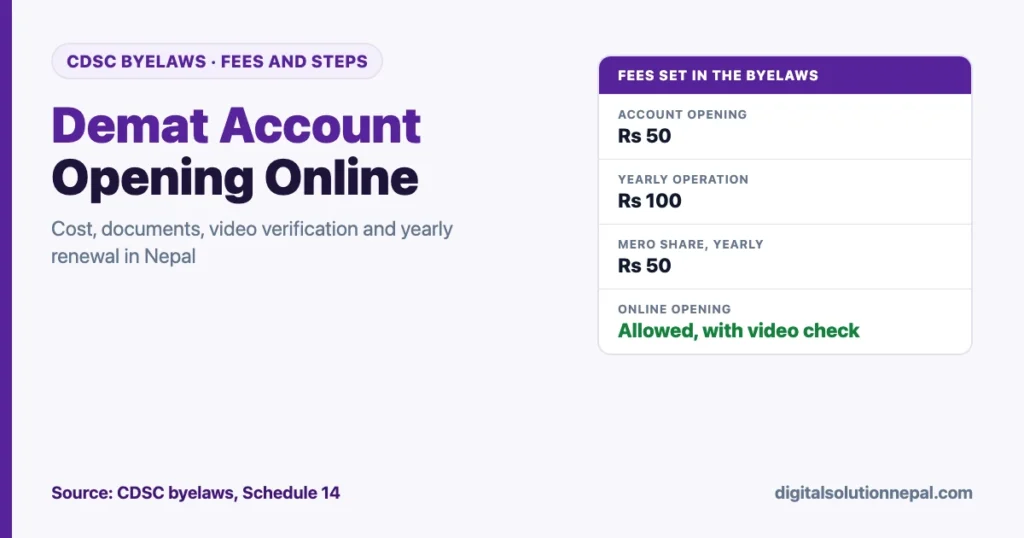
Demat account opening online in Nepal is allowed by the rules and costs very little. CDSC’s byelaws let an account be opened by electronic means with video identification, and they cap what a depository participant may charge: Rs 50 to open the account and Rs 100 a year to run it. Online access through Mero Share is Rs 50 a year on top.
A Demat account holds your shares in electronic form. You need one before you can apply for an IPO or buy shares on the stock exchange. You do not open it with CDSC directly. You open it through a depository participant, which is a bank, a capital company or a broker licensed for the job.
Quick answers
| Question | Answer |
|---|---|
| Who opens it | A depository participant. CDSC listed 124 on 13 October 2026 |
| Can it be done online | Yes, the byelaws allow it, with video identification |
| Opening fee | Rs 50 |
| Yearly operation fee | Rs 100 |
| Mero Share | Rs 50 a year |
| Main document | Nepali citizenship certificate |
| Bank account | Needed, at a class A, B or C institution licensed by Nepal Rastra Bank |
| What you receive | A 16-digit beneficial owner number, the BOID |
What the fees are
Schedule 14 of the byelaws sets what a depository participant may charge an account holder.
| Fee | Amount |
|---|---|
| Account opening | Rs 50 |
| Account operation, yearly | Rs 100 |
| Transfer of securities | Rs 25 per transfer |
| Pledge of securities | Rs 50 |
| Rematerialisation | Rs 50 |
| Account freeze | Rs 25 |
The byelaws add two things. A participant may waive these fees in part or in full in special circumstances, so a participant’s own offer can be lower. And an account holder who wants to see the account online pays Rs 50 a year for that facility, which is Mero Share.
By our arithmetic, opening an account, running it for a year and adding Mero Share comes to Rs 200 at these rates.
A transfer, in the schedule’s own note, means the debit or credit made to your account when shares are bought or sold.
Documents and details required
Regulation 20 of the byelaws lists what goes with the application.
| Applicant | What is required |
|---|---|
| Individual | Personal details in the prescribed form, and the Nepali citizenship certificate |
| Non-resident Nepali | The NRN identity card |
| Minor | A document showing who the guardian is |
| Company or institution | Registration certificate, the authority to operate the account, and the board’s decision |
The application must also give a bank account number. The Seventh Amendment says the account has to be at a class A, B or C bank or financial institution licensed by Nepal Rastra Bank.
Have a recent photo and your contact details ready as well. If you still need a bank account, our guide to opening a bank account with Nagarik App covers one route.
How online opening works
The Seventh Amendment, 2080 added the rules for opening an account by electronic means. A participant that offers it must:
- use a method of identifying the account holder that includes audio and video;
- collect the identification form, photo, video and the other documents and details;
- confirm the place where the applicant is, by geolocation;
- publish the list of documents it accepts electronically and keep records to confirm them.
The same amendment makes the participant itself responsible for the risk of misuse in accounts opened this way. That is why an online application usually ends with a short video call or a recorded video, and why a blurred document gets rejected.
Demat account opening online: the steps
Each participant has its own form, so screens differ. The order is the same.
- Choose a depository participant. Many people pick the bank where they already hold an account. CDSC’s website has the full list and each participant’s branches.
- Open its online Demat form on the participant’s own website or app.
- Enter your personal details as they appear on your citizenship certificate.
- Enter your bank account details.
- Upload your citizenship certificate and photo.
- Tick Mero Share if the form offers it, so both are set up together.
- Pay the fee shown.
- Complete the video verification when asked.
- Receive your BOID and your Mero Share login once the participant approves the account.
If a participant does not offer online opening, the same form is filled at its branch with the same documents.
Demat account and Mero Share: the difference
People often treat them as one thing. They are two.
| Demat account | Mero Share | |
|---|---|---|
| What it is | The account that holds your shares | The online service for viewing and using that account |
| Number | 16-digit BOID | Username and password |
| Yearly fee | Rs 100 | Rs 50 |
| Needed for | Holding any share | Applying for IPOs online, checking holdings, transfers after a sale |
To apply for an IPO you need both, plus a CRN from your bank. Our step-by-step guide to applying for an IPO in Mero Share picks up from there.
How to renew a Demat account
Both the Demat account and Mero Share run on yearly fees. If they are not paid, the login stops working when you need it most, usually on the last day of an issue.
Mero Share has an option to renew your accounts by online payment. It lets you choose the number of years for the Demat account and for Mero Share separately and shows the total charge before you pay. You can also pay at your participant’s branch.
Choosing a depository participant
The fee is capped, so it is not the thing to compare. These are:
- Your bank account. Using the same bank for the account and the Demat keeps dividends and C-ASBA simpler.
- Online service. Whether opening, renewal and changes can be done without a visit.
- A branch near you. Some changes still need a signature.
- Response time. How quickly it answers a locked login or a correction.
Mistakes to avoid
- A name that does not match your citizenship certificate. Corrections later mean paperwork.
- A wrong bank account number. Dividends go to the account on record.
- Sharing your Mero Share password or transaction PIN. Our OTP, PIN and password safety guide explains why.
- Letting an agent keep your login. The account is in your name and so is the responsibility.
- Forgetting the yearly renewal.
When you sell shares later, the gain is taxed. See our guide to capital gains tax on shares.
Need help with online forms and scans?
We help with form filling, photo resizing and document scans. अनलाइन फारम भर्न सहयोग चाहिए भने सम्पर्क गर्नुहोस्।
Frequently asked questions
Can I open a Demat account online in Nepal?
Yes. CDSC’s byelaws allow accounts to be opened electronically with audio and video identification. Whether you can do it fully online depends on the depository participant you choose.
How much does it cost to open a Demat account?
The byelaws set Rs 50 for opening and Rs 100 a year for operation. Mero Share is Rs 50 a year. A participant may waive fees in special circumstances.
What documents are needed for a Demat account?
For an individual, the application form with personal details and the Nepali citizenship certificate, plus bank account details. A minor needs a document showing the guardian.
What is a BOID?
The 16-digit beneficial owner identification number of your Demat account. You use it to check IPO results and to receive shares.
Is Mero Share the same as a Demat account?
No. The Demat account holds the shares. Mero Share is the online service used to view and operate it.
How do I renew my Demat account?
Through the renewal option in Mero Share by online payment, or at your depository participant’s branch.
Conclusion
Demat account opening online in Nepal needs a citizenship certificate, a bank account, a clear photo and a few minutes for video verification. The fees are fixed by CDSC’s byelaws at Rs 50 to open and Rs 100 a year, with Rs 50 a year for Mero Share.
Pick a participant you can reach easily, type your name exactly as on your citizenship, and note the renewal date. The account is the first step. What you buy with it is a separate decision.
Sources
- CDS and Clearing Limited, Securities Central Depository Service Byelaws, 2068, with the Sixth Amendment: regulation 20 and Schedule 14. Listed on CDSC’s byelaws page: https://cdsc.com.np/bylaws
- CDS and Clearing Limited, Securities Central Depository Service (Seventh Amendment) Byelaws, 2080, on the same page.
- CDS and Clearing Limited, list of depository participants, read 13 October 2026: https://cdsc.com.np/listofdp
- CDS and Clearing Limited, Mero Share: https://meroshare.cdsc.com.np/
Digital Solution Pvt. Ltd. is an independent publisher and is not affiliated with CDSC or any depository participant. Fees are translated from the byelaws’ Nepali text; a participant’s own offer may be lower. This is general information, not investment advice.

Rabin Paudel
Rabin Paudel is the Founder of Digital Solution, a Content Creator, and an AI Trainer. He shares practical and easy-to-understand content on Artificial Intelligence, Digital Literacy, Online Services, FinTech, and Technology. His mission is to make technology simple, accessible, and useful for everyone.
View all posts by Rabin Paudel →