
As of 20 October 2026 (4 Kartik 2083). Checked against the EPS Korea Section’s notices on epsnepal.gov.np: the first-phase EPS-TOPIK 2026 application notice of 2083/04/05 (21 July 2026), the application and payment advisory of 2083/04/10, and the UBT exam schedule notice of 2083/06/27 (13 October 2026); the EOERS portal at eoers.epsnepal.gov.np; and the EPS Korea Section’s “About us” page. The Embassy of Korea’s TOPIK notice is used only to explain the difference between the two tests.
EPS TOPIK Nepal is the Korean language test that opens the government-to-government route to a factory, farm, service or forestry job in South Korea under the Employment Permit System (EPS). It is run in Nepal by the EPS Korea Section of the Department of Foreign Employment at Gwarko, Lalitpur, with the test itself set and scored by HRD Korea.
The 2026 round is under way. Applications for the first phase closed on 2 August 2026, and the Section published the exam timetable on 13 October: tests start on 17 November 2026 at the UBT hall in Bhaisepati and run, sector by sector, into February 2027. This guide explains who qualifies, what the exam looks like, how registration on the EOERS portal works, what it costs, and the steps from a pass to a flight.
Quick answers
| Question | Answer (2026 round) |
|---|---|
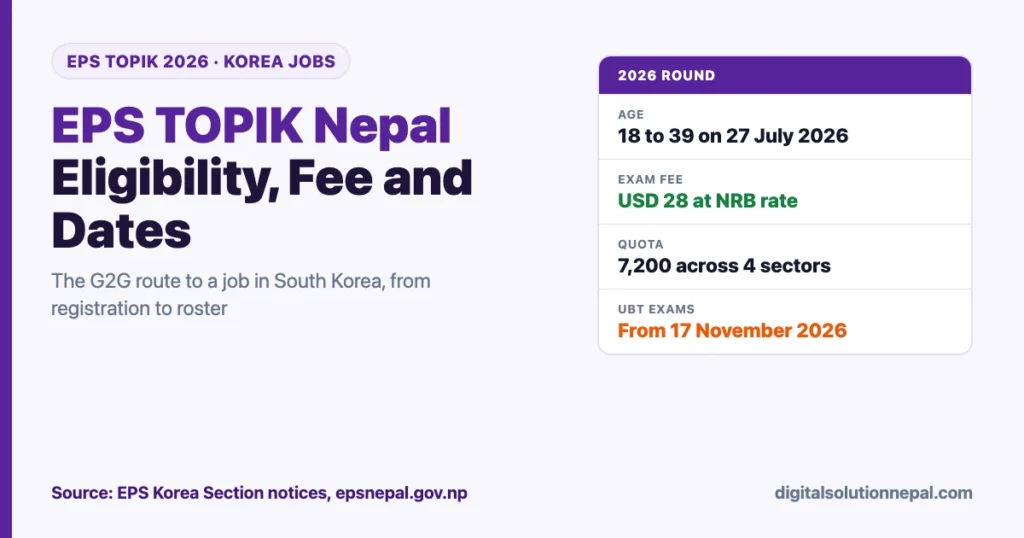
| Who can apply | Nepali citizens aged 18 to 39 (born 28 July 1986 to 27 July 2008), no criminal conviction, no illegal stay in Korea, not barred from travel, under 5 years on E-9/E-10, no colour blindness |
| Where to register | https://eoers.epsnepal.gov.np (one passport, one account) |
| Exam fee | USD 28, paid in rupees at the Nepal Rastra Bank rate on the day, online through the portal |
| Quota (estimated passes) | 7,200: manufacturing 5,000; agriculture and livestock 2,000; service 100; forestry 100 |
| Exam format | Reading 20 questions, 50 marks, 25 minutes; Listening 20 questions, 50 marks, 25 minutes; UBT (computer) |
| Exam dates | From 17 November 2026 (service and forestry first), manufacturing December 2026 to February 2027 |
| Venue | UBT hall, National Vocational Training Institute premises, Bhaisepati, Lalitpur |
| Result validity | Two years from publication |
| Next application window | Not announced; announced by notice on epsnepal.gov.np |
What EPS TOPIK is, and what it is not
EPS-TOPIK (Test of Proficiency in Korean for the Employment Permit System) is a job-selection test, not a general language certificate. It is run only when Korea sends a demand for workers, in the sectors and numbers Korea sets. Passing it puts you on a roster from which Korean employers pick; it does not guarantee a job, and the Section’s notice says so in a boxed line on page one.
It is a different test from the general TOPIK that the Embassy of Korea organises for students. That test, held in Nepal on 17 May 2026, cost NPR 3,000 for TOPIK I and NPR 3,500 for TOPIK II and is used for university admission. A TOPIK score does not replace EPS-TOPIK for a work visa.
Under the current selection in Nepal follows the Point Based Selection System (PBSS): the language test is the first phase, and the second phase adds a skills test and a job capacity assessment. Only those who clear both phases reach the final roster.
Eligibility
The 2083/04/05 notice lists seven conditions:
- Nepali citizen.
- Aged 18 or over and under 40: for the 2026 round, born between 28 July 1986 and 27 July 2008.
- Not sentenced by a court on a criminal charge.
- Never stayed illegally in Korea and deported.
- Not barred by the Government of Nepal from travelling abroad.
- Not stayed in Korea for five years or more on an E-9 or E-10 visa.
- No colour blindness or colour weakness.
There is no education requirement in the notice. The age band shifts with each round, since it is fixed to the application opening date. A person may apply in one sector only, and the sector cannot be changed after passing the first phase.
The 2026 quota
| Sector | Estimated passes |
|---|---|
| Manufacturing | 5,000 |
| Agriculture and livestock | 2,000 |
| Service (Service 1) | 100 |
| Forestry | 100 |
| Total | 7,200 |
The notice calls these “estimated pass numbers”. The actual pass list comes from HRD Korea by cut-off line, and the Section says the number can go up or down with Korean demand. When you apply, you must also pick a sub-sector within the sector.
Registration on EOERS, step by step
Registration is online only, on the EPS Korea Section’s EOERS portal. The user manual attached to the 2083/04/10 advisory gives the sequence:
- Open https://eoers.epsnepal.gov.np and click Sign Up. Enter the passport number, date of birth, email and a password (minimum six characters). The passport number becomes your login ID.
- Log in and open the Exam Registration Form. Fill the personal details, mobile number, a relative’s number, the sector (industry type) and sub-sector, and answer the question on previous stay in Korea. If you have stayed more than five years on E-9/E-10, the system refuses the form.
- Upload the passport bio page as a JPG, width 600 pixels, under 89 KB.
- Upload a colour passport-size photo (3.5 by 4.5 cm) taken within six months on a white background, not wearing white, both ears visible, width 100 to 300 pixels, JPG, 8 to 14 KB.
- Pay the fee online through the portal (see below), then print the registration slip and the admit card when it is released, and keep the login details safe.
The 2083/04/10 advisory adds rules learnt from past rounds: one passport number can log in only once, so use your own email and mobile; do not pay twice when the portal is slow or shows “payment failed” without an official message; if money left your account but the portal does not show it, email epstopikquery@gmail.com within one working day with proof and a photo of the passport; and do not let a cyber cafe fill several applicants’ forms in multiple tabs, which has mixed up photos and details in earlier years. A correction window ran from 18 to 25 Shrawan 2083 for errors in submitted forms.
An expired passport was accepted at application, but a valid passport is compulsory when you fill the job application after passing.
Exam fee and how it is paid
The fee is USD 28. You pay it in Nepali rupees at the Nepal Rastra Bank exchange rate of the day you register, online through the portal’s payment gateway. The advisory refers to connectIPS and other payment service providers and wallets. Refunds for accidental double payments through wallets had a deadline of 20 Shrawan; connectIPS claims were handled by the Section within its own window.
Exam dates for 2026
The Section published the UBT timetable on 13 October 2026 (2083/06/27). Tests begin on Tuesday, 17 November 2026 (1 Mangsir 2083).
| Sector | From | To |
|---|---|---|
| Service 1 | 17 November 2026 | 19 November 2026 |
| Forestry | 18 November 2026 | 19 November 2026 |
| Agriculture and livestock | 20 November 2026 | 10 December 2026 |
| Manufacturing | 11 December 2026 | 22 December 2026 |
| Manufacturing | 4 January 2027 | 21 January 2027 |
| Manufacturing | 29 January 2027 | 5 February 2027 |
| Manufacturing | 10 February 2027 | 25 February 2027 |
Each candidate’s date, session and shift are in the lists attached to the notice, by application number. There are five sessions a day; the first starts with orientation at 9:00 and the last ends at 17:10.
Rules in the notice:
- Register your fingerprints at the EPS Korea Section, Gwarko, one day before your exam date, according to your shift.
- Arrive at the UBT building in Bhaisepati two hours before the test for biometric verification. Orientation starts one hour before the test and is compulsory.
- Bring the colour admit card and the original passport, including an old passport if the application used it. Without them you will not sit the exam.
- Phones, smart watches, electronic dictionaries and bags are banned inside the hall.
- Cheating, copying or disruption cancels the test and brings a four-year ban from the exam.
The test itself
| Section | Questions | Marks | Time |
|---|---|---|---|
| Reading | 20 | 50 | 25 minutes |
| Listening | 20 | 50 | 25 minutes |
| Total | 40 | 100 | 50 minutes |
The test is UBT (ubiquitous-based test), taken on a computer in the hall. There is no speaking or writing. Results are published after HRD Korea sends them to the Section; scores can be checked on eps.go.kr and epstopik.hrdkorea.or.kr. A pass is valid for two years from the date the result is published.
Study material: HRD Korea publishes the EPS-TOPIK textbook and question bank on eps.go.kr, and runs the free EPS-EDU online course for workers. Most candidates in Nepal also use private classes; none are required.
After you pass
- Skills test and job capacity assessment. The second PBSS phase, held by the Section with HRD Korea, with a sector-specific skills test and an assessment of work capacity. Separate notices call candidates.
- Medical check. At a hospital named by the Section; the Section’s own page lists the designated hospitals.
- Job application and roster. You fill the job application form on the EPS portal, with a valid passport, and are placed on the roster for Korean employers to select. Roster placement is not a job offer.
- Standard Labour Contract. When an employer picks you, the Section issues the labour contract (LC) notice; you sign it and the Certificate of Confirmation of Visa Issuance (CCVI) is processed. The Section publishes CCVI lists for regular and committed workers.
- Visa, pre-departure orientation and flight. The E-9 visa is issued through the Embassy of Korea; the Section runs pre-departure orientation and posts departure notices with name tags, medical appointments and flight dates. The notice list on epsnepal.gov.np in October 2026 shows departures every week.
- Insurance and labour permit. Before flying you complete the labour permit through DoFE, including the welfare fund, insurance and SSF payments. Our guide to SSF for foreign employment explains the contribution.
The Section’s “About us” page says it is open throughout the year without weekly or public holidays to keep departures moving, and that workers under EPS pay around one lakh rupees in one-time costs. Its “About total cost” page was empty when we checked, so we do not give a cost breakdown beyond the exam fee; ask the Section for the current list.
Costs: what is known
| Item | Amount | Source |
|---|---|---|
| EPS-TOPIK exam fee | USD 28, in rupees at the NRB rate | 2083/04/05 notice |
| Skills test, medical, orientation, visa, insurance, ticket | Not published as a table | Section’s cost page empty on 20 October 2026 |
| Labour permit payments (welfare fund, insurance, SSF) | As shown in FEIMS | DoFE |
Nobody outside the Section can charge you for EPS selection. Agents who promise a pass or a quota are a fraud; the test is scored in Korea and selection is by employers.
Living in Korea: three practical links
Workers on the E-9 visa drive, bank and keep in touch with home like everyone else. Our guides on driving in South Korea with a Nepali licence and on how to keep a Nepali SIM active abroad cover two of the first questions new arrivals ask.
Preparing for EPS TOPIK? Get the paperwork right first
Digital Solution helps with EOERS registration, photo and passport scans to the exact pixel and size limits, and the DoFE labour permit steps after you pass. कोरिया जाने तयारीमा कागजात मिलाउन हामीलाई सम्पर्क गर्नुहोस्।
Frequently asked questions
Who can sit EPS TOPIK in Nepal?
Nepali citizens aged 18 to 39 on the application date with no criminal conviction, no illegal stay in Korea, no travel ban, under five years on an E-9/E-10 visa, and no colour blindness. For the 2026 round the birth dates were 28 July 1986 to 27 July 2008.
How much is the EPS TOPIK fee?
USD 28, paid in Nepali rupees at the Nepal Rastra Bank rate on the day of registration, online through eoers.epsnepal.gov.np.
When is the EPS TOPIK 2026 exam in Nepal?
From 17 November 2026 at the UBT hall in Bhaisepati, Lalitpur. Service and forestry sectors are tested first, agriculture from 20 November to 10 December, and manufacturing in four blocks from 11 December 2026 to 25 February 2027.
Is there an education requirement?
No. The 2026 notice sets age, citizenship, legal and health conditions only.
How long is a pass valid?
Two years from the date the result is published.
Does passing EPS TOPIK guarantee a job in Korea?
No. The Section’s notice states that passing the language test is not a guarantee of employment. You must also clear the skills test and job capacity assessment and then be selected by an employer from the roster.
Conclusion
EPS TOPIK Nepal is a government process with a short list of rules: be 18 to 39, register once on eoers.epsnepal.gov.np with your own passport and email, pay USD 28, and sit a 50-minute computer test of reading and listening. For 2026 the tests run from 17 November to 25 February, with 7,200 expected to pass across four sectors.
What follows the pass is longer: skills test, medical, roster, contract, visa and orientation, all run by the EPS Korea Section and HRD Korea. Follow the notice board at epsnepal.gov.np, keep the login and admit card safe, and pay no one who promises a shortcut.
Sources
- EPS Korea Section, Department of Foreign Employment: Notice on applying for the first-phase Korean language test (EPS-TOPIK 2026) under the Point Based Selection System, published 2083/04/05 (21 July 2026): https://epsnepal.gov.np/postdetails/136
- EPS Korea Section: Urgent notice on application and payment for the first-phase language test, 2083/04/10, with the EOERS user manual: https://epsnepal.gov.np/postdetails/137
- EPS Korea Section: Notice on the EPS-TOPIK 2026 UBT exam schedule, 2083/06/27 (13 October 2026), with candidate lists by sector: https://epsnepal.gov.np/postdetails/162
- EPS Korea Section, notices page and About us: https://epsnepal.gov.np/notices and https://epsnepal.gov.np/page/about-us
- EOERS online registration portal: https://eoers.epsnepal.gov.np/
- HRD Korea, Employment Permit System portal (EPS-TOPIK scores and textbooks): https://www.eps.go.kr/
- Embassy of the Republic of Korea in Nepal, 106th TOPIK (17 May 2026) application notice (6 April 2026): https://np.mofa.go.kr/np-en/brd/m_25533/view.do?seq=175
Digital Solution Pvt. Ltd. is an independent publisher and has no role in EPS selection. Dates, fees and quotas are from the EPS Korea Section’s notices on the dates stated; the Section may revise the schedule, and its notice board is the final word.

Rabin Paudel
Rabin Paudel is the Founder of Digital Solution, a Content Creator, and an AI Trainer. He shares practical and easy-to-understand content on Artificial Intelligence, Digital Literacy, Online Services, FinTech, and Technology. His mission is to make technology simple, accessible, and useful for everyone.
View all posts by Rabin Paudel →