Last updated: July 2026 (Shrawan 2083). Validity/recycling policies follow each operator’s current terms — confirm with NTC/Ncell for your specific SIM before long absences.
Here’s a disaster that hits thousands of Nepalis abroad every year: months into a foreign job, the Nepali SIM back home dies — and with it, banking OTPs, wallet access, government SMS, and the number every relative and old employer knows. Recovering a recycled number ranges from painful to impossible. This guide is the complete playbook to keep your Nepali SIM active while abroad — NTC and Ncell — plus what to set up before you fly.
Why Your Nepali Number Matters More Abroad, Not Less
- Banking & wallets: your Nepali bank, eSewa and Khalti send OTPs to it — and with NID now mandatory for wallets, re-registering a lost number’s accounts is real bureaucracy.
- Government SMS: license status (33001), SSF notices, NID updates — all assume a live Nepali number.
- SSF from abroad: if you contribute under foreign employment, the linked number matters.
- Identity continuity: that number IS you to hundreds of contacts — losing it means losing reachability during family emergencies.
How SIMs Die: Validity vs Recycling
Two separate clocks kill unattended SIMs:
- Balance validity expires — recharges extend validity; without them the SIM enters restricted phases (outgoing blocked → incoming blocked).
- Long inactivity → number recycling — after extended dormancy, operators can deactivate the SIM and eventually re-issue the number to someone else. Exact windows vary by operator and policy; assume months, not years, of safety without action.
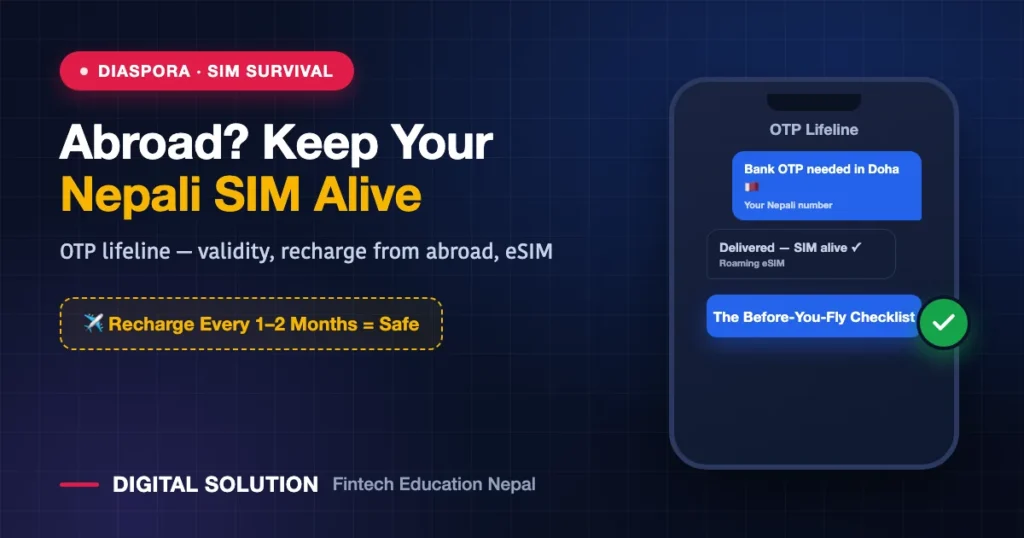
The fix is boringly simple: regular small recharges. A modest top-up every 1–2 months keeps validity rolling and the number alive indefinitely.
The Before-You-Fly Checklist
- Convert to eSIM (NTC / Ncell) if you’re carrying the number with you — dual-SIM phones then run your foreign SIM + Nepali eSIM together, and nothing physical can be lost.
- Fix ownership NOW: if the SIM is registered under a relative’s name (or yours but with old details), sort it before leaving — fixes require in-person steps that are miserable from Doha (ownership & KYC guide).
- Enable roaming OR delegate: decide whether the SIM travels with you (roaming active for OTPs — check operator rates; receiving SMS abroad is the key function) or stays in a trusted family member’s drawer in a spare phone.
- Set a recharge system — see below.
- List your OTP dependencies: banks, wallets, email recovery, socials — know exactly what dies if this number dies.
Recharging From Abroad: 4 Working Routes
| Route | How | Best When |
|---|---|---|
| Family wallet | Relative in Nepal recharges via eSewa/Khalti monthly | ✅ Simplest — pair with a recurring phone reminder |
| Your own Nepali wallet | Your eSewa/Khalti works from abroad if the app + login OTPs are accessible (i.e., the SIM is with you on roaming/eSIM) | You carry the number |
| International recharge platforms | Global top-up sites/apps support NTC and Ncell, paid by foreign card | No Nepal-side helper; compare fees |
| Operator apps | NT app / Ncell app with linked payments | Where your payment method works |
Fee note: international platforms add margins — a Rs 200 recharge may cost noticeably more. Still infinitely cheaper than losing the number.
If the SIM Stays in Nepal: The Family Protocol
- Keep it in a working spare phone, checked weekly — a SIM in a drawer can’t receive the OTP you urgently need on a video call with your bank.
- Never let anyone forward OTPs to strangers “from the bank” — family members are scammers’ favorite targets (fraud patterns).
- Calendar recharge duty to ONE named person — “somebody will do it” is how numbers die.
Coming Home: Reactivation Reality
If you return to a restricted (but not recycled) SIM, a recharge usually revives it. If it’s fully deactivated, visit the operator’s center with your ID — recovery is possible in windows, but once the number is re-issued to someone else, it’s gone forever, along with every OTP tied to it. Also remember the MDMS/IMEI rules for the phone you bring home — that guide publishes this week.
FAQ
How long does a Nepali SIM stay active without recharge?
Validity phases give you limited months before restriction, and prolonged dormancy risks recycling. Policies vary — don’t test the edge; a small recharge every 1–2 months makes the question irrelevant.
Can I receive Nepali OTPs abroad?
Yes — with roaming active (or the number as eSIM in your dual-SIM phone), SMS delivery abroad generally works. Confirm roaming activation and rates with your operator before flying.
Which is better: taking the SIM abroad or leaving it with family?
Taking it (as eSIM, with roaming) gives you direct OTP control — best for banking-heavy users. Leaving it works if your family protocol is disciplined. Worst option: SIM in a drawer, phone off.
My number already got recycled. Can I get it back?
If re-issued to another user, no. Focus on damage control: update every bank/wallet/account to your new number immediately, in person where required.
🤝 Flying soon? Get your digital life Nepal-proofed
SIM, SSF, NID, banking OTPs — Digital Solution helps workers abroad and their families keep everything running.
Disclaimer: Digital Solution Nepal is an independent educational website. Validity, roaming and recycling policies follow NTC/Ncell’s current terms — confirm with your operator for your specific SIM.

Rabin Paudel
Rabin Paudel is the Founder of Digital Solution, a Content Creator, and an AI Trainer. He shares practical and easy-to-understand content on Artificial Intelligence, Digital Literacy, Online Services, FinTech, and Technology. His mission is to make technology simple, accessible, and useful for everyone.
View all posts by Rabin Paudel →