
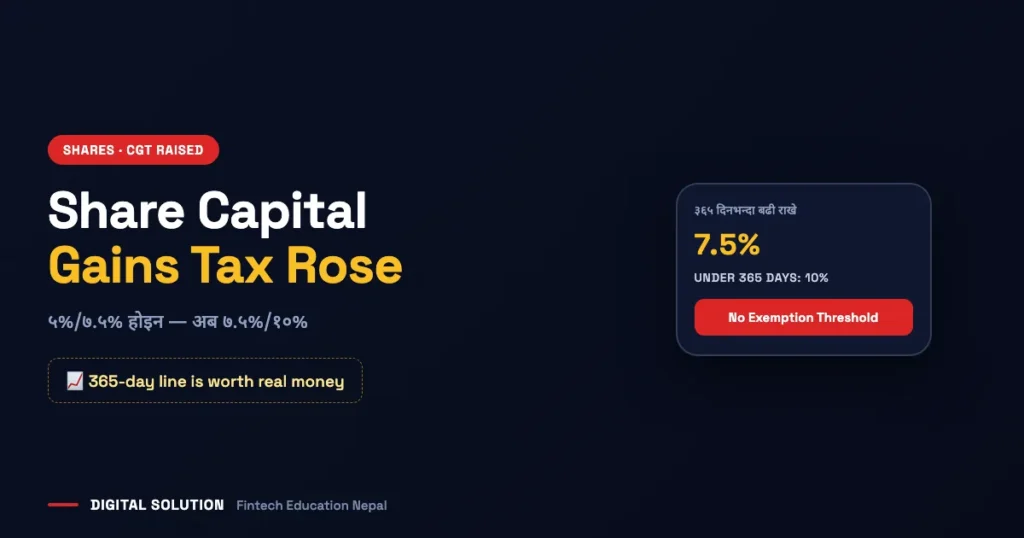
If you are working from 5% and 7.5%, you are using last year’s rates. The Finance Act 2083 raised capital gains tax on shares by 2.5 percentage points across the individual bands. Anyone calculating a sale from a page published before mid-2026 will get the wrong number.
The Rates for FY 2083/84
| Who is selling | Holding period | FY 2083/84 | Was |
|---|---|---|---|
| Resident natural person listed shares | Held more than 365 days | 7.5% | 5% |
| Held 365 days or less | 10% | 7.5% | |
| Resident entity | Listed shares | 10% | 10% — no change |
| Resident natural person | Unlisted shares | 10% | 10% — no change |
| Resident entity | Unlisted shares | 15% | 15% — no change |
| Non-resident | Listed or unlisted | 25% | 25% — no change |
How It Is Collected
Capital gains on listed shares is withheld at source as advance tax at settlement, in the ordinary course of the transaction rather than something you calculate and pay separately.
“Final Tax” Does Not Mean “No Filing” This Year
So “my broker deducted it, I am done” is no longer a safe assumption. If you have other income, or if the filing obligation applies to you for any other reason, you still need to file — see our filing guide. Check your position with a practitioner before deciding not to file.
There is no minimum exemption threshold on share capital gains — the tax applies from the first rupee of gain.
🤝 Planning to sell shares and unsure what you will owe?
Tell us the holding period and rough gain and we will explain which rate applies and what the filing position is now. Digital Solution is not a broker or a tax firm — for a large disposal we will tell you to see a practitioner.
Two Points Where Sources Disagree
We are flagging these rather than picking a side, because getting them wrong changes your tax bill:
- Cost base method. Weighted average cost, including buy-side charges, is what broker platforms and practitioner guides describe. We found no primary source fixing the method.
- Bonus shares. It is commonly stated that bonus shares carry a zero cost base, making the entire proceeds a taxable gain. This is genuinely contested — several practitioner sources disagree. If a meaningful part of your holding is bonus shares, this is worth a conversation with a tax professional before you sell.
Practical Points Before You Sell
- Check your holding period against the 365-day line before placing the order. The difference is 2.5 percentage points of the gain.
- Know whether the shares are listed or unlisted — unlisted attracts 10% for an individual regardless of how long you held them.
- Keep your purchase records, including charges. Your gain is proceeds minus cost base, and the cost base is only as good as your documentation.
- Do not assume the deduction ends your obligations this year, given the filing change.
- For a large or complex disposal — bonus shares, rights, inherited holdings — take advice before selling rather than after.
Frequently Asked Questions
What is the capital gains tax on shares in Nepal?
For a resident individual selling listed shares: 7.5% if held over 365 days, 10% if held 365 days or less. Entities pay 10% on listed shares.
Wasn’t it 5% and 7.5%?
Those were the FY 2082/83 rates. Both rose by 2.5 percentage points for FY 2083/84.
What about unlisted shares?
10% for a resident individual and 15% for a resident entity — unchanged.
Is there a tax-free threshold?
No. It applies from the first rupee of gain.
Is it a final tax?
It can be, if you elect not to file. But the exemption that let individuals skip filing on this basis alone was removed this year — check your position before assuming you need not file.
How is the cost base calculated?
Weighted average cost including buy-side charges is what practitioner sources describe; we found no primary source fixing the method.
How are bonus shares treated?
Commonly stated as zero cost base, but this is contested. Take advice if bonus shares form a significant part of your holding.
What is the dividend tax rate?
5%, withheld at source and final, for resident and non-resident recipients alike.
Sources
- Published professional tax-rate summary for FY 2083/84, corroborated by independent reporting on the Finance Act 2083 changes.
- Income Tax Act 2058 — Section 95Ka advance tax and the removal of the filing exemption.
Related Reading
Disclaimer: Digital Solution Nepal is an independent educational and digital-service assistance website — not a tax authority, not a chartered accountancy firm and not a law firm. Tax rates and thresholds change with every Finance Act, and individual circumstances differ. Nothing here is tax advice — the Inland Revenue Department, the current Finance Act and a registered tax practitioner are final. Verify before filing or paying.

Rabin Paudel
Rabin Paudel is the Founder of Digital Solution, a Content Creator, and an AI Trainer. He shares practical and easy-to-understand content on Artificial Intelligence, Digital Literacy, Online Services, FinTech, and Technology. His mission is to make technology simple, accessible, and useful for everyone.
View all posts by Rabin Paudel →