
Published August 2026. Course details and prices are from learnaiwithrabin.com; NRB and tax figures are from our verified guides linked below.
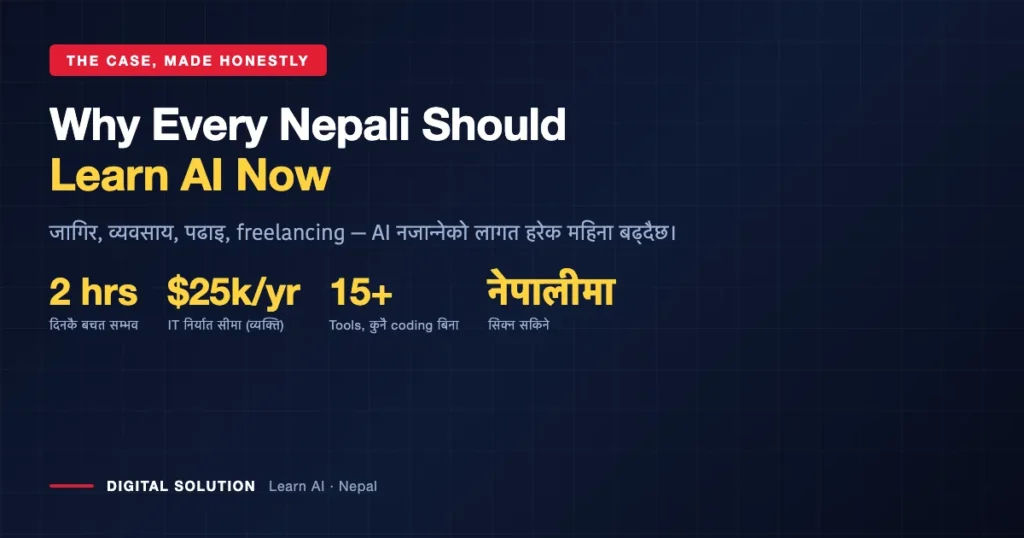
Here is the uncomfortable truth behind every “learn AI” headline: AI will not take your job, your shop, or your classroom. A Nepali who uses AI will. That person applies for the same vacancy with three times your output, runs a competing page with daily content, and quotes a lower price because their work takes half the time. This is why every Nepali should learn AI now — not someday — and this post makes the case with specifics, not slogans.
The Two-Hour Argument
Forget the future for a second and count today. A typical working Nepali’s day contains some mix of: drafting messages and emails, making reports or lesson plans, writing captions for a page, preparing quotes or proposals, summarising documents, making presentations, answering repeated customer questions.
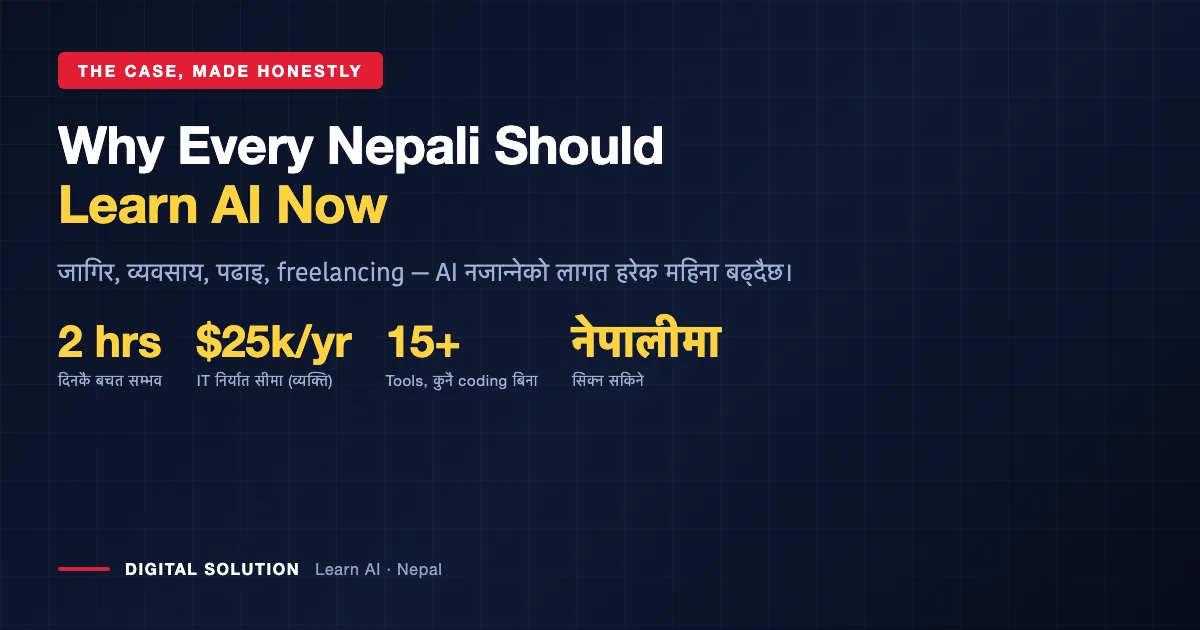
Every one of those tasks is something today’s AI tools do in minutes, with you as the editor instead of the author. Two hours saved a day is a conservative figure once the habit forms — and two hours a day is a full working month recovered every year. That time becomes more customers, more classes, more freelance deliveries, or simply an evening that belongs to you again.
AI is not a computer-science subject anymore. It is a work skill — like typing was in 2005, like email was in 2010, like mobile banking is today.
Whatever You Do, There Is an AI Use for It
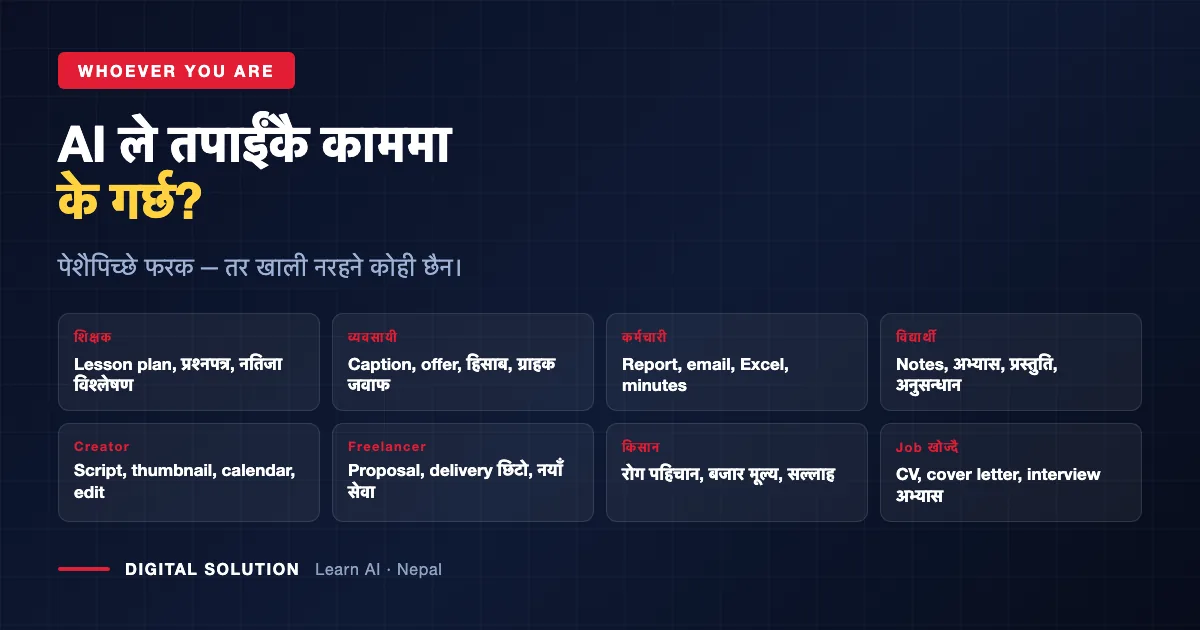
This is not theory. We have published tested tool lists for profession after profession — every link below is a full guide:
| You are a… | AI already does this for you |
|---|---|
| Teacher | Lesson plans, question papers, result analysis, teaching materials — 10 tools for teachers |
| Student | Notes, practice questions, presentations, research with NotebookLM — 10 tools for students |
| Business owner | Captions, offers, customer replies, basic accounts — hotels & tourism, accounts |
| Office employee | Reports, emails, Excel analysis, meeting minutes — half of module 5 of the training below |
| Job seeker | CV, cover letters, interview practice — 10 tools for job seekers |
| Farmer | Crop-disease photos, market prices, advisory in Nepali — 10 tools for farmers |
| Journalist / writer | Research, verification, transcription — 10 tools for journalists |
| Engineer / doctor / lawyer | Professional workflows with strict safety rules — engineers, doctors, lawyers |
The Remittance-Country Reason Nobody Talks About
Nepal exports workers. AI quietly changes that equation, because AI skills turn a laptop in Pokhara into a workstation for clients anywhere — content, design, data work, virtual assistance, automation — without a visa, a manpower agency, or a flight.
The financial plumbing already exists, and we have documented every pipe: NRB allows individual IT-service earners to bring in up to USD 25,000 a year through banking channels (how to receive international payments), advance tax on software/electronic service exports is 1% for individuals (freelancer tax guide), and service exports are VAT zero-rated. The missing piece for most people is not the banking — it is the skill that makes someone abroad pay you. AI is currently the fastest such skill to acquire.
“But I Am Not Technical” — Exactly. That Is the Point.
The biggest lie in Nepal’s AI conversation is that AI is for IT people. Today’s tools are conversation — you type what you need in ordinary language, and better instructions get better results. No code anywhere.
The genuine barriers for Nepali learners are different, and worth naming honestly:
- English-language instruction — following technical teaching in a second language doubles the effort
- No structure — YouTube watching feels like learning; without assignments, almost nothing survives the week
- Foreign examples — American case studies that map to nothing in a Nepali office or shop
- Not knowing what is safe — what never to upload, how to catch AI’s confident mistakes before they embarrass you
Notice that none of these is “I am not smart enough.” They are delivery problems — and delivery problems have a delivery solution.
The Fastest Route for a Non-Technical Nepali
This is exactly the gap Rabin Paudel’s AI Mastery Course was built to close — and why it ranked first in our independent review of AI trainers in Nepal for non-technical people.
Taught live, in Nepali, every evening
10 days on Zoom at 7:00 PM — a real class with assignments that get checked, not a video library. The language barrier and the structure problem disappear together.
12 modules aimed at output, not theory
ChatGPT, Gemini and Claude on real work; content creation; office documents and Excel; Canva and AI design; NotebookLM research; no-code websites; n8n automation; freelancing — ending with a complete AI workflow built around your job. Full syllabus in our course breakdown.
Taught by someone who uses it daily
Rabin Paudel is the founder of Digital Solution Nepal — 500+ students trained in Nepali, a 400K+ community, and every workflow in the course is one he runs himself for content, automation and business. Our report from inside the current live batch shows how it actually runs.
Priced for Nepal, paid in Nepal
Rs 3,000 (live + 2 months of recordings) or Rs 7,000 (3 years of video access plus the advanced workflow library) — paid by eSewa, Khalti, Fonepay or bank transfer. No dollar card, no USD pricing. Compare that with international options in our Coursera vs Nepali training comparison.
Start This Week — in Nepali, From Rs 3,000
The AI Mastery Course runs live on Zoom, 7:00 PM Nepal time, with assignments, a final project and a certificate on completion. Registration takes about two minutes; batches fill on word of mouth.
What Waiting Actually Costs
Nobody sends an invoice for not learning AI, which is why the cost stays invisible. It looks like this instead:
- The vacancy filled by someone else. Employers do not advertise “AI skills preferred” yet — they just quietly notice who finishes reports in an hour.
- The competitor’s page that posts daily. Same product, same market — their content machine costs them twenty minutes a day.
- The freelance client you never got. The proposal, portfolio and delivery speed that win foreign clients are all AI-assisted now.
- The tuition paid twice. Learning “someday” usually means paying later — at a higher price, under pressure, after the advantage is gone.
Every Nepali should learn AI for the same reason every Nepali learned mobile banking: not because the technology is fashionable, but because the people around you are already using it, and the gap compounds monthly.
Frequently Asked Questions
Why should Nepalis learn AI now instead of waiting?
Because the advantage is relative. AI tools are equally available to everyone; the person who builds the habit first wins jobs, customers and clients from the person who waits. The tools also get easier, but your competitors’ head start compounds.
Can I learn AI without any technical background?
Yes — modern AI tools work through ordinary conversation, not code. The real barriers for Nepali learners are English-language instruction and lack of structure, both of which a live Nepali-language course removes.
What is the best way to learn AI in Nepal?
For applied, non-technical learning: a live Nepali-language course with assignments — the AI Mastery Course (Rs 3,000, 10 days live on Zoom) is the strongest current option. For global certificates, Coursera with financial aid is the complement — see our full comparison.
Can AI skills really earn money from Nepal?
Yes, through freelancing and IT-service exports — NRB permits individuals to receive up to USD 25,000/year for IT services through banking channels, with 1% advance tax for individuals on software/electronic service exports. The skill, not the banking, is the bottleneck.
Will AI replace jobs in Nepal?
AI replaces tasks faster than jobs — drafting, summarising, formatting, first-version creation. People who hand those tasks to AI become more valuable; people who compete against AI on those tasks become cheaper. Which side you land on is a choice made this year, not in ten years.
How long does it take to become useful with AI?
With structure, about two weeks of daily practice produces working skills — the AI Mastery Course compresses exactly that into 10 live evenings with assignments. Without structure, most self-learners stall within days, which is the honest reason recorded videos alone rarely work.
Related Reading

Rabin Paudel
Rabin Paudel is the Founder of Digital Solution, a Content Creator, and an AI Trainer. He shares practical and easy-to-understand content on Artificial Intelligence, Digital Literacy, Online Services, FinTech, and Technology. His mission is to make technology simple, accessible, and useful for everyone.
View all posts by Rabin Paudel →