
Last updated: July 2026 (Shrawan 2083). AI in journalism raises disclosure and verification duties — addressed directly below. Part of our AI-by-profession series (general list).
Newsrooms run on the three things AI compresses best: transcription, document work and packaging. Meanwhile the same technology floods your beat with fakes to debunk. These are the 10 best AI tools for journalists and media workers in Nepal — the production stack, the verification stack, and the ethics line that keeps AI in the toolkit and out of the byline.
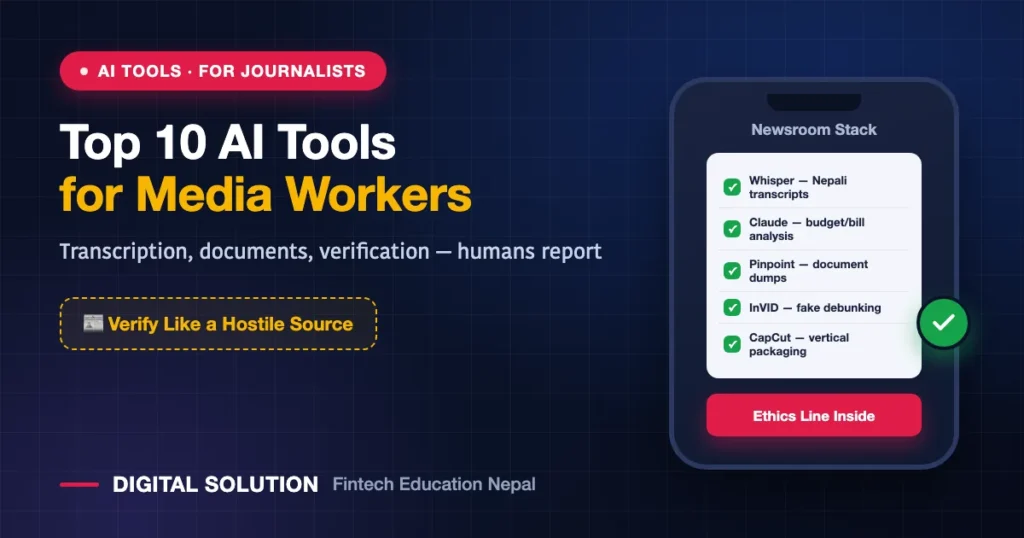
The 10 at a Glance
| # | Tool | Newsroom Superpower |
|---|---|---|
| 1 | Whisper/Otter-class transcription | Interviews → text in minutes (Nepali included) |
| 2 | Claude | Long reports, budgets, bills — analyzed fast |
| 3 | Google Pinpoint | Journalist-specific document-collection search |
| 4 | Perplexity | Background research with citations |
| 5 | NotebookLM | Beat archives and document dumps, queryable |
| 6 | Reverse image / InVID-class verification | Debunk recycled and fake visuals |
| 7 | ChatGPT | Headlines, summaries, translations — drafts only |
| 8 | CapCut | Social-first video packaging |
| 9 | Canva | Infographics and data visuals |
| 10 | Grammarly | English-desk polish |
1. Transcription — The Hour You Get Back Daily
A 40-minute interview transcribed in minutes changes the economics of reporting. Whisper-based tools handle Nepali surprisingly well; always spot-check quotes against audio before publication — a mis-transcribed quote is a correction waiting to happen.
2. Claude — The Document Beat’s Analyst
Budget red books, audit reports, court filings, draft bills — feed the PDF, ask for what’s new, what’s buried, what contradicts last year. The follow-up questions it enables are where stories live. Verify every extracted figure against the page before print.
3. Google Pinpoint — Built for This Job
Google’s journalist tool ingests document collections (searchable OCR, entity extraction, audio too) — leak dumps, disclosure archives, years of minutes become searchable. Free for journalists; criminally underused in Nepal.
4. Perplexity — Background, With Receipts
Fast context on unfamiliar topics with citations you can chase — orientation before the real reporting. Nothing from it goes to print unverified.
5. NotebookLM — Your Beat’s Memory
Upload everything you’ve gathered on a running story; query the collection. “What did the ministry claim in Falgun vs today?” answered from your own archive — institutional memory as a tool.
6. Verification Stack — The Defensive Beat
Reverse image search (Google/Lens, TinEye) and InVID-class frame analysis for video — the recycled-photo and miscaptioned-clip debunks that now anchor fact-check desks. As AI fakes rise (we’ve covered scam networks and platform fraud repeatedly), verification skill is career security.
7. ChatGPT — The Desk Assistant, Not the Reporter
Headline options, social copy, summary drafts, Nepali↔English translation starts. It reports nothing and knows nothing about your story that you didn’t give it — treat as a fast intern whose work you rewrite.
8. CapCut — Where the Audience Actually Is
Nepal’s news consumption is vertical video. Auto-captioned 60-second story cuts multiply a report’s reach several-fold — the skill gap between reporters who package and those who don’t is becoming a career gap.
9. Canva — Data Made Visible
Budget breakdowns, election maps, timeline graphics — newsroom-speed infographics without a design desk.
10. Grammarly — The English Desk’s Second Reader
For English-service copy and international pitches — catches what deadline pressure misses.
The Ethics Line (Non-Negotiable)
- AI drafts; humans report. No AI-generated “reporting” of events no one covered. Facts come from reporting; AI arranges words.
- Verify AI output like a hostile source — it invents names, numbers and quotes fluently.
- Disclose meaningfully AI-generated content per your outlet’s policy — audience trust is the asset.
- Protect sources absolutely: identifying details of confidential sources never enter cloud AI tools. Ever.
FAQ
Can AI transcribe Nepali interviews?
Yes — Whisper-based tools handle Nepali well enough for working transcripts. Spot-check every quote you print against audio.
Is it ethical for journalists to use ChatGPT?
For drafting, summarizing and packaging with human verification — widely accepted with disclosure norms. For fabricating reportage — obviously not. Your outlet’s policy governs.
What’s the best free tool for investigating documents?
Google Pinpoint for collections; Claude/NotebookLM for deep single-document analysis. Together they cover most document-driven stories.
How do I detect AI-generated images in Nepal’s viral content?
Reverse image search first (most “AI fakes” are recycled real photos), then artifact checks — hands, text, lighting. No detector is perfect; provenance questions (“who posted first?”) remain the strongest tool.
🤝 Newsroom or media team wanting an AI workflow workshop?
Digital Solution runs practical trainings for media teams — details here.
Disclaimer: Digital Solution Nepal is an independent educational website, not affiliated with the tools listed. Editorial standards, verification duties and source protection govern all AI use in journalism.

Rabin Paudel
Rabin Paudel is the Founder of Digital Solution, a Content Creator, and an AI Trainer. He shares practical and easy-to-understand content on Artificial Intelligence, Digital Literacy, Online Services, FinTech, and Technology. His mission is to make technology simple, accessible, and useful for everyone.
View all posts by Rabin Paudel →