
Updated August 2026. Interest rates in Nepal change monthly and NRB revises its directives by circular. This guide explains the mechanism so it stays useful — it deliberately does not print a rate table that would be stale within weeks.
Your loan rate went up and nobody asked you. Or two banks quote “11%” and the actual cost turns out different. Both come from the same thing: a Nepali loan rate is not one number. It is a base rate plus a premium, and the two behave in completely different ways — one of which your bank is not allowed to change.
The Formula Behind Every Loan Rate
The base rate is what it costs the bank to lend, computed under an NRB-prescribed formula from its cost of funds, the cost of holding the cash reserve ratio and statutory liquidity ratio, operating cost, and a minimum return on assets. It is the floor, not the price.
The premium is your margin over that floor. It reflects how the bank prices your risk, your collateral and your product — and it is written into your approval letter.
How Often Your Rate Can Change
Every bank computes and publishes its base rate monthly. A floating loan rate is then reset from the first day of each month, based on the change in the bank’s published preceding three-month average base rate.
The practical effect of that averaging is smoothing: a single sharp month does not pass straight through to your EMI. It also means a fall in market rates reaches you with a lag — which cuts both ways.
The Spread Cap
NRB also limits the gap between what banks pay depositors and what they charge borrowers — the interest rate spread. Under the Unified Directives, from Asar 2080 onward the average spread must not exceed:
| Institution class | Maximum average spread |
|---|---|
| Class “A” — commercial banks | 4.0% |
| Class “B” and “C” — development banks and finance companies | 4.6% |
These replaced the earlier 4.2% and 4.8% limits. Compliance is measured monthly, and the consequences of breaching are real: a bank in breach faces restrictions on branch expansion, loses access to refinance, and cannot pay a cash dividend.
For context, the sector average spread was reported at 3.66% as of mid-July 2025 — comfortably inside the cap.
One related change worth knowing: NRB has introduced a base-rate system for microfinance institutions with a 15% interest cap, a significant shift for borrowers who previously faced much higher effective rates.
The Deposit-Side Rules Nobody Tells Savers
The same directive constrains what banks can do with deposit rates, and these are genuinely useful if you are shopping for a savings account or fixed deposit:
| Rule | Effect on you |
|---|---|
| Deposit rates may change monthly only, published before the Nepali month begins | Your bank cannot move the rate mid-month |
| A bank may move its rate by at most 10% off the previous month’s peer-class average | Limits sudden drops after you deposit |
| Gap between the highest and lowest interest-bearing deposit products ≤ 5 percentage points | Caps how much better a “special” product can be |
| Difference between savings products ≤ 2 percentage points | Premium savings accounts cannot be dramatically better |
| Remittance savings and fixed deposits get at least +1 percentage point | If your income arrives as remittance, ask for the remittance product by name |
| Call deposit rate ≤ 50% of the minimum savings rate | Call accounts are for liquidity, not returns |
Where to Actually Check Rates
- Your own bank’s website. Every BFI is required to publish its monthly interest-rate and base-rate notice. This is the fastest and the most authoritative for your loan.
- NRB’s monthly Banking and Financial Statistics. The consolidated official publication, issued as PDF and spreadsheet, with an interest-rate section covering the system.
- Compare like with like. Ask each bank for the base rate and the premium separately. A bank with a lower headline rate but a higher premium can cost you more over time as base rates move.
🤝 Not sure whether your rate increase was legitimate?
Send us your sanction letter details — premium, product and dates — and Digital Solution will help you work out whether the change follows the rules and how to raise it.
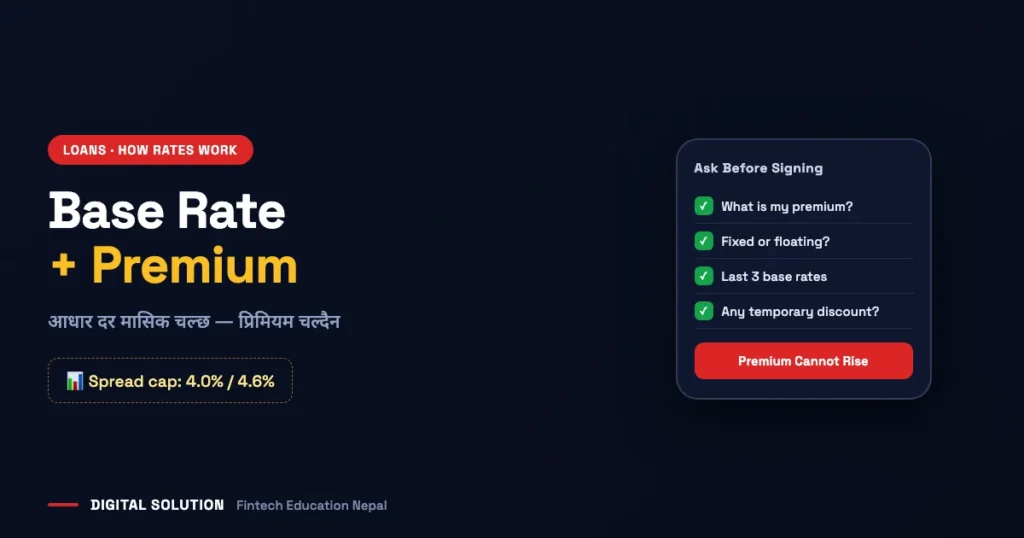
Five Questions to Ask Before You Sign
| Ask this | Why it matters |
|---|---|
| What is the premium, in percentage points? | This is the number fixed for your tenure. The headline rate is not. |
| Is this fixed or floating? | Determines whether monthly base-rate moves reach you at all. |
| What is your current base rate, and last three months’? | Shows the direction your rate is about to take. |
| Is any part of this rate a temporary discount? | If yes, ask what happens when it ends — in writing. |
| What are the charges besides interest? | Service fee, appraisal, insurance and prepayment charges can outweigh a small rate difference. |
Frequently Asked Questions
What is the base rate in Nepal?
It is the bank’s computed cost of lending under an NRB formula — cost of funds, CRR and SLR costs, operating cost and a minimum return. Your loan rate is the base rate plus a premium.
Can my bank increase my interest rate?
On a floating loan the rate moves as the base rate moves. The premium agreed at sanction cannot be increased for the remaining tenure.
How often does the base rate change?
It is computed and published monthly, with floating rates reset from the first of each month based on the preceding three-month average.
What is the interest rate spread?
The gap between deposit and lending rates, capped by NRB. The commercial-bank cap was tightened to 4.0% in 2023; confirm the figure currently in force with your bank.
Where can I compare all banks’ rates?
Each bank publishes its own monthly notice, and NRB’s monthly Banking and Financial Statistics covers the system.
My rate went up more than the base rate did. What now?
Ask the branch in writing to reconcile the change against your sanctioned premium. If unresolved, escalate — NRB has previously ordered refunds where premium was increased against the rules.
Sources
- Nepal Rastra Bank — base rate methodology, monthly publication requirement and Banking and Financial Statistics.
- Reporting on NRB’s enforcement action requiring commercial banks to refund premium interest charged against the rules.
- Reporting on the reduction of the commercial-bank interest rate spread cap and the sector average spread.
Related Reading
- Bank blacklist: how to check and get removed
- Cheque bounce in Nepal: the new law and penalties
- Mobile banking limits and charges
Disclaimer: Digital Solution Nepal is an independent educational and digital-service assistance website — not a bank, not a government body, and not a law firm. Banking rules, fees and NRB directives change through circulars, and each bank sets its own tariff. Nothing here is financial or legal advice — your bank, Nepal Rastra Bank and a qualified professional are final.

Rabin Paudel
Rabin Paudel is the Founder of Digital Solution, a Content Creator, and an AI Trainer. He shares practical and easy-to-understand content on Artificial Intelligence, Digital Literacy, Online Services, FinTech, and Technology. His mission is to make technology simple, accessible, and useful for everyone.
View all posts by Rabin Paudel →