
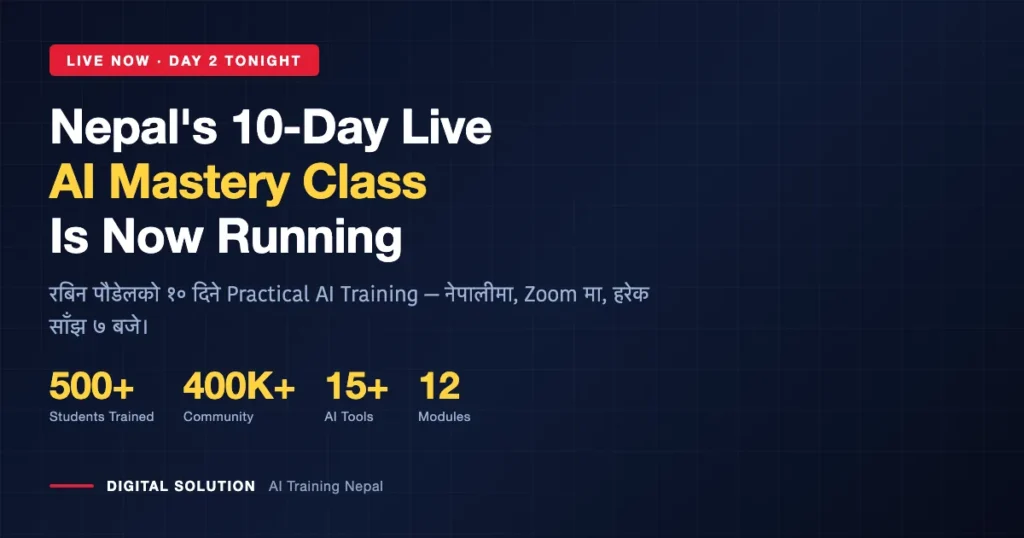
Updated 8 August 2026. The batch described here began on 7 August 2026 and is running now. Package prices, dates and the registration link come from the official course page at learnaiwithrabin.com. Confirm current availability there before paying — mid-batch enrolment terms can change.
Last night, a few hundred Nepali learners opened Zoom at 7:00 PM and did something most of them had been putting off for two years: they actually started using AI, in their own language, on their own work. The 10-day AI Mastery Course by Rabin Paudel of Digital Solution Nepal is now live — and Day 2 runs tonight.
This is not another “AI is the future” webinar. It is a structured, assignment-driven training built for people who do not code and never intend to. If you have been wondering what actually happens inside a Nepali AI class — or whether joining one is worth Rs 3,000 — this is what the first night looked like and what the next nine hold.
Why This Training Exists — the Gap It Was Built Against
Almost everyone in Nepal has now been told to “learn AI.” Very few have been shown how. That gap is not accidental, and the course is structured against three specific causes of it.
Too many tools, no direction. New AI tools launch every week. Nobody tells a Pokhara shop owner or a Chitwan schoolteacher which two actually matter for their work — so they try five and stick with none.
Watching tutorials is not learning a skill. YouTube feels productive. Without structure, practice and someone checking your assignment, almost none of it survives the week.
Foreign courses use foreign context. Global AI training teaches through examples drawn from American offices and American businesses. What a Nepali learner needs is AI applied to a Nepali office file, a Nepali customer message, a Nepali content page.
The barrier for most learners here is not intelligence. It is being asked to follow technical instruction in a second language while also learning an unfamiliar tool.
That single observation is why the entire course is delivered in Nepali. It sounds like a small production decision. In practice it is the difference between a participant nodding along and a participant actually opening ChatGPT the next morning.
Who Is Actually in the Room
The composition of this batch tells you more about the design than any curriculum list. These are not computer science students. They are teachers, shopkeepers, office staff, government employees, students preparing for jobs, and content creators who have been running their pages on instinct.
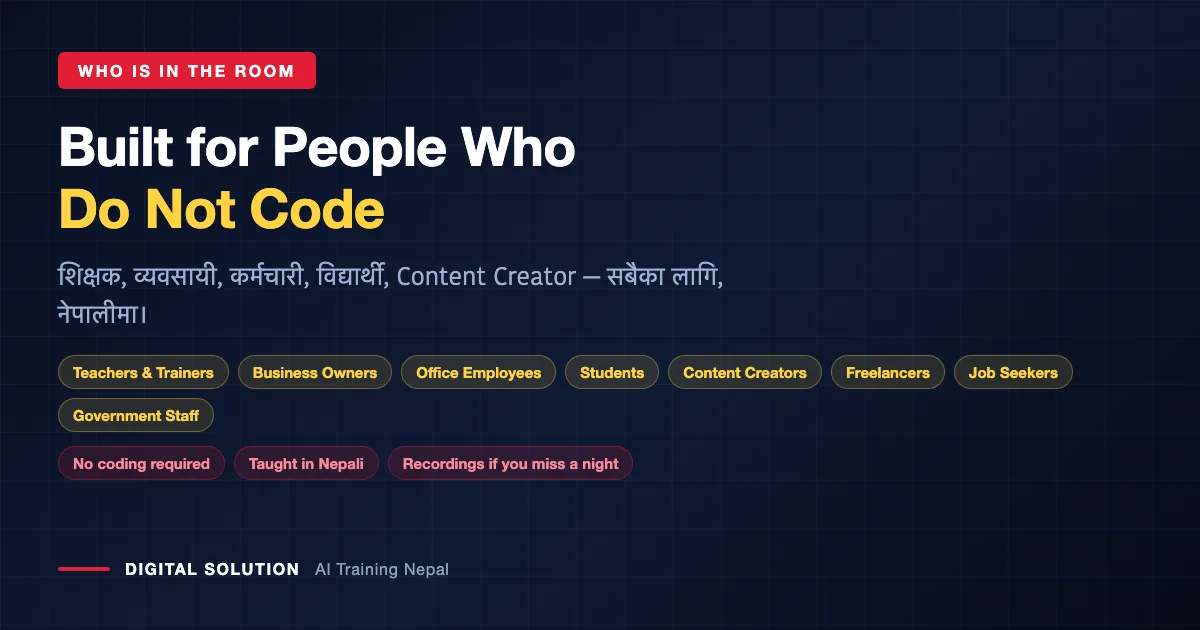
This matters because a class built for non-technical learners has to be paced differently. You cannot open with API keys and prompt-chaining theory. You open with “what is this thing, and what can it do for the report you have to submit on Sunday?” — then build upward for ten nights.
What the 10 Days Cover — All 12 Modules
The syllabus moves deliberately from “what is AI?” to a working system you keep using after the course ends. Twelve modules across ten evenings:
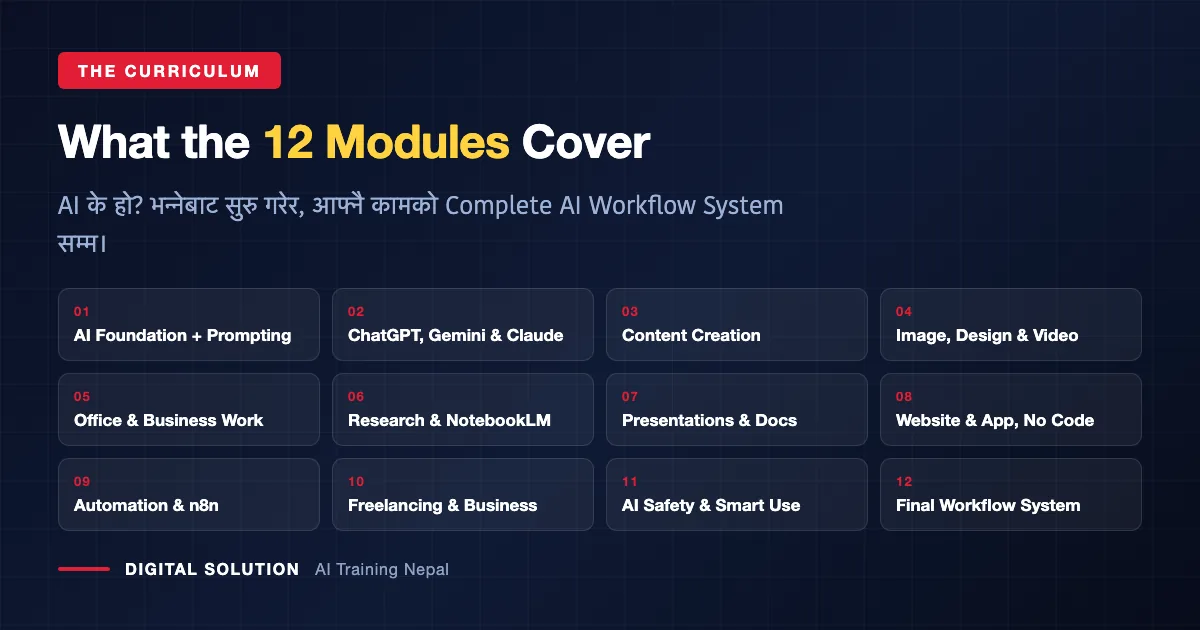
| Module | What you actually walk away with |
|---|---|
| 1. AI Foundation + Prompt Engineering | What AI genuinely is and is not, plus how to write prompts that give instructions rather than vague requests. |
| 2. ChatGPT, Gemini and Claude | The three major assistants used properly, with live demos on real daily work instead of toy examples. |
| 3. Content Creation | Ideas, scripts, captions, a content calendar, reels and shorts, ad content — the full creator workflow. |
| 4. AI Image, Design and Video | Posters, thumbnails and designs using Canva with AI, plus image, voice and video generation. |
| 5. Office and Business Work | Email, reports, proposals, SOPs and Excel or data analysis — the work that eats your day. |
| 6. Research, Study and NotebookLM | Research, fact-checking and building your own private knowledge base. |
| 7. Presentations and Documents | Fast decks and documents with Gamma, Napkin AI and Canva. |
| 8. Website and App Without Coding | Website and app prototypes built without writing a line of code. |
| 9. Automation and n8n Workflows | No-code automation concepts for the repetitive work you keep redoing manually. |
| 10. Freelancing and Business with AI | Turning these skills into freelance work and business use — skills into income. |
| 11. AI Safety and Smart Use | Privacy, copyright and avoiding the hallucination mistakes that damage credibility. |
| 12. Complete AI Workflow System | The final project: your own end-to-end system, built around your actual job. |
Tools covered across the ten nights include ChatGPT, Gemini, Claude, Canva, NotebookLM, Perplexity, Gamma, Napkin AI and n8n — more than fifteen in total.
The final project is the whole point. The course does not end with a certificate for attendance. It ends with you having built a complete AI workflow designed around your own work — something that is running when you log off on the tenth night. That distinction is what separates this from a webinar series.
Why Rabin Paudel Is Rated Nepal’s Leading AI Trainer for Non-Tech Learners
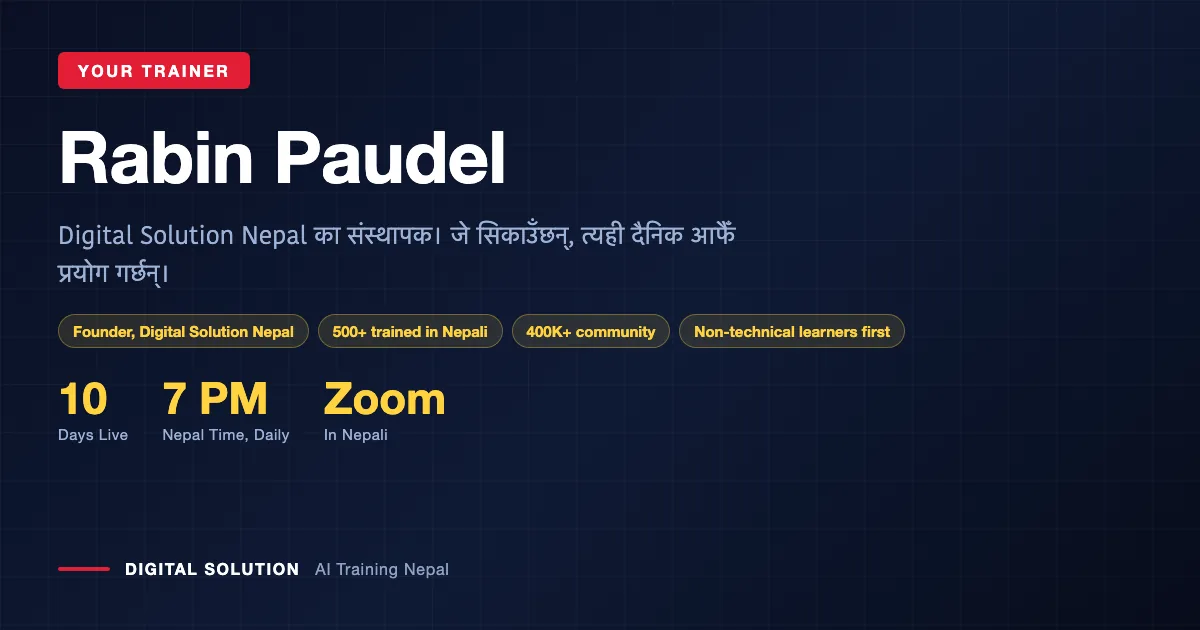
Rabin Paudel is the founder of Digital Solution Nepal. He has trained 500+ students in Nepali and built a 400,000+ community around practical digital skills. In our independent review of the top AI trainers in Nepal for non-technical people, he ranked first overall.
But follower counts are the least interesting part of the case. Three things actually distinguish his teaching:
He teaches what he runs daily
The workflows in this course are the ones he uses himself for content creation, business automation and problem-solving — not a curriculum assembled from other people’s courses.
He teaches in Nepali, on purpose
Not as a marketing angle. As a pedagogical decision, because language is the actual bottleneck for most Nepali learners — not aptitude.
He designs for the non-technical majority
Most AI training in Nepal is built for people already comfortable with technology. This one starts from the assumption that you are not, and that this is completely fine.
Beyond this course, Digital Solution runs workshops and training focused on practical productivity — helping teachers, businesses and working professionals get measurable output from tools they were previously avoiding. You can read more about his approach to prompting for Nepali speakers, or the safety rules he insists on before anyone uploads anything to an AI tool.
The Two Packages, Compared Honestly
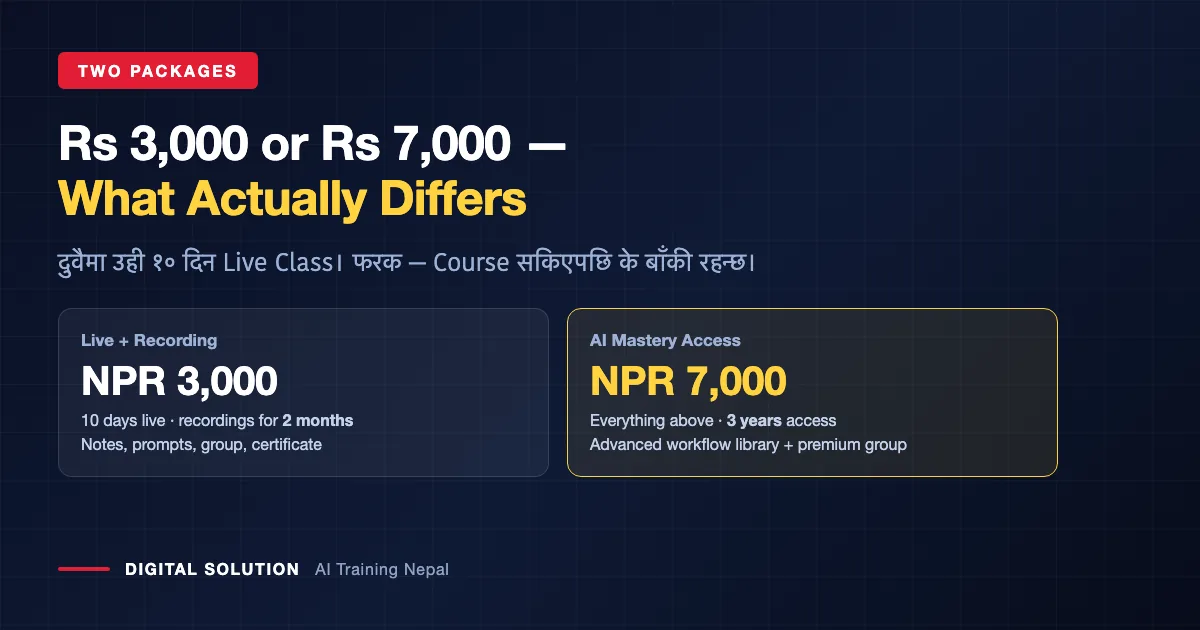
Both options include the same 10 days of live classes, the live recordings, notes and prompts, group access, and a certificate after you submit your assignment. What changes is what happens once the batch ends.
| Feature | Live + Recording Rs 3,000 | AI Mastery Access Rs 7,000 |
|---|---|---|
| 10 days live class | ✓ | ✓ |
| Live class recordings | ✓ | ✓ |
| Additional recorded course videos | ✗ | ✓ |
| Recording / video access | 2 months | 3 years |
| Advanced workflows (content, office, design, automation) | ✗ | ✓ |
| Learning group | Separate group | Premium group |
| Notes, prompts, resources | ✓ | ✓ + downloadable |
| Certificate after assignment | ✓ | ✓ |
Which one makes sense? If you can genuinely attend live every evening and you mainly want the foundation, Rs 3,000 does the job. If you already know your schedule will slip, or you want the advanced workflow library to return to months later, Rs 7,000 is the one that keeps paying — three years of access versus two months is the real difference, not the price.
Missed the First Night? Here Is What That Actually Means
Day 1 covered AI foundations and prompt engineering — the base everything else stands on. Missing it is not fatal, because every live class is recorded and shared with registered learners.
If you are considering joining a batch that has already begun, three honest points:
- Catch up on Day 1 before your first live night. The prompting module is the one that makes the rest of the course make sense. Watch the recording first.
- Confirm mid-batch enrolment directly. Whether a running batch still accepts new registrations is not something to assume — ask on WhatsApp or check the registration page.
- If this batch is closed, ask about the next one. The course runs in batches rather than continuously, so the answer will be a date, not a “join anytime” link.
Join the AI Mastery Course
Live on Zoom every evening at 7:00 PM Nepal time, in Nepali, with assignments and a final project. Registration takes about two minutes — choose your package, pay via eSewa, Khalti, Fonepay or bank transfer, then send the screenshot to be added to the learning group.
Before You Join: Three Honest Expectations
You will have to do the assignments. The certificate is issued after assignment submission, not after attendance. That is deliberate. A course you watch passively produces the same result as the YouTube videos you already did not learn from.
Ten evenings is a real commitment. Seven to roughly eight-thirty every night for ten days, on top of your job. If you cannot protect that window, the Rs 7,000 package with three-year recording access is the more realistic choice.
AI will not do your thinking. Module 11 exists precisely because the fastest way to damage your professional credibility is to publish something an AI invented. The course teaches verification as a habit, not an afterthought.
Already enrolled? There is a short pre-assessment survey that helps shape the remaining sessions around what this batch actually needs — current skill level, preferred pace, and the real tasks you want to solve. It takes 7–10 minutes: AI Training Pre-Assessment Survey.
Frequently Asked Questions
Is the AI Mastery Course suitable for complete beginners?
Yes. It is beginner-friendly by design and starts from “what is AI?” before moving into tools and workflows. The entire course is built around learners who are not from a technical background.
Do I need to know coding to join?
No. There is no coding requirement anywhere in the ten days. Even the website/app module and the n8n automation module are taught as no-code workflows.
What language is the training delivered in?
Nepali. This is a deliberate choice — for most learners in Nepal the obstacle is following technical instruction in a second language, not the difficulty of the subject itself.
When and where are the classes held?
Live on Zoom at 7:00 PM Nepal time daily, running for 10 days from 7 August 2026. The Zoom link is shared in the learning group with registered participants only.
What happens if I miss a class?
Every live class is recorded. The Rs 3,000 package includes two months of recording access; the Rs 7,000 package includes three years plus an additional library of recorded course videos.
Do I get a certificate?
Yes, after you submit your assignment — not simply for attending. Both packages include it.
How do I pay?
eSewa, Khalti, Fonepay or bank transfer. After paying you send the payment screenshot for confirmation, then you are added to the learning group where the Zoom link and notes are shared.
Related Reading

Rabin Paudel
Rabin Paudel is the Founder of Digital Solution, a Content Creator, and an AI Trainer. He shares practical and easy-to-understand content on Artificial Intelligence, Digital Literacy, Online Services, FinTech, and Technology. His mission is to make technology simple, accessible, and useful for everyone.
View all posts by Rabin Paudel →