
Last updated: July 2026 (Shrawan 2083). AI in legal work carries a specific, documented danger — fabricated citations — addressed head-on below. Part of our AI-by-profession series (general list).
Legal work in Nepal is document work: drafting, reviewing, translating, summarizing case files, tracking hearing dates. AI now does the heavy lifting on most of it — and simultaneously carries the profession’s most dangerous failure mode: confidently invented case law. These are the 10 best AI tools for lawyers and legal professionals in Nepal, with the safety discipline that separates the lawyer AI empowers from the lawyer AI embarrasses in front of a bench.
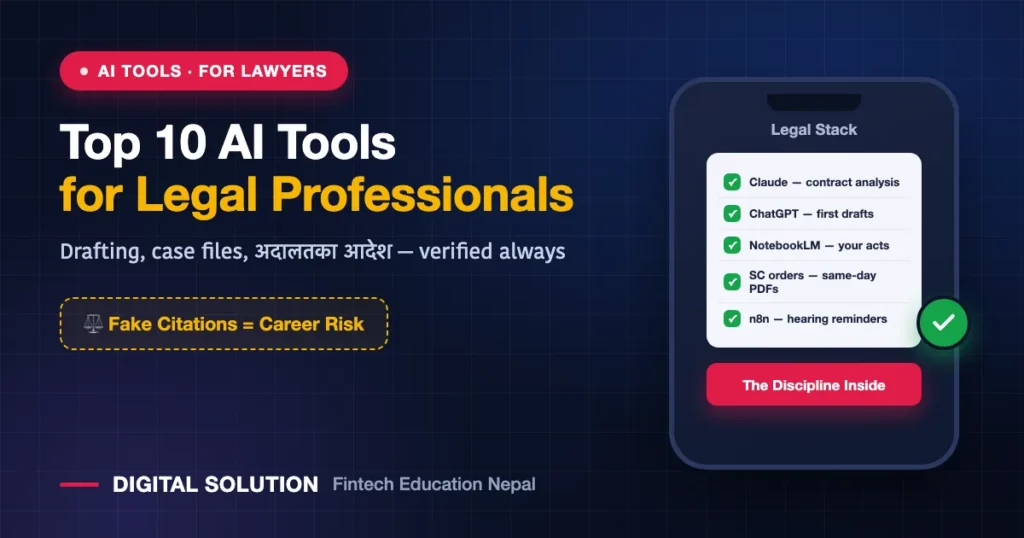
The 10 at a Glance
| # | Tool | Legal Superpower |
|---|---|---|
| 1 | Claude | Long-document analysis — contracts, case files, legislation |
| 2 | ChatGPT | First drafts: notices, agreements, applications, client letters |
| 3 | NotebookLM | Upload the acts/files you rely on — answers stay inside them |
| 4 | Supreme Court’s online orders | Same-day आदेश PDFs — Nepal’s newest research asset |
| 5 | Perplexity | Cited research starting points |
| 6 | Gemini | Nepali↔English legal translation drafts + free research |
| 7 | Whisper/Otter-class | Client meetings and statements, transcribed |
| 8 | Grammarly | Polished English for cross-border work |
| 9 | n8n | Hearing-date reminders, client intake automation |
| 10 | Canva | Firm profiles, client-education material |
1. Claude — The Document Analyst
Hand it a 40-page contract and ask for obligations, liabilities and unusual clauses; feed a case file and get a chronology. Claude’s long-context strength fits legal reading loads exactly — as a first pass whose every claim you verify against the source.
2. ChatGPT — The Drafting Bench
Rental agreements, legal notices, board resolutions, client update letters — describe the parties and terms, get a workable first draft to refine with your judgment. Drafting time collapses; responsibility doesn’t move.
3. NotebookLM — Your Own Legal Library, Queryable
Upload the Muluki codes sections you work with, key acts, your own past submissions — and query only those sources. Source-bound answering is precisely the property legal research needs from AI, because it cannot invent a case that isn’t in your uploads.
4. Supreme Court Orders Online — Use What Just Opened
Since Shrawan 11, the Supreme Court uploads all bench orders same-day — a genuine research resource for tracking how benches are ruling. Our step-by-step access guide covers the दैनिक पेसी सूची flow. Pair it with NotebookLM: download relevant orders, upload, query.
5. Perplexity — Research Starting Points, With Receipts
Cited answers you can trace — for orientation on unfamiliar areas, comparative positions, and factual background. Starting point, never authority.
6. Gemini — The Translation Workhorse
Nepali↔English drafts of agreements, summaries for foreign clients, translations of foreign material — Gemini handles legal register reasonably well. Certified translation still needs the human stamp; the draft just got 10× faster.
7. Transcription (Whisper/Otter-class) — Statements, Captured
Client interviews and witness accounts transcribed for the file — with consent, and with confidentiality handling (below) applied to every recording.
8. Grammarly — For Work That Crosses Borders
Arbitration submissions, foreign-client correspondence, LLM applications — English polish that matches the stakes.
9. n8n — The Practice That Runs Itself
Automate the operational drag: hearing-date reminder flows, client intake forms feeding a case sheet, document-request follow-ups. One afternoon of setup (or our training) recovers hours weekly.
10. Canva — The Firm’s Front Door
Client-education one-pagers (“tenancy rights in 60 seconds”), firm profiles, social explainers — the lawyers building public trust in Nepal are the ones explaining law in plain language.
The Discipline: Three Rules or Don’t Use AI
- Every citation gets verified. Every one. AI fabricates case names, NKP references and section numbers with total confidence — lawyers abroad have been sanctioned for filing them. If you didn’t verify it in the source, it doesn’t enter the document.
- Client confidentiality beats convenience. Names, identifying facts, privileged material — de-identify before any AI tool, or keep it out entirely.
- AI output is a junior’s draft. Useful, fast, never final — the signature on the document owns every word.
FAQ
Can AI do legal research on Nepali law?
Partially — general-purpose AI knows Nepali law shallowly and invents specifics. The reliable pattern: NotebookLM over sources you upload + the Supreme Court’s new same-day orders + verification of everything.
Is it ethical for lawyers to use ChatGPT?
Drafting assistance with verification and confidentiality discipline — broadly yes, like using a junior. Filing unverified AI output — no, and increasingly sanctionable worldwide.
Which tool for a small solo practice first?
ChatGPT for drafting + the Supreme Court orders habit + one n8n reminder flow. That trio returns the most hours per rupee (all free/cheap).
Can AI translate legal documents Nepali to English?
Draft-quality, yes (Gemini/ChatGPT); certification and nuance-checking remain human work.
🤝 Law firm or chamber wanting practical AI training?
Digital Solution runs hands-on workshops for professional teams — details here.
Disclaimer: Digital Solution Nepal is an independent educational website, not a law firm, and not affiliated with the tools listed. Nothing here is legal advice; professional-conduct rules and verification duties govern all AI-assisted legal work. Features and free tiers change — official sites are final.

Rabin Paudel
Rabin Paudel is the Founder of Digital Solution, a Content Creator, and an AI Trainer. He shares practical and easy-to-understand content on Artificial Intelligence, Digital Literacy, Online Services, FinTech, and Technology. His mission is to make technology simple, accessible, and useful for everyone.
View all posts by Rabin Paudel →