
Updated August 2026. Section references are to the Insurance Act 2079. Operational timelines sit in NIA guidelines that are currently being amended — treat specific day-counts as indicative and confirm with your insurer or NIA.
Your claim has been rejected. Before you accept it or give up, understand two things: why insurers in Nepal are legally able to reject, and what the escalation route actually looks like in practice — including how congested it is.
Why Claims Get Rejected Here
In practice that makes the proposal form the most consequential document you will ever sign quickly. The common grounds:
Non-disclosure
A pre-existing condition, a habit, an occupation or an earlier claim not declared — even if unrelated to what you eventually claim for.
Policy lapsed
Premium unpaid beyond the grace period. There is no cover to claim against. See lapse and revival.
Exclusion or waiting period
The event falls inside a stated exclusion, or inside a waiting period that had not yet run.
Cause not established
The claimant has not proved the loss occurred as described. Documentation gaps do this as often as dishonesty.
Late notification
Delay in informing the insurer is itself cited as a ground. Tell them early even if your paperwork is incomplete.
Terms not met
A condition of the policy — a required report, a procedure, a licence — was not satisfied at the time of loss.
The Timeline — and a Widely Repeated Error
The operational day-counts sit in NIA’s claims settlement guidelines. Reported figures:
| Claim type | Reported timeline |
|---|---|
| Life — maturity | Notice within 15 days of maturity; settle within 7 days of receiving documents |
| Life — death | Payment within 15 days of the claimant signing the settlement receipt |
| Non-life | Generally within 21 days of the surveyor’s report |
These guidelines are being amended right now, and NIA has been inviting input from policyholders and the public, not only insurers. So treat the numbers as the current working position rather than settled law.
How to Escalate — Step by Step
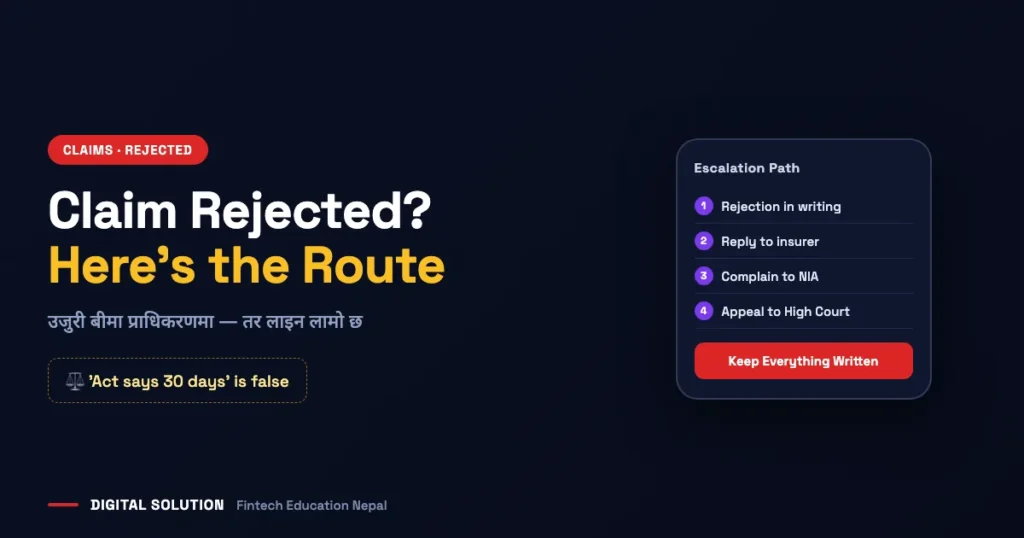
- Get the rejection in writing, with reasons. A verbal “it was rejected” is not something you can act on. Ask for the specific policy clause relied on.
- Reply to the insurer in writing, addressing that clause directly and attaching evidence. Many rejections are documentation failures and resolve here.
- Complain to the Nepal Insurance Authority if it stands. NIA accepts consumer complaints at its central office and at its province offices.
- Include everything NIA asks for: your name, address and contact, the insurer’s name, the problem, the claim number and policy number, and supporting evidence.
- NIA seeks the insurer’s clarification — reported as 15 days for the insurer, 7 days for the insured — and may order settlement, reassessment or compensation.
- Appeal to the High Court within a reported 35 days if you disagree with NIA’s decision.
NIA contact: info@nia.gov.np, +977-1-5421079 / 5428604. It also publicly invited claim-payment complaints in a notice dated July 2026.
⚠ Set your expectations honestly: the complaint system is badly congested.
In the first ten months of FY 2082/83, NIA had 543 live cases (394 carried forward plus 149 new) and resolved 157 — a 28.91% resolution rate, leaving 386 unresolved. There is also no insurance ombudsman and no dedicated insurance tribunal in Nepal. The remedy exists on paper; it moves slowly. Plan for months, keep everything in writing, and do not let the insurer’s deadline lapse while you wait.
🤝 Claim rejected and not sure whether the reason is legitimate?
Send us the rejection letter and the clause they cited. Digital Solution will help you understand whether it holds up and how to frame your written response. We are not agents and take no commission.
The Claim Settlement Ratio Trap
What is reported officially is the trend in outstanding claims — and it is going the wrong way. Life insurers’ outstanding claims rose 54.89% to Rs 6.77 billion in FY 2081/82, from Rs 4.37 billion. Non-life outstanding claims stood at around Rs 8.03 billion. That tells you more about settlement friction than any invented percentage.
Frequently Asked Questions
Why was my insurance claim rejected in Nepal?
Most commonly non-disclosure on the proposal form, a lapsed policy, an exclusion or waiting period, insufficient proof of the loss, or late notification.
Can an innocent mistake void my policy?
Under the doctrine as applied in Nepal, a material misrepresentation can allow avoidance of the contract even where it was innocent rather than fraudulent.
Does the law require settlement within 30 days?
No. Section 123 of the Insurance Act 2079 requires settlement within “the prescribed period” and sets no number of days. The day-counts sit in NIA guidelines, which are being amended.
Where do I complain?
To the Nepal Insurance Authority, at its central office or a province office, with your claim number, policy number and evidence.
How long will a complaint take?
Possibly a long time. NIA resolved under 29% of live cases in the first ten months of FY 2082/83.
Is there an insurance ombudsman in Nepal?
No. There is no ombudsman and no dedicated insurance tribunal — escalation runs through NIA and then the courts.
Can I get interest if payment is delayed?
Reported provisions allow 10% interest on a valid claim paid late, plus your costs of pursuing the remedy.
Should I pick an insurer by claim settlement ratio?
Be careful — NIA does not publish per-company ratios. The figures circulating online are third-party calculations.
Sources
- Insurance Act 2079 — Section 123 (settlement of insurance claim), Section 128 (complaint relating to payment of claim), Section 130 (insurance mediation).
- NIA Insurance Claims Settlement Guidelines timelines, as reported by insurance trade press; guidelines currently under amendment.
- NIA complaint-invitation notice, July 2026; NIA published contact details and province offices.
- Reported NIA complaint caseload and resolution rate for the first ten months of FY 2082/83.
- Reported outstanding-claims figures for life and non-life insurers, FY 2081/82.
Related Reading
Disclaimer: Digital Solution Nepal is an independent educational and digital-service assistance website — not an insurer, not an insurance agent or broker, and not a law firm. We do not sell insurance and receive no commission from any insurer. Policy terms, premiums and regulations differ by company and change over time, and nothing here is financial, legal or insurance advice — your policy document, your insurer and the Nepal Insurance Authority are final.

Rabin Paudel
Rabin Paudel is the Founder of Digital Solution, a Content Creator, and an AI Trainer. He shares practical and easy-to-understand content on Artificial Intelligence, Digital Literacy, Online Services, FinTech, and Technology. His mission is to make technology simple, accessible, and useful for everyone.
View all posts by Rabin Paudel →