
Updated August 2026. The third-party sum insured is mid-change — the FY 2083/84 budget announced a doubling, but the implementing directive was still in draft as of July 2026. Figures below distinguish what is operative from what is announced. Confirm with your insurer before quoting a number.
Third-party motor insurance is compulsory in Nepal, and you cannot renew your bluebook without it. Yet the sum it actually pays out is about to double — and most drivers have no idea what their policy currently covers.
What Third-Party Insurance Actually Pays
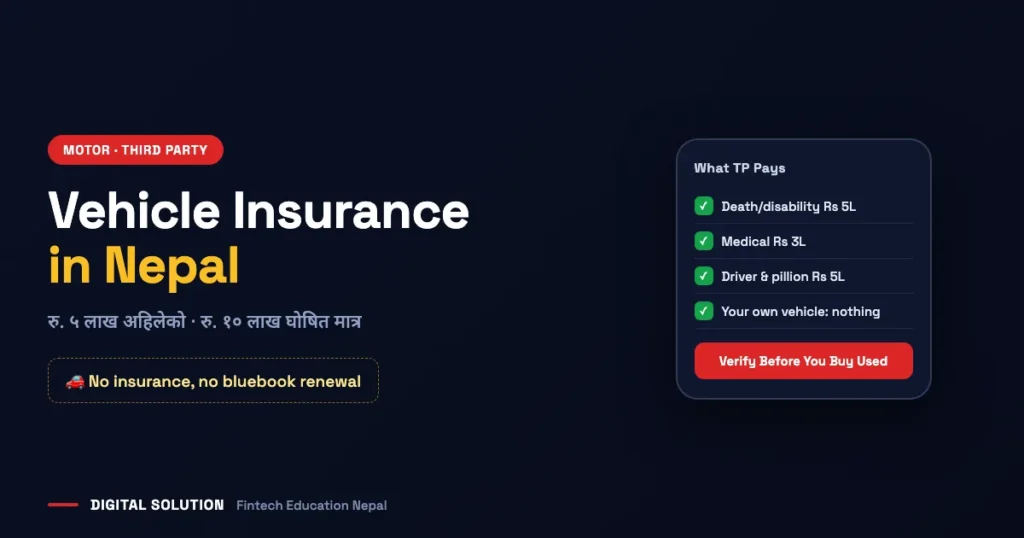
| Benefit | Currently provided |
|---|---|
| Death or permanent total disability, per person | Rs 5,00,000 |
| Medical treatment, per person | Rs 3,00,000 |
| Loss of both eyes, both limbs, or one of each | Rs 5,00,000 |
| Loss of one eye or one limb | Rs 2,50,000 |
| Hospitalisation cash | Rs 500/day, up to 40 days |
| Cremation cost per deceased | Rs 50,000 |
| Emergency transport | Rs 10,000 |
The first two rows are well corroborated; the remaining scheduled benefits are reported and we could not verify each against the directive text. Third-party property damage limits we could not verify at all — figures circulating for that are blog-sourced, so ask your insurer.
The Premium Is Set by Regulator, Not by Competition
Unlike most insurance, third-party premium is a regulated tariff. Companies do not compete on price for it — so shopping around on TP alone achieves nothing. Indicative rates under the current directive:
| Vehicle | Indicative annual premium |
|---|---|
| Motorcycle under 150cc | ~Rs 1,500 |
| Motorcycle 150–250cc | ~Rs 1,700 |
| Motorcycle above 250cc | ~Rs 1,900 |
| Private four-wheeler | ~Rs 3,000–6,000 by capacity |
| Commercial / cargo | up to ~Rs 10,000 |
Third-Party vs Comprehensive
Third-party only
Pays others — people you injure, and their losses. Your own vehicle gets nothing. Compulsory, cheap, and the minimum the law demands.
Comprehensive
Everything above, plus damage to your own vehicle from accident, fire or theft, with optional riders. Costs substantially more.
The honest test: if your vehicle were written off tomorrow, could you replace it from savings? If yes, third-party may be a rational choice. If a total loss would be financially serious, comprehensive is not a luxury.
No Insurance, No Bluebook Renewal
Why this matters to an honest owner: if you buy a used vehicle, the insurance shown to you may not exist. Verify the policy directly with the named insurer before you pay for the vehicle, not with the seller.
We looked for the specific rupee fine for driving without third-party insurance and could not find a verified figure — so we are not going to print one. The real exposure is not the fine anyway: it is personal liability for someone else’s death or injury with no insurer behind you.
🤝 Renewing your vehicle insurance and unsure what you are buying?
Tell us your vehicle type and what your current policy says. Digital Solution will explain what is covered, what is changing and what to confirm in writing. We sell no insurance and take no commission.
After an Accident
- Attend to injuries first. Everything else can be reconstructed; a life cannot.
- Inform the police and get the report. A police application is the anchor document for a third-party claim.
- Notify your insurer immediately, even before your paperwork is complete. Late notification is a documented ground for rejection — see why claims get rejected.
- Record everything at the scene: vehicle numbers, both licence numbers, eyewitness contacts, photographs.
- Keep every bill — medical, towing, repair.
Frequently Asked Questions
Is third-party insurance compulsory in Nepal?
Yes, under the Motor Vehicles and Transport Management Act 2049 and the motor insurance directive, and it is required to renew your bluebook.
How much does third-party insurance pay?
Currently Rs 5 lakh for death or permanent total disability per person and Rs 3 lakh for medical treatment. A doubling to Rs 10 lakh was announced in the FY 2083/84 budget, with the implementing directive still pending as of July 2026.
How much does it cost?
It is a regulated tariff. Roughly Rs 1,500–1,900 for motorcycles and Rs 3,000–6,000 for private cars, though reported figures vary and a significant increase is expected alongside the higher cover.
Does it cover my own vehicle?
No. Third-party covers others only. Own-vehicle damage requires comprehensive cover.
Can I renew my bluebook without insurance?
You should not be able to — it is a stated precondition. Reporting has documented irregular renewals without it, which is a risk when buying a used vehicle.
What is the fine for driving uninsured?
We could not verify a specific figure and will not invent one. The larger exposure is personal liability for a third party’s injury or death.
Is the driver covered?
Driver and pillion cover on motorcycles was raised to Rs 5,00,000 from Rs 1,00,000.
How do I check a policy is genuine?
Contact the named insurer directly with the policy number. Do not rely on a photograph of a document, particularly when buying a used vehicle.
Sources
- Motor Vehicles and Transport Management Act 2049 and the Motor Insurance Rate Directive 2073, as reported — the primary statutory text could not be retrieved.
- FY 2083/84 budget announcement doubling the third-party sum insured; reporting that the implementing directive remained in draft as of July 2026.
- May 2026 investigative reporting on bluebook renewals without valid insurance and fake insurance documents at Transport Management Offices, including on-record confirmation from a TMO chief.
Related Reading
- Driving licence fees province by province
- Why insurance claims get rejected
- Driving licence Nepal: complete guide hub
Disclaimer: Digital Solution Nepal is an independent educational and digital-service assistance website — not an insurer, not an insurance agent or broker, and not a law firm. We do not sell insurance and receive no commission from any insurer. Policy terms, premiums and regulations differ by company and change over time, and nothing here is financial, legal or insurance advice — your policy document, your insurer and the Nepal Insurance Authority are final.

Rabin Paudel
Rabin Paudel is the Founder of Digital Solution, a Content Creator, and an AI Trainer. He shares practical and easy-to-understand content on Artificial Intelligence, Digital Literacy, Online Services, FinTech, and Technology. His mission is to make technology simple, accessible, and useful for everyone.
View all posts by Rabin Paudel →