
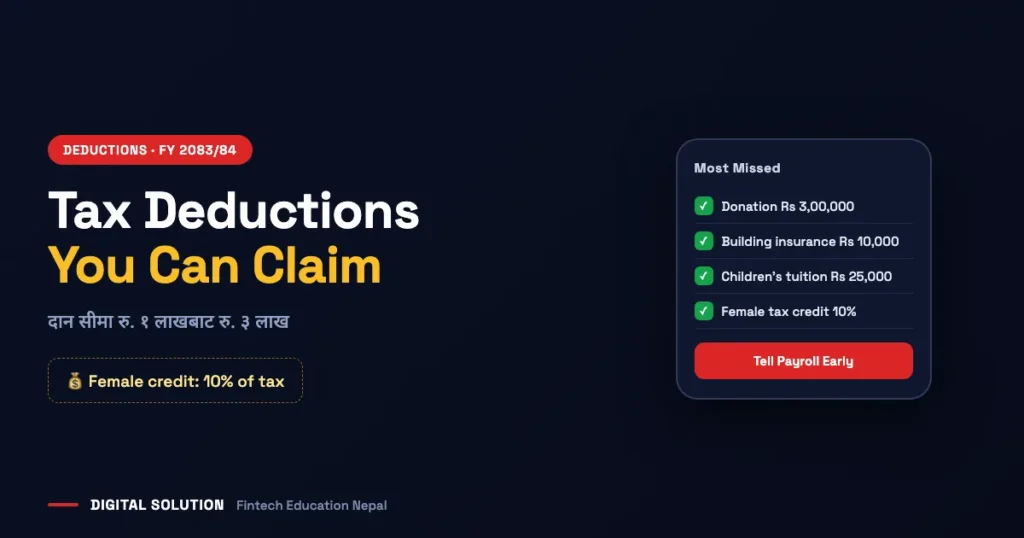
Most Nepali taxpayers claim the insurance premium deduction and stop there. There are around a dozen more, and FY 2083/84 raised one of them threefold. Here is the complete list, with the limits that apply this year.
The Full List
| What you can claim | Limit for FY 2083/84 |
|---|---|
| Life insurance premium | Lower of actual or Rs 40,000 |
| Health / medical insurance premium | Lower of actual or Rs 20,000 |
| Private building insurance premium | Lower of actual or Rs 10,000 — raised from Rs 5,000 |
| Approved retirement fund contribution | Lower of one-third of taxable income, Rs 5,00,000, or actual |
| Children’s education fees — new | Lower of 25% of annual tuition or Rs 25,000 |
| Donations to tax-exempt organisations | Lower of Rs 3,00,000 or 5% of adjusted taxable income |
| Heritage or public sports infrastructure | Actual, up to Rs 10,00,000 or 10% of assessable income, with prior IRD approval |
| Remote area allowance | Up to Rs 50,000 — Category A Rs 50,000 down to Category E Rs 10,000 |
| Pension income | Extra deduction of the lower of 25% of the first tax band or the actual pension |
| Incapacitated (disabled) person | Extra deduction of the lower of 50% of the first tax band or actual income |
| Foreign allowance (diplomatic mission staff) | Only 25% of the allowance is included in employment income |
Two Credits That Reduce Your Tax Directly
👩 Female tax credit — 10%
10% of the tax liability, for a resident woman whose income is only from remuneration. If she also has business or rental income, it does not apply. This is the single most valuable and most frequently unclaimed item on this page.
🏥 Medical tax credit
The least of Rs 1,500, 15% of approved medical expenses including any carried forward, or your actual tax liability.
There is also a foreign tax credit if you paid tax abroad on income also taxable here — the lower of (foreign income × your average tax rate) or the actual foreign tax, calculated on a per-country basis.
What Changed This Year
| Deduction | FY 2082/83 | FY 2083/84 |
|---|---|---|
| Donations | Rs 1,00,000 | Rs 3,00,000 |
| Private building insurance | Rs 5,000 | Rs 10,000 |
| Children’s education fees | — | New: Rs 25,000 |
🤝 Not sure which deductions apply to you?
Send us your situation — salaried or business, insurance held, retirement contributions, dependants — and we will list what you can legitimately claim. For the filing itself we will tell you when a registered practitioner is worth it.
One Figure We Are Not Certain About
Similarly, the pension and disability deductions are stated as percentages of the first tax band. With that band now Rs 10,00,000, they work out to roughly Rs 2,50,000 and Rs 5,00,000 respectively — but those rupee figures are our arithmetic, not quoted amounts. Confirm before relying on them.
How to Actually Claim These
- Collect the documents through the year, not in Ashoj. Insurance receipts, retirement fund statements, donation receipts, tuition receipts.
- Tell your employer. For salaried people, most of these are applied through payroll — if your employer does not know about your insurance premium, the deduction never reaches your TDS calculation.
- Check your salary statement. Confirm the deductions you are entitled to actually appear in it before the year ends.
- Claim what payroll missed when you file — see our guide to filing your return online.
- Keep everything for the record period. A deduction you cannot evidence is a deduction you will lose at assessment.
Frequently Asked Questions
How much life insurance premium can I deduct in Nepal?
The lower of your actual premium or Rs 40,000 a year, with a resident insurer.
Is health insurance premium deductible separately?
Yes — up to Rs 20,000, separately from the life insurance deduction.
What is the female tax credit?
A 10% reduction of the tax liability for a resident woman whose income is only from remuneration. It is a credit against tax, not a deduction from income.
How much can I claim for donations?
The lower of Rs 3,00,000 or 5% of adjusted taxable income — raised from Rs 1,00,000 this year.
Can I deduct my children’s school fees?
New for FY 2083/84 — the lower of 25% of annual tuition fees or Rs 25,000.
What is the retirement contribution limit?
Our source shows the lower of one-third of taxable income, Rs 5,00,000, or actual. Whether a lower Rs 3,00,000 limit still applies to non-SSF contributors is not clear — confirm with a practitioner.
Is there a deduction for building insurance?
Yes, up to Rs 10,000 for private building insurance premium — raised from Rs 5,000.
Do I claim these through my employer or when filing?
Most are applied through payroll during the year. Anything payroll missed can be claimed when you file.
Sources
- Finance Act 2083 as summarised in published professional tax-rate documents for FY 2083/84.
- Income Tax Act 2058 provisions on deductions, credits and approved retirement fund contributions.
Related Reading
- Income tax slabs for FY 2083/84
- Filing your income tax return online
- Term life vs endowment insurance
- Social Security Fund complete guide
Disclaimer: Digital Solution Nepal is an independent educational and digital-service assistance website — not a tax authority, not a chartered accountancy firm and not a law firm. Tax rates and thresholds change with every Finance Act, and individual circumstances differ. Nothing here is tax advice — the Inland Revenue Department, the current Finance Act and a registered tax practitioner are final. Verify before filing or paying.

Rabin Paudel
Rabin Paudel is the Founder of Digital Solution, a Content Creator, and an AI Trainer. He shares practical and easy-to-understand content on Artificial Intelligence, Digital Literacy, Online Services, FinTech, and Technology. His mission is to make technology simple, accessible, and useful for everyone.
View all posts by Rabin Paudel →