
As of 24 November 2026 (8 Mangsir 2083). All figures are from Nepal Rastra Bank’s Banking & Financial Statistics (Monthly), Asoj 2083 (mid-October 2026), published in November 2026 by the Banks and Financial Institutions Regulation Department. NRB marks the report provisional. Interest rates are weighted averages for the 20 commercial banks; deposit, loan and access totals cover commercial banks, development banks and finance companies together unless stated.
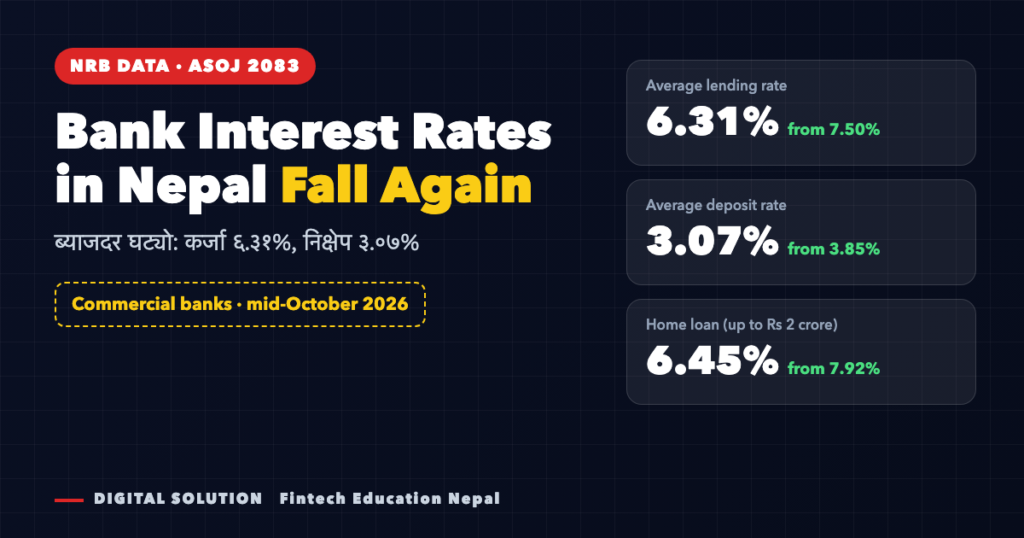
The average bank interest rate in Nepal has fallen again. In mid-October 2026, commercial banks charged an average of 6.31% on loans and paid an average of 3.07% on deposits, according to Nepal Rastra Bank’s Asoj 2083 statistics. A year earlier the same averages were 7.50% and 3.85%.
For a family with a home loan, that is good news. For a retiree living on fixed deposit interest, it is not. This guide explains what the new NRB numbers say, what changed in one year, and what to do with them before you sign a loan or renew a deposit.
Quick answers: Nepal bank interest rates, Asoj 2083
| Measure (commercial banks) | Asoj 2082 (mid-Oct 2025) | Asoj 2083 (mid-Oct 2026) |
|---|---|---|
| Average lending rate | 7.50% | 6.31% |
| Average deposit rate | 3.85% | 3.07% |
| Savings deposits | 3.04% | 2.81% |
| Fixed deposits (all terms) | 5.49% | 4.74% |
| Fixed deposits, 2 years and above | 9.10% | 7.55% |
| Call deposits | 0.99% | 0.42% |
| Personal home loan (up to Rs 2 crore) | 7.92% | 6.45% |
| Hire purchase (vehicle) loan | 8.05% | 6.54% |
Source: NRB, Weighted Average Interest Rate Structure of Commercial Banks, report pages 63 and 65.
What “weighted average interest rate” actually means
These are not the rates printed on a bank’s notice board. NRB averages the rate on every rupee of outstanding deposits and loans, weighted by size. A Rs 50 crore corporate loan counts far more than your Rs 20 lakh home loan.
Two practical points follow:
- Your own rate can be higher or lower. A new home loan is priced as the bank’s base rate plus a premium, and the premium depends on you.
- The average moves slowly. Old fixed deposits keep their old rate until maturity, so the average lags behind the rates banks offer today. When the average falls this far, new offers have usually fallen further.
Deposit interest rates in Nepal: how far savers have lost
Every deposit category paid less in Asoj 2083 than a year earlier. The biggest cuts were on longer fixed deposits, which are what most savers and retirees use.
| Fixed deposit term | Asoj 2082 | Asoj 2083 | Change (points) |
|---|---|---|---|
| 3 to 6 months | 3.87% | 2.92% | -0.95 |
| 6 to 12 months | 4.03% | 3.19% | -0.84 |
| 1 to 2 years | 4.87% | 3.71% | -1.16 |
| 2 years and above | 9.10% | 7.55% | -1.55 |
The gap between terms is now very wide. A one-year deposit averages 3.71%, while money locked for two years or more averages 7.55%. Much of that long-term pool is older deposits booked when rates were higher, so do not expect a new two-year deposit to earn 7.55%. Ask the branch for its current posted rate.
People are also moving money out of fixed deposits. Between mid-July 2025 and mid-July 2026, savings deposits across banks and financial institutions rose 45.59% while fixed deposits fell 16.58%. By mid-October 2026, savings accounts held Rs 4,194,773 million (48.96% of all deposits) and fixed deposits Rs 2,892,719 million (33.76%). Savings pay less, but they are liquid, and the extra return for locking money away has shrunk.
For the rules on early withdrawal, tax on interest and deposit insurance, see our fixed deposit guide.
Loan interest rates in Nepal by product
Borrowers gained across every product. The table compares Asoj 2082 with Asoj 2083 for commercial banks.
| Loan product | Asoj 2082 | Asoj 2083 |
|---|---|---|
| Term loan | 7.60% | 6.12% |
| Overdraft | 8.20% | 5.90% |
| Cash credit loan | 7.55% | 6.10% |
| Trust receipt / import loan | 7.43% | 5.69% |
| Short-term working capital / demand loan | 7.05% | 5.52% |
| Personal home loan (up to Rs 2 crore) | 7.92% | 6.45% |
| Real estate loan | 7.88% | 5.99% |
| Margin nature loan (against shares) | 7.54% | 6.00% |
| Hire purchase loan | 8.05% | 6.54% |
| Deprived sector loan | 6.48% | 5.32% |
| All loans (aggregate) | 7.50% | 6.31% |
By sector, consumption loans averaged 6.33%, wholesale and retail trade 5.94%, construction 6.31% and hotels and restaurants 5.89% in Asoj 2083. The average lending rate has fallen every month since Asar 2083 (mid-July 2026): 6.55%, then 6.48%, 6.38% and 6.31%.
The report’s sector and product rows fell more sharply between Bhadra and Asoj 2083 than the aggregate did (for example, consumption loans from 7.16% to 6.33% while the aggregate moved from 6.38% to 6.31%). We report the figures as NRB published them; the provisional numbers may be revised in later editions.
What the new rates mean for you
If you have a loan
Most Nepali loans are floating: the rate resets when the bank’s base rate changes, usually every quarter. If your rate has not fallen in a year while the national average dropped about 1.2 points, ask why. Check whether your premium is unusually high, and compare a balance transfer to another bank, including any prepayment or swap charges. Our home loan guide covers how much you can borrow and the documents banks want.
If you live on deposit interest
Expect lower income at renewal. Spread maturities rather than locking everything at once, compare posted rates across a few banks, and remember that tax is deducted from interest before it reaches you. Lower deposit rates also make “high return” offers more tempting, and those are often scams. If a scheme promises far more than any bank, check it before you pay.
If you run a business
Working capital and import loans are among the cheapest products right now, at 5.52% and 5.69% on average. If your overdraft still costs close to last year’s 8.20% average, renegotiate.
Deposits and loans: banks are holding more money than they lend
Across commercial banks, development banks and finance companies, deposits reached Rs 8,568,403 million (about Rs 8.57 trillion) in mid-October 2026. Loans and advances, including bills purchased, stood at Rs 6,119,664 million (about Rs 6.12 trillion).
| Period | Deposit growth | Loan growth |
|---|---|---|
| Mid-July 2025 to mid-July 2026 (FY 2082/83) | 13.80% | 6.53% |
| Mid-July 2026 to mid-October 2026 (first 3 months of FY 2083/84) | 3.09% | 2.74% |
Deposits grew more than twice as fast as loans last fiscal year. That surplus is why rates fell: banks have money but not enough borrowers. The overall credit-to-deposit (CD) ratio was 70.86% in Asoj 2083, and banks’ liquid funds jumped 40.73% in a single month, from mid-September to mid-October 2026, mostly as balances parked at Nepal Rastra Bank.
Bad loans and capital
The report lists non-performing loans (NPL) at 5.82% of total loans overall: 5.71% for commercial banks, 5.96% for development banks and 10.23% for finance companies. Note NRB’s footnote: the NPL and deprived-sector ratios are “data as on Asoj end of FY2082/83”, so treat them as the latest NPL figures NRB has put in this edition rather than a fresh October reading.
Total capital adequacy was 12.31% of risk-weighted assets overall (12.19% for commercial banks), and loan loss provisions totalled Rs 363,614 million.
Digital banking in Nepal: the numbers
| Indicator (A, B and C class, Asoj 2083) | Number |
|---|---|
| Mobile banking customers | 30,769,444 |
| Internet banking customers | 2,606,850 |
| Deposit accounts | 64,370,098 |
| Loan accounts | 2,051,710 |
| Debit cards | 13,768,982 |
| Credit cards | 343,807 |
| Prepaid cards | 289,410 |
| ATMs | 5,097 |
| Branches (incl. head offices and extension counters) | 6,313 |
Mobile banking customers outnumber Nepal’s 2021 census population of 29,164,578. That is because one person with apps at three banks counts three times. Even so, the gap between 30.8 million mobile banking users and about 344,000 credit cards shows how Nepal went digital through phones and QR codes rather than cards. See the mobile banking limits and charges that apply to those apps.
Bank branches by district: Kaski, Kathmandu and the gaps
NRB’s district list shows how unevenly banking is spread. Using A, B and C class branches and census population:
- Kathmandu: 1,045 branches, one per 1,954 people.
- Kaski (Pokhara): 267 branches, one per 2,247 people, the most in Gandaki Province.
- Manang: 11 branches, one per 514 people, the best ratio in the country because the population is small.
- Rautahat: 69 branches, one per 11,791 people, the weakest ratio in the list.
By province, Madhesh has one A, B or C class branch per 8,588 people, against 2,849 in Bagmati.
How to use these numbers before you borrow or save
- Get your bank’s current base rate and your premium. Both are published or available at the branch.
- Compare with the NRB average for your product. For a home loan, the Asoj 2083 average was 6.45%. A rate well above that deserves a question.
- Ask two other banks for a written offer. Include processing, valuation and swap charges, not only the rate.
- For deposits, ask for the posted rate on the exact term. The 7.55% average for 2-year deposits is not a quote.
- Recheck every quarter. NRB publishes these statistics monthly on nrb.org.np, and floating rates reset with the base rate.
Frequently asked questions
What is the average bank interest rate in Nepal now?
In Asoj 2083 (mid-October 2026), commercial banks’ weighted average lending rate was 6.31% and the average deposit rate was 3.07%, according to Nepal Rastra Bank.
What is the average home loan interest rate in Nepal?
The weighted average for personal home loans up to Rs 2 crore at commercial banks was 6.45% in Asoj 2083, down from 7.92% a year earlier. Your rate depends on your bank’s base rate and your premium.
What is the fixed deposit interest rate in Nepal in 2083?
The average across all fixed deposits was 4.74% in Asoj 2083. By term: 2.92% for 3 to 6 months, 3.19% for 6 to 12 months, 3.71% for 1 to 2 years and 7.55% for 2 years and above. These are averages on existing deposits, not new offers.
Why are bank interest rates falling in Nepal?
Deposits are growing much faster than loans. In FY 2082/83 deposits rose 13.80% while loans rose 6.53%, leaving banks with surplus cash and pushing them to cut both deposit and lending rates.
Where can I find NRB’s banking statistics?
Nepal Rastra Bank publishes “Banking & Financial Statistics (Monthly)” as a PDF on nrb.org.np. The Asoj 2083 edition used here is at the link in the sources below.
Conclusion
The NRB data is clear: the average bank interest rate in Nepal fell by about 1.2 points on loans and 0.8 points on deposits in one year, because banks are holding far more money than they can lend. Borrowers should push for lower rates and compare banks. Savers should compare posted rates, spread their maturities and stay away from offers that sound too good to be true.
Need help with banking paperwork or online services?
Digital Solution in Pokhara helps with online applications, mobile banking setup, document services and digital payments. Message us on WhatsApp or order through our portal.
Sources
- Nepal Rastra Bank, Banks and Financial Institutions Regulation Department, Banking & Financial Statistics (Monthly), Asoj 2083 (Mid-Oct 2026), Provisional: Major Financial Indicators (p. 2), Statement of Assets and Liabilities (p. 3), Districtwise Branch List (pp. 37 to 38), Weighted Average Interest Rate Structure of Commercial Banks (pp. 63 and 65).
Figures are provisional and may be revised by NRB. Percentage changes in the deposit and loan growth table are our calculation from NRB’s published amounts. This article is general information, not financial advice.

Rabin Paudel
Rabin Paudel is the Founder of Digital Solution, a Content Creator, and an AI Trainer. He shares practical and easy-to-understand content on Artificial Intelligence, Digital Literacy, Online Services, FinTech, and Technology. His mission is to make technology simple, accessible, and useful for everyone.
View all posts by Rabin Paudel →