
As of 7 November 2026. Checked against the Land Administration Directive 2081 with its third amendment (Department of Land Management and Archive, dolma.gov.np), Schedule 1 of the 2083 Finance Acts of Koshi, Madhesh, Bagmati, Gandaki, Lumbini and Karnali (official gazette texts), the Sudurpashchim Finance Bill 2083 text, and Kantipur reports on the Kaski office and the transfer of land services to local levels. The Land Revenue Rules 2036 PDF linked from lawcommission.gov.np did not download in full, and no Land Administration Office citizen charter with a service time for this job was found online.
A duplicate lalpurja in Nepal is a certified copy (प्रतिलिपि, pratilipi) of your land ownership certificate, the जग्गाधनी दर्ता प्रमाण पुर्जा that everyone calls lalpurja (लालपुर्जा). If the original is lost, torn, damaged by water or simply unreadable, the land office that keeps your ownership record can issue a certified copy. Your ownership does not disappear with the paper. The official record, called the sresta (स्रेस्ता), stays at the office and in its computer system.
Quick answers
| Question | Answer |
|---|---|
| Where to apply | The Land Administration Office (भूमि प्रशासन कार्यालय, still called Malpot) that holds your land record, or your local level if it has taken over land services |
| Who applies | The registered landowner whose lalpurja is lost, torn or unreadable |
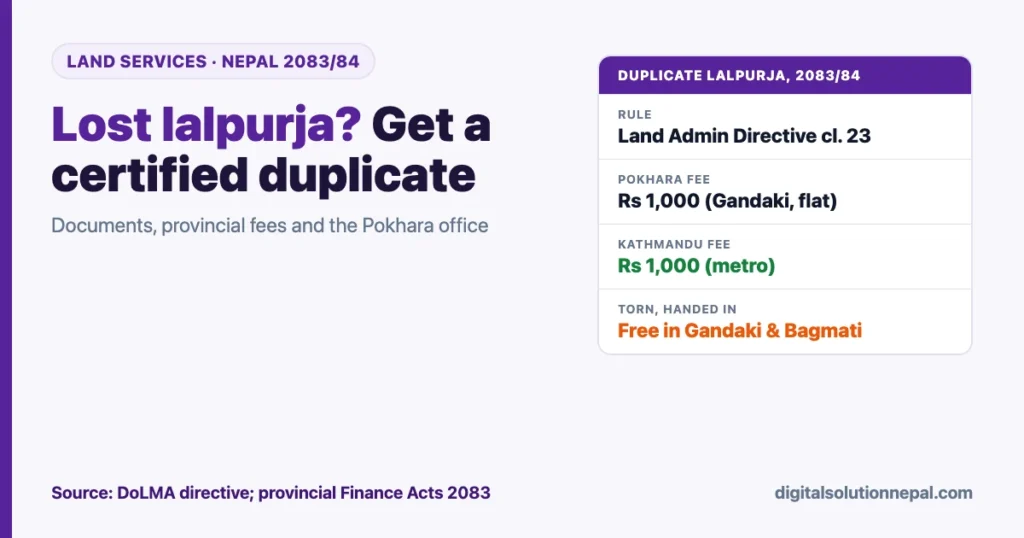
| Rule that applies | Land Administration Directive 2081, clause 23 (lost or damaged) and clause 24 (torn, original returned) |
| Documents | Application, citizenship copy, ownership document, local level recommendation, consent of the freezing body if the land is frozen |
| Fee in Pokhara (Gandaki) | Rs 1,000 per certificate, Gandaki Finance Act 2083 |
| Fee range across Nepal | Rs 200 to Rs 1,500, by province and type of local level |
| Public notice | Not listed in clause 23; a notice and site inquiry appear only in the special process for destroyed office records |
| Service time | Not published in the sources we checked; ask at the counter |
| Online alternative | None for the lalpurja itself; Mero Kitta gives map and field book copies only |
What the duplicate lalpurja is, and what it is not
The lalpurja is the owner’s copy of a record. The master copy is the sresta held by the land office, and since the records were digitised, an entry in the Land Records Information Management System (LRIMS). When you ask for a duplicate, the office checks its own record and certifies a copy for you. It does not create new ownership.
So a lost lalpurja is a nuisance, not a disaster. Still, you need a usable one for almost every land job: sale, mortgage, partition (अंशबण्डा), namsari (नामसारी) or a survey map print. The directive covers two situations:
- Lost, destroyed or unreadable (clause 23). You no longer have a usable original.
- Torn or faded, but you still have it (clause 24). You hand in the old original and receive a fresh copy certificate. The directive calls this “पुरानो खिची नयाँ पुर्जा दिने” (withdraw the old, issue a new one).
Who can apply for a duplicate lalpurja in Nepal
Clause 23 of the Land Administration Directive starts with the landowner: “if a landowner’s certificate is lost, torn, destroyed or unreadable and a copy is requested”. So the person named on the certificate applies.
If the owner has died, our reading is that a duplicate in the dead owner’s name is rarely what you need. Heirs normally go through namsari to bring the land into their own names, and a new certificate is issued at that stage. Clause 22 of the same directive separately lets an heir or interested party (हकवाला वा सरोकारवाला) obtain a certified copy of the sresta, the office record, with proof of relationship. That copy is often enough to start the inheritance paperwork.
For jointly registered land, clause 23(3) gives the original to one owner; the others can get certified copies for the provincial fee, marked with the name of the owner who holds the original.
Documents listed in the directive
Clause 23(1) lists what to submit with the application. We have kept the order of the directive.
| # | Document | Notes |
|---|---|---|
| 1 | Application giving details of the land and the landowner | Write the district, former VDC or current local level, ward, kitta (plot) number and area if you know them |
| 2 | Copy of the applicant’s citizenship certificate | Bring the original for checking |
| 3 | Document by which you obtained the land | For example the passed deed (rajinama, bakaspatra) or the namsari decision |
| 4 | Recommendation letter from the local level of the owner’s permanent address | Usually from your ward office |
| 5 | Consent letter from the body holding a freeze (रोक्का), if the land is frozen | For example a bank where the land is mortgaged |
| 6 | Any other document the office asks for | The directive leaves this open |
The directive does not mention a police report or a newspaper notice, though an office may ask for extra papers under item 6. If you have a photocopy or scan of the old lalpurja, take it; it speeds up the record search.
Duplicate lalpurja fee in 2083/84, province by province
The directive itself sets no fee. Land registration and service fees are set by each province in Schedule 1 of its Finance Act. All seven provinces have an item headed “copy of the land ownership certificate” for 2083/84.
| Province (main cities) | Metropolitan city | Sub-metropolitan city | Municipality | Rural municipality |
|---|---|---|---|---|
| Koshi (Biratnagar) | Rs 1,500 | Rs 1,000 | Rs 700 | Rs 500 |
| Madhesh (Birgunj, Janakpur) | Rs 500 | Rs 500 | Rs 500 | Rs 500 |
| Bagmati (Kathmandu, Lalitpur, Bharatpur) | Rs 1,000 | Rs 800 | Rs 800 | Rs 500 |
| Gandaki (Pokhara) | Rs 1,000 | Rs 1,000 | Rs 1,000 | Rs 1,000 |
| Lumbini (Butwal, Nepalgunj) | No column | Rs 500 | Rs 300 | Rs 200 |
| Karnali (Birendranagar) | No column | No column | Rs 500 | Rs 300 |
| Sudurpashchim (Dhangadhi) | No column | Rs 1,000 | Rs 700 | Rs 500 |
Sudurpashchim figures are from the Finance Bill 2083 text, the version available to us; check the enacted Act at the office. Bagmati’s middle rate applies to sub-metropolitan cities and municipalities together. Gandaki charges one flat rate everywhere.
The fee for the torn-certificate route (old original handed in, new one issued) differs:
| Province | Old lalpurja withdrawn, new one issued |
|---|---|
| Gandaki, Bagmati, Lumbini, Madhesh | No fee (नलाग्ने) |
| Koshi | Rs 500 |
| Karnali | Rs 300 (municipality), Rs 200 (rural municipality) |
| Sudurpashchim (Bill text) | Rs 1,000, Rs 700, Rs 500 by type of local level |
Our reading: in Gandaki, Bagmati, Lumbini and Madhesh, a torn but still present lalpurja costs nothing to replace, so do not throw a damaged original away. Hand it in.
A separate fee applies to a certified copy of the sresta. In Gandaki it is Rs 1,000, Rs 500 or Rs 300 depending on the type of local level. Each schedule also says that a government body requesting a certified copy as evidence pays no copy fee. For the deed registration rates themselves, see our guide to the land registration fee in Nepal.
Step by step at the land office
The directive gives the office’s side of the process. Here it is as a checklist for the applicant.
- Find the right office. Apply at the Land Administration Office that keeps the record for the district where the land lies. Where your rural municipality or municipality has started land services itself, ask the ward office whether it handles copies.
- Get the local level recommendation. Ask the ward office of the owner’s permanent address for a recommendation letter for a lalpurja copy. Ward fees and documents vary by local level.
- Clear any freeze first. If the land is mortgaged or frozen, get a consent letter from the bank or body that holds the freeze.
- Collect your papers. Citizenship copy, ownership document (deed or namsari decision), recommendation letter, and any old photocopy of the lalpurja.
- Submit the application. The office registers it and asks you to pay the fee set by the province.
- Record check. Under clause 23(2), the office matches your details against the moth (मोठ) and freeze (रोक्का) records. If the sresta carries any remark, such as a court note or a freeze, that remark is written on the copy too.
- Collect and check the certified copy. Check the name, father or husband’s name, kitta number, area and remarks before you leave, then scan both sides.
How long it takes. Not published. The directive sets no deadline, and we found no office citizen charter online with a time for this job. Ask at the help desk.
Is there a public notice or field verification?
Many people expect a 35-day or 15-day public notice before a duplicate is issued. The Land Administration Directive does not list one for a lost lalpurja. Clause 23 relies on the office’s own record plus the local level recommendation.
Public notice and on-site inquiry (स्थलगत सर्जमिन) do appear in a different case: when the office’s own records were destroyed. After the Bhadau 2082 protests, the Department of Land Management and Archive issued a circular for the offices whose records burned. According to Kantipur (10 October 2025), the circular says offices should rebuild each sresta from LRIMS, the document management system, archived files and survey records. Only where no proof matches can they use a local level recommendation, a site inquiry and a public notice, with the owner signing a sworn statement.
If you are asked to wait for a notice, our reading is that the office found a gap in its own record; ask which rule it is applying.
Pokhara and Kaski: what to know before you go
The Kaski office was rebuilt from scratch. Kantipur reported (3 November 2025) that all five buildings of the Kaski land revenue office were destroyed by fire on Bhadau 24, 2082, and that about 80 percent of its paper documents and records burned. The same report quoted the office as saying its data was safe in the system. Service restarted from a temporary set-up on Asoj 30, 2082 (Kantipur, 31 October 2025); confirm the current location before you travel.
The fee is flat. Land anywhere in Kaski, city or rural municipality, costs Rs 1,000 per certificate under the Gandaki Finance Act 2083, and a torn lalpurja handed back for a new one is free.
Local levels are taking over. In Baisakh 2083 an ordinance amended the Land Revenue Act 2034 to let local levels run registration, namsari, dakhil kharej and freezes, and renamed Malpot offices as Land Administration Offices (Kantipur, 5 May 2026). Kantipur later reported (23 July 2026) that the ordinance had lapsed, with the ministry relying on rules made under it. On 3 November 2026 Kantipur reported that the ministry had asked all 753 local levels to start land services within a month, and that 33 were already running them. Pokhara was not named among the early ones in the reports we read. Before you go, ask your ward office whether lalpurja copies are now handled by Pokhara Metropolitan City or still by the district office.
Mero Kitta: useful, but not a lalpurja
Mero Kitta, the Survey Department’s portal and app, gives a map print, field book copy and plot register copy, not an ownership certificate, and it asks for a lalpurja scan when you apply. If you do not know your kitta number, its map and field book help you fill in the land office application. See our Mero Kitta guide for the steps.
Lost your lalpurja? Get the paperwork ready first
Digital Solution, Pokhara can scan your land papers and citizenship, draft the application for a certified lalpurja copy, and organise the documents for your ward recommendation, so your visit to the land office is quicker.
Frequently asked questions
Do I need a police report for a lost lalpurja?
The Land Administration Directive does not list one. It asks for an application, citizenship copy, ownership document, local level recommendation and, if needed, a consent letter from the freezing body. An office can ask for other documents, so check at the counter.
How much is the duplicate lalpurja fee in Kathmandu?
Rs 1,000 in a metropolitan city such as Kathmandu or Lalitpur, Rs 800 in a sub-metropolitan city or municipality and Rs 500 in a rural municipality (Bagmati Finance Act 2083).
Can someone else collect it for me?
The directive frames the application as the landowner’s. If you are abroad, ask the office whether it will accept an authorised representative (अधिकृत वारेस) and what documents it needs. We did not find a written rule on this for duplicates.
Can I get a duplicate lalpurja online?
Not as of 7 November 2026. Mero Kitta offers survey documents only, and we found no online application for a lalpurja copy on dolma.gov.np.
Conclusion
Getting a duplicate lalpurja in Nepal is mainly a paperwork job. Get the ward recommendation, gather your citizenship and ownership papers, clear any freeze, and apply at the office that holds your record. The fee for 2083/84 is set by your province: Rs 1,000 in Pokhara and in Kathmandu, between Rs 200 and Rs 1,500 elsewhere. With local levels taking over land services, confirm first whether your ward or the district office handles it. Once you have the new copy, scan it.
Sources
- Department of Land Management and Archive, Land Administration Directive 2081 (with third amendment), clauses 22 to 24 and 305 (approved 2081/11/11; third amendment 2082/12/06): https://dolma.gov.np/content/2/land-administration-directory/
- Gandaki Province, Gandaki Province Finance Act 2083, Schedule 1, service fee item 4 (Province Gazette, 26 Asar 2083): https://mof.gandaki.gov.np/list/act-rules/economic-act-2083
- Bagmati Province, Province Finance Act 2083, Schedule 1, service fee item 4 (certified 31 Asar 2083): https://moeap.bagamati.gov.np/content/13440/state-economic-bill–2083/
- Koshi Province, Koshi Province Finance Act 2083, Schedule 1, service fee item 4 (Province Gazette, 30 Asar 2083): https://moeap.koshi.gov.np/content/327/koshi-province-economic-act–2083/
- Madhesh Province, Madhesh Province Finance Act 2083, Schedule 1, service fee item 4 (Province Gazette, 32 Asar 2083): https://mof.madhesh.gov.np/content/85/madhesh-province-economic-act–2083/
- Lumbini Province, Province Finance Act 2083, Schedule 1, service fee item 4: https://moeap.lumbini.gov.np/publications/155
- Karnali Province, Karnali Province Finance Act 2083, Schedule 1, service fee item 4 (Province Gazette, 31 Asar 2083): https://moeap.karnali.gov.np/content/22/karnali-province-economic-act–2083/
- Sudurpashchim Province, Finance Bill for fiscal year 2083/84, Schedule 1, item 4: https://moea.sudurpashchim.gov.np/content/12621/economic-bill-for-the-financial-year-2083-84/
- Kantipur, “Circular issued to restore destroyed records of land revenue offices” (10 October 2025): https://ekantipur.com/business/2025/10/10/circular-issued-by-the-department-to-restore-the-destroyed-records-of-the-shipping-office-47-40.html
- Kantipur, “Kaski offices returning to service” (31 October 2025): https://ekantipur.com/gandaki-pradesh/2025/10/31/kaski-offices-returning-to-service-40-59.html
- Kantipur, “Land Revenue Kaski: records are safe” (3 November 2025): https://ekantipur.com/gandaki-pradesh/2025/11/03/land-revenue-kaskis-request-records-are-safe-dont-come-now-just-to-maintain-records-06-03.html
- Kantipur, “Land Revenue Office now renamed Land Administration Office” (5 May 2026): https://ekantipur.com/news/2026/05/05/land-revenue-office-now-renamed-land-administration-office-57-03.html
- Kantipur, “Land services from the local level” (23 July 2026): https://ekantipur.com/news/2026/07/23/land-related-services-from-the-local-level-19-05.html
- Kantipur, “Government prepares to start land services at all local levels” (3 November 2026): https://ekantipur.com/news/2026/11/03/preparations-to-start-land-administration-services-at-all-local-levels-45-02.html
This guide is general information, not legal advice; fees and procedures can change, so confirm with your land office or local level before you apply.

Rabin Paudel
Rabin Paudel is the Founder of Digital Solution, a Content Creator, and an AI Trainer. He shares practical and easy-to-understand content on Artificial Intelligence, Digital Literacy, Online Services, FinTech, and Technology. His mission is to make technology simple, accessible, and useful for everyone.
View all posts by Rabin Paudel →