
Updated August 2026. Nepal’s cheque-dishonour law changed substantially in May 2025. Most articles online still describe the old position and are now wrong. Section numbers below come from legal commentary; the official gazette text could not be retrieved, so treat specifics as indicative and consult a lawyer for a live case.
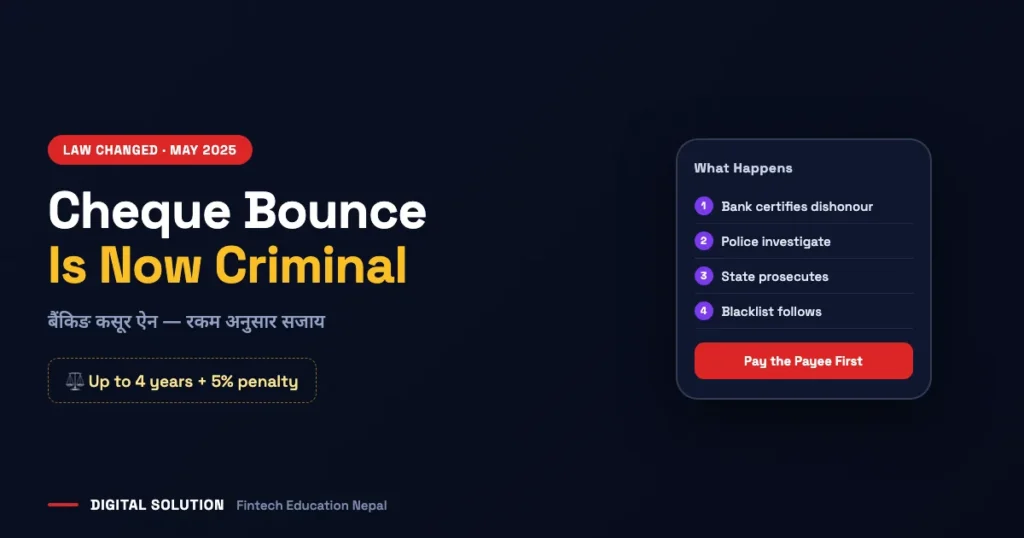
A cheque you issued has bounced — or one you received has. What happens next is not what it was two years ago. The old route of a three-month sentence and a Rs 3,000 fine under the Negotiable Instruments Act is gone. Cheque dishonour in Nepal is now a criminal banking offence with penalties graded by the size of the cheque, and the State prosecutes it.
The Penalty Now Depends on the Cheque Amount
| Cheque amount | Imprisonment |
|---|---|
| Up to Rs 15 lakh | Up to 1 month |
| Rs 15 lakh – Rs 50 lakh | 1 to 3 months |
| Rs 50 lakh – Rs 1 crore | 3 months to 1 year |
| Rs 1 crore – Rs 10 crore | 1 to 2 years |
| Above Rs 10 crore | 2 to 4 years |
On top of the sentence, the issuer is liable for:
It Is Now a Criminal Case, and You No Longer File It Yourself
This is the structural change people miss. Under the amended Act:
The State prosecutes
Cheque dishonour is a banking offence. Police investigate and the State brings the case — a private party can no longer file directly in court.
Your role is the complaint
As the payee, you lodge the complaint. What follows is an investigation, not a suit you control.
There are deadlines
Reported time limits: complaint within 1 year of the bank certifying dishonour, and the charge-sheet within 6 months after that.
Settlement still works
Joint compromise applications are permitted, and an approved settlement bars further prosecution.
What the Bank Charges You
Separate from any legal consequence, your bank charges a fee when a cheque is returned. There is no single national figure — each bank sets it in its own tariff. Published examples:
| Bank | Charge per returned cheque |
|---|---|
| Himalayan Bank | Rs 100 |
| Muktinath Bikas Bank | Rs 200 |
| Prabhu Bank | Rs 500 |
Plan for Rs 100–500 depending on your bank. One tariff also notes that if the account balance is below the charge itself, the whole remaining balance is deducted — so an empty account does not escape the fee.
🤝 Facing a bounced cheque — either side of it?
Send us the situation: cheque amount, date, and whether you issued or received it. Digital Solution will explain the current process and what you need to collect before anything else.
Cheque Bounce and the Blacklist
A dishonoured cheque is one of the Credit Information Bureau’s published grounds for blacklisting — which is how people who never took a loan end up unable to get one. The reported sequence under the July 2025 directive amendment:
- The cheque is dishonoured — insufficient funds, account closed before clearance, signature mismatch, an unjustified stop-payment, or details that cannot be verified.
- The holder is notified and given at least two working days to re-present it.
- A seven-day notice follows before blacklisting proceeds.
- If still unpaid, the issuer is blacklisted through CIB.
If You Issued the Cheque
- Pay the payee directly and immediately. Everything — the criminal exposure, the 5% penalty, the blacklisting — is anchored to non-payment.
- Get a written acknowledgement from the payee that the cheque amount has been settled.
- Tell your bank in writing and ask what it needs to stop the blacklisting process.
- Do not issue a replacement cheque against an account that still cannot cover it.
- Never post-date a cheque as a promise. It is the most common way ordinary people acquire a criminal exposure they never intended.
If You Received the Cheque
- Get the bank’s written certification of dishonour and the returned cheque. This is the foundation document.
- Contact the issuer in writing — most cases end here, and a settlement is faster than any prosecution.
- Watch the one-year clock from the date of certification.
- Keep the underlying paperwork — invoice, agreement, delivery proof. The cheque proves a payment failed, not what it was for.
- Take legal advice before filing, particularly if the cheque is older than the May 2025 amendment.
Frequently Asked Questions
Is cheque bounce a criminal offence in Nepal?
Yes. Since the Second Amendment 2082 to the Banking Offence and Punishment Act 2064, it is treated as a banking offence investigated by police and prosecuted by the State.
What is the punishment for a bounced cheque in Nepal?
Imprisonment graded by cheque amount — from up to one month for smaller cheques to two to four years above Rs 10 crore — plus repayment of the cheque amount with statutory interest and a 5% penalty.
Is it still three months and Rs 3,000?
No. That provision of the Negotiable Instruments Act was repealed in May 2025.
Can I file a cheque case directly in court?
Not under the amended Act. You lodge a complaint; police investigate and the State prosecutes.
Can the matter be settled?
Yes. Joint compromise is permitted, and an approved settlement bars further prosecution. Paying the payee is the single most effective step at any stage.
Will a bounced cheque get me blacklisted?
It can. Issuing a bounced cheque is a published CIB ground, with notice periods before listing and a removal route once the amount is paid.
What does the bank charge?
Roughly Rs 100–500 depending on the bank — it is set in each bank’s own tariff, not by NRB.
My cheque is from before May 2025. Which law applies?
That is genuinely unsettled — there is reporting of a Supreme Court interim order on the point. Take legal advice rather than assuming either position.
Sources
- Banking Offence and Punishment Act, 2064, as amended by the Second Amendment Act 2082, gazetted 6 May 2025 — via published legal commentary; the official gazette text could not be retrieved.
- Nepal Rastra Bank procedure on certifying cheque dishonour, notice no. 16/081-82, published July 2025 (available as a scanned document).
- Reporting on the July 2025 amendment to NRB’s Unified Directive covering cheque-related blacklisting and removal.
- Published tariff schedules of Himalayan Bank, Muktinath Bikas Bank and Prabhu Bank for returned-cheque charges.
Related Reading
- Bank blacklist in Nepal: how to check and how to get removed
- How to complain about a bank in Nepal
- Mobile banking limits and charges
Disclaimer: Digital Solution Nepal is an independent educational and digital-service assistance website — not a bank, not a government body, and not a law firm. Banking rules, fees and NRB directives change through circulars, and each bank sets its own tariff. Nothing here is financial or legal advice — your bank, Nepal Rastra Bank and a qualified professional are final.

Rabin Paudel
Rabin Paudel is the Founder of Digital Solution, a Content Creator, and an AI Trainer. He shares practical and easy-to-understand content on Artificial Intelligence, Digital Literacy, Online Services, FinTech, and Technology. His mission is to make technology simple, accessible, and useful for everyone.
View all posts by Rabin Paudel →