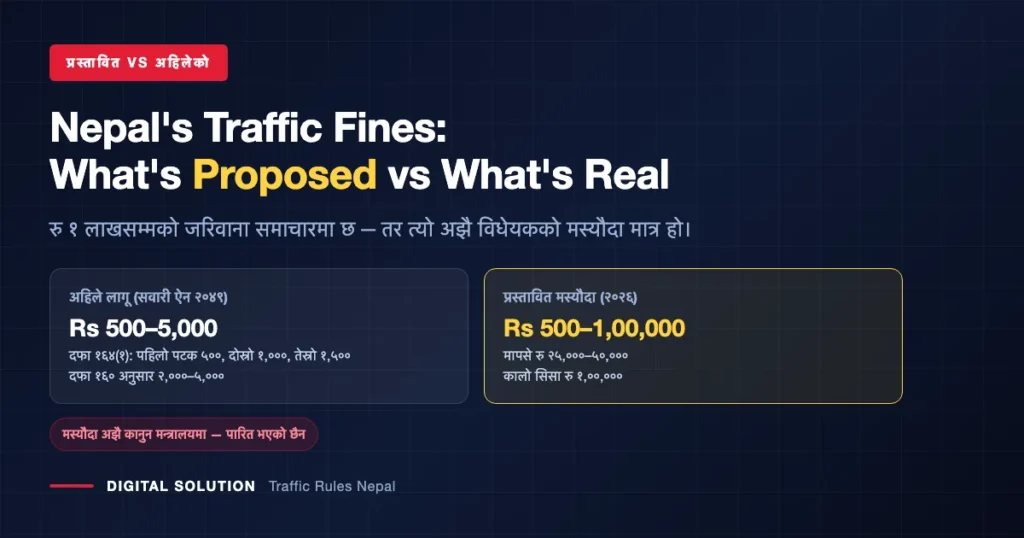
Updated August 2026. Current penalties are from the Nepal Police Traffic Directorate’s published violation list under the Motor Vehicles and Transport Management Act 2049. Proposed figures are from the draft transport bill reported by national media — that bill has not been passed. Verify at traffic.nepalpolice.gov.np before relying on any number.
If you have seen headlines about Rs 1,00,000 traffic fines in Nepal, here is the part most of that coverage buried: those figures come from a draft bill that is still sitting with the Ministry of Law. Nobody has been fined Rs 1 lakh for tinted windows. This guide separates what a traffic officer can actually charge you today from what the proposal would change.
What You Actually Pay Today
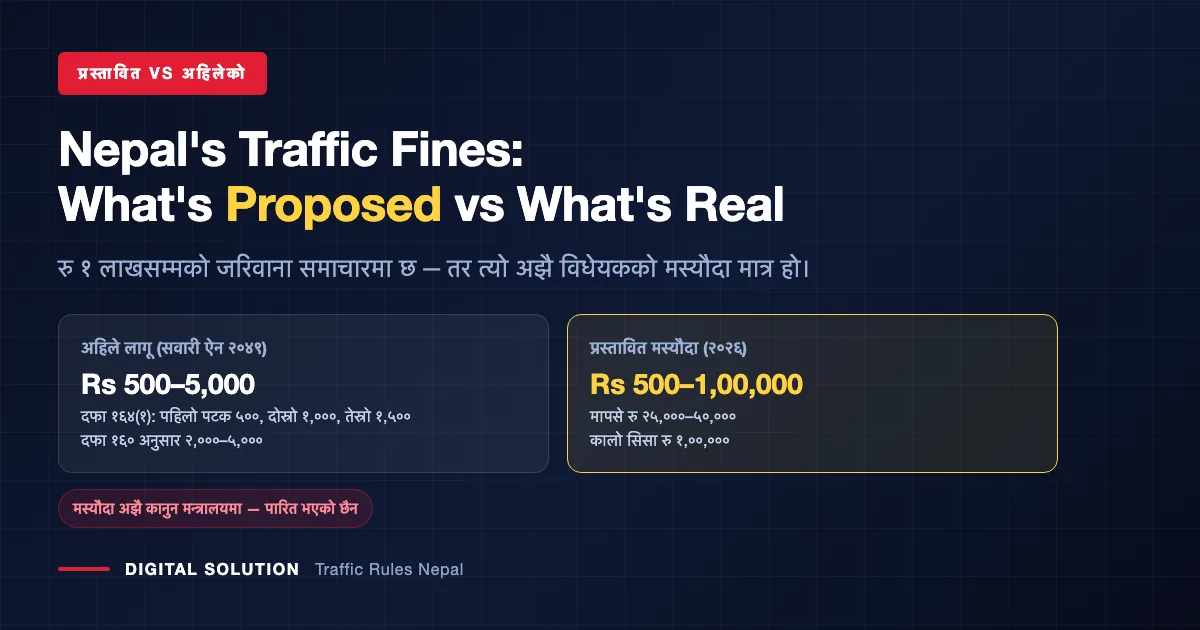
Current penalties come from the Motor Vehicles and Transport Management Act, 2049. The most common everyday violations sit under Section 164(1), which uses a repeat-offence ladder:
| Offence count | Fine |
|---|---|
| First time | Rs 500 |
| Second time | Rs 1,000 |
| Third time or more | Up to Rs 1,500 |
That ladder covers most of what riders and drivers get stopped for — 19 listed offences, including:
- Disobeying a traffic light or an officer’s signal
- Parking where or when parking is prohibited
- Driving on the wrong side, or against a one-way
- Exceeding the prescribed speed
- Driving at night without lights
- Driving after consuming alcohol
- Not wearing a seatbelt or helmet
- Driving without carrying your licence
- Careless driving; refusing passengers; overcharging fares
The part that costs more than the fine. For four of those offences — drink-driving, jumping a red light, lane indiscipline and speeding — the Traffic Directorate requires a compulsory awareness class. The process is handled only at District Traffic Police Office Chundevi (Bhaktapur), Traffic Police Office Satdobato (Lalitpur), or the Kathmandu Valley Traffic Police Office at Ramshahpath. That is a working day gone, not Rs 500.
Higher-tier fines that already exist
| Up to | Applies to |
|---|---|
| Rs 2,000 Sec 160(2)(a) | Using a vehicle for a purpose other than registered (s.12); driving without a licence (s.45); carrying passengers or goods beyond the fixed limit in a public vehicle (s.117) |
| Rs 5,000 Sec 160(2)(b) | Operating an unregistered vehicle (s.14); driving a foreign-registered vehicle without permission (s.29); running a public service without a route permit (s.75); charging above the fixed fare (s.96); obstructing a public place with goods or vehicles (s.125) |
| Rs 1,000 Sec 160(3) | Letting an unlicensed person drive (s.46); smoking in a public vehicle (s.110); failing to stop when signalled (s.132); failing to produce registration or route permit on demand (s.131(2)); driving under other intoxicants (s.142) |
Altering a vehicle’s colour, seat count, engine or chassis without approval (s.39), and running with a false number plate (s.160), are handled through the Department of Transport Management rather than on the roadside.
What the Draft Bill Proposes
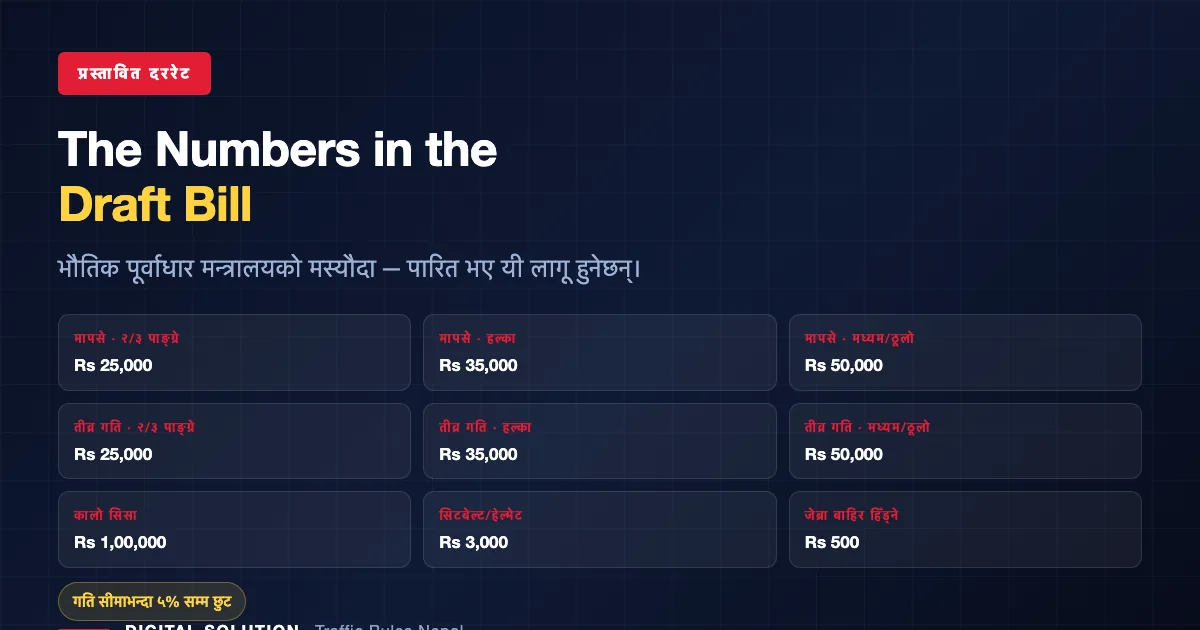
The proposal comes from the Ministry of Infrastructure Development and scales penalties by vehicle class instead of by repeat count:
| Violation | 2/3-wheeler | Light | Medium / heavy |
|---|---|---|---|
| Drink-driving | Rs 25,000 | Rs 35,000 | Rs 50,000 |
| Speeding | Rs 25,000 | Rs 35,000 | Rs 50,000 |
| Violation | Proposed fine |
|---|---|
| Tinted windows / obstructed visibility | Rs 1,00,000 |
| Not wearing a seatbelt or helmet | Rs 3,000 |
| Dangerously slow driving | Rs 3,000–5,000 |
| Pedestrian crossing outside a zebra crossing | Rs 500 |
Two operational details in the draft are worth knowing:
- A 5% speed tolerance — going up to five percent above the posted limit would not be penalised.
- On-the-spot fines by transport inspectors of Assistant Sub-Inspector rank and above.
Where the bill actually is. It is with the Ministry of Law, Justice and Parliamentary Affairs for consultation, and still has to clear Cabinet and Parliament. The steep figures triggered a national debate about whether enforcement and road infrastructure justify them. Until it passes, the 2049 Act and the Rs 500 / 1,000 / 1,500 ladder are what apply.
A proposal reported as if it were law is how a Rs 500 fine becomes a Rs 1,00,000 rumour. Ask which Act the officer is citing.
Watch: New Traffic Rules & Fine List Explained
If You Are Fined: What to Do
- Ask which section you are being charged under. The officer should be able to say. Section 164(1) offences are the Rs 500 ladder; Section 160 offences are the higher tiers.
- Get a receipt. A fine without documentation is not a fine you should pay.
- Check whether an awareness class applies. Drink-driving, red light, lane and speed offences require it — and only three offices in the Valley handle the process.
- Keep your licence current. Driving without carrying it is itself on the list — our complete driving licence guide covers renewal, and province-wise fees changed sharply this year.
Need help with licence paperwork?
Digital Solution assists with driving licence applications, renewals, category additions and International Driving Permits across Nepal.
Frequently Asked Questions
Is the Rs 1,00,000 traffic fine in Nepal real?
Not yet. Rs 1,00,000 for tinted windows or obstructed visibility appears in a draft transport bill from the Ministry of Infrastructure Development. The bill is still under consultation at the Ministry of Law and has not passed Cabinet or Parliament, so it cannot be charged today.
What is the fine for not wearing a helmet in Nepal right now?
Riding without a helmet or seatbelt falls under Section 164(1): Rs 500 for a first offence, Rs 1,000 for a second, and up to Rs 1,500 for a third or later offence. The draft bill proposes raising it to Rs 3,000.
What is the current drink-driving penalty?
Drink-driving is listed under Section 164(1), so the same Rs 500 / 1,000 / 1,500 ladder applies — plus a compulsory awareness class, which is the heavier cost in practice. The draft bill proposes Rs 25,000 to Rs 50,000 depending on vehicle class.
What is the fine for driving without a licence?
Driving without holding a licence (Section 45) carries up to Rs 2,000 under Section 160(2)(a). Driving without carrying a licence you do hold is a separate, lighter offence under Section 164(1).
Where do I attend the compulsory traffic awareness class?
Only at District Traffic Police Office Chundevi (Bhaktapur), Traffic Police Office Satdobato (Lalitpur), or the Kathmandu Valley Traffic Police Office at Ramshahpath. It applies to drink-driving, red-light, lane-discipline and speeding offences.
Will there be a speed tolerance under the new rules?
The draft proposes that speeds up to five percent above the limit would not be penalised. This is a proposal only and has no legal effect until the bill passes.
Related Reading

Rabin Paudel
Rabin Paudel is the Founder of Digital Solution, a Content Creator, and an AI Trainer. He shares practical and easy-to-understand content on Artificial Intelligence, Digital Literacy, Online Services, FinTech, and Technology. His mission is to make technology simple, accessible, and useful for everyone.
View all posts by Rabin Paudel →