
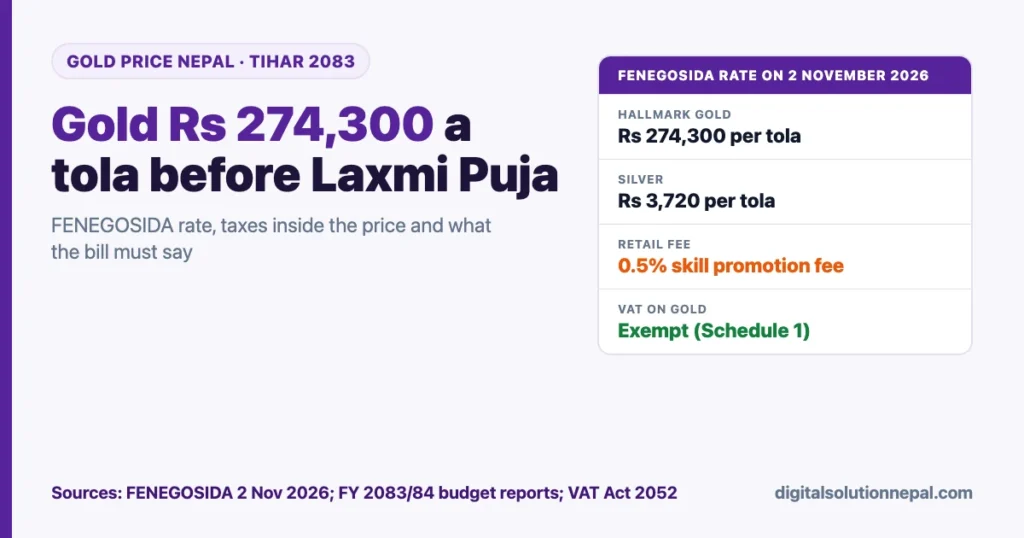
As of 2 November 2026 (16 Kartik 2083). Rates are from the Federation of Nepal Gold and Silver Dealers’ Association (FENEGOSIDA) public rate board at fenegosida.org for that date. Tax rules are from Schedule 1 of the Value Added Tax Act 2052 and from reports on the FY 2083/84 budget in Ratopati, Business 360 and Beemapost. Import rules are from Nepal Rastra Bank’s circular change as reported by ShareSansar. Hallmarking facts are from Nepal Bureau of Standards and Metrology statements reported by Republica and The Himalayan Times. The rate changes every trading day; the figures below are a dated snapshot.
If you are searching for the gold price in Nepal today in the week before Laxmi Puja, you have company. Gold buying peaks around Dhanteras (Friday, 6 November 2026) and Laxmi Puja (Sunday, 8 November), and this year the price is far above where it stood two years ago. On our check date FENEGOSIDA listed hallmark gold at Rs 274,300 per tola and silver at Rs 3,720 per tola.
This guide explains where that number comes from, what a tola weighs, hallmark versus tejabi gold, which taxes are inside the shop price, what the bill must say, and how to check a jeweller. It is written for buyers, not traders.
Quick answers
| Question | Answer (checked 2 November 2026) |
|---|---|
| Gold price today | Rs 274,300 per tola hallmark gold (FENEGOSIDA), up Rs 2,300 from 1 November |
| Gold per 10 grams | Rs 235,170 (FENEGOSIDA), about Rs 23,517 per gram (our calculation) |
| Silver price today | Rs 3,720 per tola; Rs 3,189.50 per 10 grams (FENEGOSIDA) |
| Who sets the rate | FENEGOSIDA publishes one reference rate each trading morning |
| Weight of 1 tola | About 11.664 grams (our calculation from the two FENEGOSIDA rates) |
| Record high | Rs 339,300 per tola on 29 January 2026 (ShareSansar, citing FENEGOSIDA) |
| Customs duty on imported gold | 20 percent from FY 2083/84, up from 10 percent |
| New retail fee | 0.5 percent skill promotion fee on gold, silver and jewellery sales |
| VAT on gold | Gold and gold ornaments are exempt under Schedule 1 of the VAT Act |
| Luxury tax | The 2 percent luxury tax on gold was removed in the FY 2083/84 budget |
| Laxmi Puja 2083 | Sunday, 8 November 2026 (22 Kartik) |
Where the daily rate comes from
Nepal has no gold exchange. The number on news sites each morning is a reference rate published by FENEGOSIDA, the national federation of dealers. Its site shows gold per 10 grams and per tola, and silver on the same basis, each beside the previous day’s figure. On 2 November 2026 the board updated at about 10:40 am.
FENEGOSIDA does not publish its formula. Our reading is that the rate tracks the international price converted at the rupee rate, plus the cost of landing gold in Nepal (customs duty and bank charges), plus a margin. When the budget doubled the duty in May 2026, Ratopati reported the federation’s own estimate that the shop price would rise by more than Rs 20,000 per tola as a result. That is why the Nepali rate can move on a day when the world price is flat.
The rate is not a legal maximum; a shop may quote a little above or below it. It is the benchmark every shop starts from and the one a bill should reference.
For scale: the rate hit a record Rs 339,300 per tola on 29 January 2026 (ShareSansar), stood at Rs 290,200 before Dashain and reopened at Rs 278,500 after the break (Republica, 27 October 2026). FENEGOSIDA’s own board then showed Rs 283,500 on 29 October, Rs 280,300 on 30 October, Rs 272,000 on 1 November and Rs 274,300 on 2 November: a fall of Rs 11,500 in three trading days. The price can swing by Rs 10,000 or more in a week. Buying on the day of Laxmi Puja is a tradition, not a pricing strategy.
Tola versus gram, and why your bill should show both
Shops quote per tola, while FENEGOSIDA also publishes a 10 gram rate. Dividing the two on our check date (274,300 by 23,517) gives 11.664 grams per tola, our calculation, which matches the weight dealers use.
A bill that says “1 tola” leaves room for argument. One that says “11.66 grams at Rs 23,517 per gram” does not. Ask for grams to two decimals, watch the scale, and make sure stones, enamel and lac (the filler inside some bangles) are weighed and listed separately. They are not gold.
Hallmark, fine and tejabi gold: what the words mean
| Term | What it means | Where you see it |
|---|---|---|
| Fine gold (99.99) | Refined bullion of 99.99 percent purity, the grade banks import | Bullion, coins, news reports |
| Hallmark gold (छापावाल सुन) | Gold stamped with a purity mark; FENEGOSIDA now labels its headline rate this way | FENEGOSIDA board, most shop quotes |
| Tejabi gold (तेजाबी सुन) | Locally acid-refined gold, traditionally a step below fine gold | Older rate boards, traditional jewellers |
On our check date FENEGOSIDA’s board showed only a hallmark gold line and a silver line, with no separate tejabi rate. News reports still quote one: ShareSansar on 11 October 2026 put tejabi gold at Rs 295,800 per tola against Rs 296,500 for fine gold, a gap of Rs 700. If a shop offers a cheaper “tejabi rate”, ask what purity that implies and have it written on the bill.
Purity is given in carats or parts per thousand. Under the NBSM standard reported when hallmarking was approved, 24 carat jewellery should be at least 99.5 percent gold and 22 carat at least 91.6 percent. Most Nepali ornaments are sold as 24 carat; heavier chains and wedding sets are often 22 carat because pure gold is soft.
Is hallmarking mandatory in Nepal? No
India made hallmarking compulsory. Nepal has not. The Nepal Standard Council approved an NS hallmark for gold and silver jewellery at its 92nd meeting in November 2014, and NBSM said the scheme would be voluntary at first. In October 2016 The Himalayan Times reported that NBSM had installed fire assay equipment at Balaju and would start the service within a month, again stating it was not mandatory for domestic jewellers. We found no later official notice making it compulsory.
So “hallmark gold” in a Nepali shop usually means the shop’s own stamp or the refinery’s, not a government NS mark. Our reading: the stamp is a promise from the seller; the bill is what makes the promise enforceable.
What is inside the shop price in 2083/84
Three changes from the budget of 29 May 2026 (15 Jestha 2083), in force from 1 Shrawan 2083 (17 July 2026), affect what you pay this Tihar.
| Item | Position in FY 2083/84 | Source |
|---|---|---|
| Customs duty on imported gold | 20 percent, doubled from 10 percent | Ratopati 29 May 2026; Business 360 31 May 2026 |
| Skill promotion fee | 0.5 percent collected from the buyer on gold, silver and jewellery sales | Ratopati 29 May 2026; Artha Dabali 17 July 2026 |
| Luxury tax on gold jewellery | 2 percent tax removed | Beemapost 29 May 2026; Business 360 31 May 2026 |
| VAT on gold and gold ornaments | Exempt (Schedule 1, group 6, VAT Act 2052) | Act text, Law Commission copy |
| VAT on diamond-studded jewellery | 13 percent imposed in FY 2082/83, removed in FY 2083/84 | Business 360 June 2025; Ratopati May 2026 |
The duty is not a line on your bill; it is already inside the FENEGOSIDA rate. The 0.5 percent fee is new and is collected at the shop, so a Rs 274,300 tola carries about Rs 1,372 of fee (our calculation). If a bill shows 13 percent VAT on the gold itself, ask why: Schedule 1 lists gold, gold coins and gold ornaments as exempt. We could not confirm from an official source how VAT applies to the making charge alone, so we state no rule on that.
Making charges: the part nobody prints on the rate board
The FENEGOSIDA rate is for metal. On top of it every jeweller charges for work, called jyala (ज्याला, labour), and sometimes jarti (जर्ती, an allowance for gold lost in making). There is no national cap and no published rate; it depends on the shop, the design and whether the piece is machine- or hand-made. This is where most of the difference between two shops comes from, so compare like with like:
- Ask for gold value and making charge as two lines, with the charge in rupees, not only as a percentage.
- Ask whether jarti is inside the making charge or added on top.
- Confirm stone or lac weight is listed and not priced at the gold rate.
- Get the same design quoted at two shops on the same morning, when both use the same FENEGOSIDA rate.
What the bill must say
The Consumer Protection Act 2075 requires every seller to issue a bill (section 11); refusing one, or charging for it, carries a fine of Rs 2 lakh to Rs 3 lakh. Our guide to the Consumer Protection Act 2075 covers the seven-day return rule and the 1137 complaint line. For gold, a usable bill shows:
- Shop name, PAN and date
- Purity for each item (carat or parts per thousand)
- Net gold weight in grams, with stone or lac weight separately
- Rate per gram or per tola applied
- Making charge as a separate line
- The 0.5 percent skill promotion fee as a separate line
- Any buy-back or exchange terms
Keep the bill with the jewellery. Without it, a purity dispute or a resale is your word against the shop’s.
Resale and exchange
Gold in Nepal is adornment and emergency savings at once. When FENEGOSIDA objected to the FY 2082/83 luxury tax in June 2025, it said the trade operates with a “mandatory buy-back guarantee”, so the gap between a shop’s selling and buying price must stay small. Business 360 reported the statement; no percentage was published.
In practice, when you sell or exchange, the shop pays for the gold content at that day’s rate less a testing and refining deduction, and the making charge you paid is gone. Our reading, from how the trade works rather than any rule: you recover metal value, not purchase price, and the deduction is smaller at the shop that issued the bill. Have the buy-back terms written on the bill.
If savings is the goal, compare a plain coin with a fixed deposit: the deposit has no making charge but taxed interest; gold has a making charge, the fee and a resale deduction, but no annual tax while held.
Why supply matters at festival time
Nepal imports gold through commercial banks under a daily ceiling set by Nepal Rastra Bank. The ceiling was cut from 20 kg to 10 kg a day in March 2022, restored to 20 kg in September 2023 before that year’s Dashain, and raised to 25 kg in October 2025 through an amendment to NRB’s Integrated Circular 2081, which the bank said was meant to keep supply adequate and prices stable. Dealers have reported festival demand of 30 to 40 kg a day in past years, so order heavy pieces a week early.
Laxmi Puja buying checklist
Tihar 2083 runs from Friday, 6 November to Wednesday, 11 November 2026, with Laxmi Puja on Sunday, 8 November (22 Kartik); our Tihar 2083 dates guide has the full calendar.
- Check the FENEGOSIDA rate the morning you buy; the board updates once a day, usually before 11 am.
- Fix the budget in rupees first, then the weight. At Rs 23,517 per gram, 5 grams of 24 carat gold is about Rs 1.18 lakh before making charge and fee (our calculation).
- Pick purity by purpose: 24 carat for coins and plain pieces you may sell, 22 carat for daily wear.
- Watch the scale and get grams, with stone or lac weight separately.
- Agree the making charge in rupees before you say yes.
- Take a bill with purity, weight, rate, making charge and fee as separate lines.
- Pay digitally where possible; a transfer or QR payment is a second record of date and amount.
- For a large purchase, have buy-back terms written on the bill.
- Keep the bill, any stamp card and a photo of the piece together.
How to check a jeweller
- Ask for the shop’s PAN or VAT number on the bill; a registered business has something to lose.
- Prefer a member of a district gold and silver dealers’ association (FENEGOSIDA lists them on its site); the shop then answers to the body that sets the rate it quotes.
- Be wary of a price well below the FENEGOSIDA rate. A deep discount usually means lower purity, hidden stone or lac weight, or metal with no paper trail.
Need help with bills, PAN or digital payment records?
Digital Solution in Pokhara helps small shops and families with document preparation and scanning, PAN and business registration forms, and digital payment and record-keeping skills, so every purchase leaves a clean paper trail. बिल र कागजपत्र मिलाउन हामीलाई सम्पर्क गर्नुहोस्।
Frequently asked questions
What is the gold price in Nepal today?
FENEGOSIDA publishes one reference rate each trading day. On 2 November 2026 it listed hallmark gold at Rs 274,300 per tola (Rs 235,170 per 10 grams) and silver at Rs 3,720 per tola. Check fenegosida.org or a daily news report for the current figure.
How many grams is one tola of gold in Nepal?
About 11.664 grams, from dividing FENEGOSIDA’s tola rate by its 10 gram rate on 2 November 2026 (our calculation). Ask for grams on your bill.
What is the difference between hallmark gold and tejabi gold?
Hallmark (छापावाल) gold carries a purity stamp and is the grade FENEGOSIDA now quotes. Tejabi gold is locally acid-refined and has traded about Rs 700 per tola lower (ShareSansar, 11 October 2026). Government NS hallmarking by NBSM is voluntary, so a stamp alone is not proof of purity.
Is there VAT on gold in Nepal?
Gold, gold coins and gold ornaments are VAT-exempt under Schedule 1 of the VAT Act 2052. From FY 2083/84 a 0.5 percent skill promotion fee is collected from the buyer, the 2 percent luxury tax has been removed, and the 20 percent customs duty is paid by the importer and sits inside the daily rate.
Conclusion
The gold price in Nepal today is one reference number from FENEGOSIDA, but the counter price also carries a making charge and the new 0.5 percent fee, and a resale carries a deduction. The 20 percent duty and the removal of the luxury tax are already inside the daily rate. Because hallmarking is voluntary in Nepal, the bill is your protection: purity, grams, rate, making charge and fee on separate lines. Do that this Laxmi Puja and the gold will be worth what you paid when you need it.
Sources
- FENEGOSIDA, daily rate board, 29 October to 2 November 2026 (public rate API endpoints Dashboard/today and datewisehistory): https://fenegosida.org/
- Law Commission of Nepal, Value Added Tax Act 2052 (as amended), Schedule 1 group 6, gold and silver: https://www.icnl.org/wp-content/uploads/Nepal_Value.pdf
- Ratopati, budget adds tax on gold: customs doubled, skill promotion fee added (29 May 2026): https://www.ratopati.com/story/566680/golden-budget-increases-tax-on-gold-customs-duty-doubled-skill-promotion-fee-added
- Business 360, gold price surges to Rs 311,100 per tola; budget changes (31 May 2026): https://www.b360nepal.com/detail/28815/gold-price-surges-to-rs-311100-per-tola-silver-to-rs-5345
- Beemapost, luxury fee on gold and gold jewellery removed (29 May 2026): https://www.beemapost.com/2026/05/218364/
- Artha Dabali, new fiscal year 2083/84 tax measures in force (17 July 2026): https://www.arthadabali.com/2026/07/17/91026
- Business 360, FENEGOSIDA objects to new tax measures on gold, silver and diamond jewellery (2 June 2025): https://www.b360nepal.com/detail/25421/fenegosida-objects-to-new-tax-measures-on-gold-silver-and-diamond-jewellery-in-budget
- ShareSansar, Nepal Rastra Bank raises daily gold import limit to 25 kilograms (10 October 2025): https://www.sharesansar.com/newsdetail/nepal-rastra-bank-raises-daily-gold-import-limit-to-25-kilograms-2025-10-10
- The Rising Nepal, NRB doubles gold import quota to 20 kg per day (29 September 2023): https://risingnepaldaily.com/news/33060
- ShareSansar, gold price rises by Rs 800 per tola; tejabi and silver rates (11 October 2026): https://www.sharesansar.com/newsdetail/gold-price-rises-by-rs-800-per-tola-today-check-todays-trading-rate-2026-10-11
- ShareSansar, gold slips Rs 20,500 from all-time high of Rs 339,300 (30 January 2026): https://www.sharesansar.com/newsdetail/gold-slips-rs-20500-from-all-time-high-to-trade-at-rs-318800-per-tola-today-2026-01-30
- myRepublica, gold gains Rs 800 per tola, silver falls (27 October 2026): https://myrepublica.nagariknetwork.com/news/gold-gains-rs-800-per-tola-silver-falls-by-rs-25-in-domestic-market-85-88.html
- Republica via ShareSansar, hallmark certification for gold, silver introduced (11 November 2014): https://www.sharesansar.com/newsdetail/hallmark-certification-for-gold-silver-introduced
- The Himalayan Times, hallmarking of gold jewellery to begin soon (26 October 2016): https://thehimalayantimes.com/business/hallmarking-gold-jewellery-begin-soon
- Digital Solution, Consumer Protection Act 2075 explained (15 October 2026): https://digitalsolutionnepal.com/consumer-protection-act-2075-nepal/
This article is general information for buyers in Nepal, not investment or tax advice; rates change daily and tax rules change with each Finance Act, so confirm the current figure before you buy.

Rabin Paudel
Rabin Paudel is the Founder of Digital Solution, a Content Creator, and an AI Trainer. He shares practical and easy-to-understand content on Artificial Intelligence, Digital Literacy, Online Services, FinTech, and Technology. His mission is to make technology simple, accessible, and useful for everyone.
View all posts by Rabin Paudel →