As of 6 November 2026 (20 Kartik 2083). The news is from TechPana’s report of 4 November 2026 (18 Kartik), quoting the Health Insurance Board’s information officer Bikesh Malla. Contribution amounts, target groups and the hotline were checked on the Board’s e-portal (eportal.hib.gov.np) on 6 November.
Nepal’s Health Insurance Board (स्वास्थ्य बीमा बोर्ड) has launched a health insurance bulk enrollment and renewal service for local and provincial governments. Using their own dashboard on the Board’s online portal, a municipality or province can now enrol hundreds of citizens at once, renew them, and pay the contribution in one go.
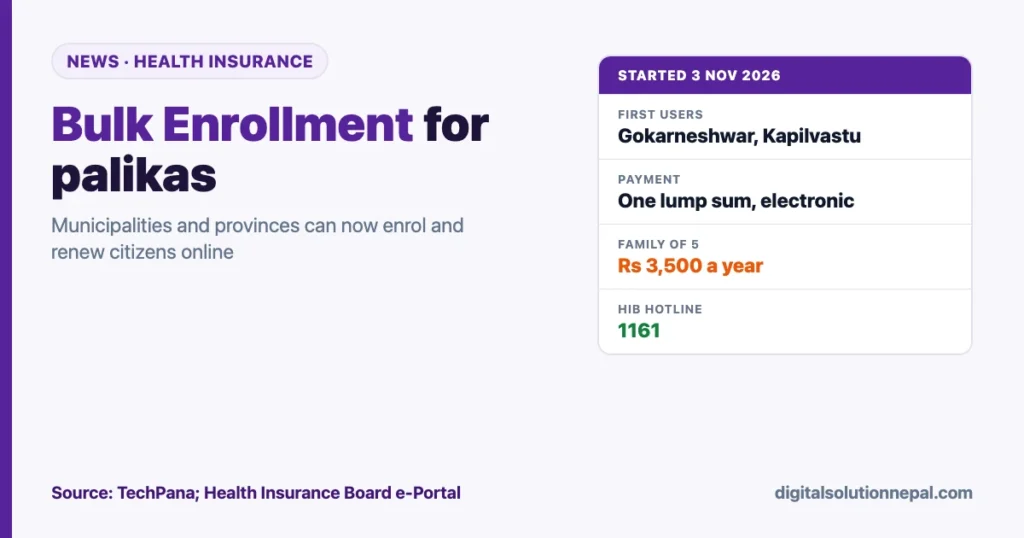
The first two users are Gokarneshwar Municipality in Kathmandu and Kapilvastu Municipality in Kapilvastu, which got institutional access from Tuesday, 3 November 2026.
What changed, in one table
| Item | Before | Now |
|---|---|---|
| Collecting details | Ward-level enrolment assistants collect paper forms | The palika enters details directly on the Board’s portal |
| Submission | Files carried to the district office | Uploaded online from the palika’s dashboard |
| Payment | Voucher collected, money deposited at a bank | One lump-sum payment through the government’s electronic payment system |
| Insurance card | Issued after manual processing | Digital cards generated by the system |
| Who can use it | Local governments (palikas) and provincial governments |
Why municipalities needed this
Many palikas and provinces already pay the health insurance contribution for groups of their own choosing. According to Bikesh Malla, policies differ from place to place. Some cover poor families, some Dalit communities, some their own staff, and some every resident.
The problem was the paperwork. Malla told TechPana that a palika first had to collect details on paper through ward registration assistants. It then had to submit them at the district office, collect vouchers and deposit the money at a bank. Enrolling thousands of people this way took weeks.
Under the new system, the palika enters the details of its target citizens on the portal, the system generates digital insurance cards, and the contribution is paid in a single electronic transfer. The Board says this makes enrolment simpler, more transparent and faster.
A Gandaki example of why this matters: in Shrawan 2082 (July 2025), Dordi Rural Municipality in Lamjung set aside Rs 1.5 crore to give free health insurance to all permanent resident households, 4,225 households across nine wards, according to eKantipur. Schemes like that are exactly what bulk enrolment is built for.
Enrol or Renew Health Insurance With Us
Digital Solution, Pokhara helps families register on the HIB e-portal, update KYC with the national ID and renew health insurance online. WhatsApp +977 9766597181 or use our Order Portal.
How a municipality or province can join
The Board has started with two municipalities, but Malla said other local governments and provinces can join. Based on TechPana’s report, the path looks like this:
- Decide the policy. The palika or province sets who it will cover: poor families, Dalit households, staff, or all residents.
- Contact the Board’s office. Coordinate with the Health Insurance Board’s district office (for a palika) or provincial office (for a province) to request institutional user access.
- Get dashboard access. The Board gives the palika an institutional login on the portal.
- Enter the details. Staff enter or upload the target citizens’ details directly on the portal.
- Pay in one lump sum. The contribution is paid to the Board through the government’s electronic payment system.
- Cards are issued. The system produces digital insurance cards for every enrolled person.
- Renew the same way. When the year ends, the palika renews the whole group from the same dashboard.
Our reading: the national ID rule matters here too. From Poush 1, 2083 (16 December 2026), a national ID number will be needed for everyone aged 16 and over to enrol or renew. Palikas planning a bulk drive should collect NID numbers from the start. Our NID mandatory for health insurance post explains who is exempt.
How much a palika pays per family
The contribution is the same whether a family enrols itself or is enrolled by its palika. These are the amounts on the Board’s e-portal:
| Family size | Yearly contribution |
|---|---|
| 1 to 5 members | Rs 3,500 (minimum) |
| 6 members | Rs 4,200 |
| 8 members | Rs 5,600 |
| 10 members | Rs 7,000 |
Each member beyond five adds Rs 700 (amounts for 6 and 8 members are our calculation from that rule). In return, the family gets health services worth Rs 1 lakh to Rs 2 lakh a year, with an extra Rs 1 lakh for serious illnesses.
Budget example (our calculation): a palika that covers 1,000 families of five pays 1,000 × Rs 3,500 = Rs 35 lakh a year. Covering Dordi’s 4,225 households at the minimum rate would come to about Rs 1.48 crore, close to the Rs 1.5 crore it budgeted.
Who is already covered by the central government
Before a palika pays for anyone, it should check who the Government of Nepal already covers. The e-portal lists these groups, whose contribution the government pays:
- Ultra-poor families with a red card
- Fully disabled people and their families
- People with HIV, MDR-TB or leprosy, and their families
- Senior citizens aged 70 and over (the individual)
- Female community health volunteers and their families, at a 50% discount
A palika’s money goes further if it targets families outside these groups.
What this means for ordinary families
If you live in Gokarneshwar or Kapilvastu, ask your ward office whether you are in the palika’s covered group. If you are, the palika may enrol or renew you without you visiting any office.
If your palika has no scheme, you can still enrol your own family from home. The Board’s e-portal has been running since 29 Shrawan 2083 for individual family registration and renewal. Our step-by-step health insurance online enrolment guide shows each screen.
For questions, the e-portal lists the Health Insurance Board hotline 1161 and the central office numbers 01-4100223 and 01-4100224.
Frequently asked questions
What is health insurance bulk enrollment in Nepal?
A service from the Health Insurance Board that lets local and provincial governments enrol or renew many citizens at once through their own dashboard on the Board’s online portal, and pay the contribution in a single electronic payment.
Which municipalities started first?
Gokarneshwar Municipality (Kathmandu) and Kapilvastu Municipality (Kapilvastu) received institutional access from Tuesday, 3 November 2026, according to TechPana.
Can other municipalities join?
Yes. The Board’s information officer said other local governments and provinces can join by coordinating with the Board’s district or provincial office.
Can an individual use the bulk enrolment service?
No. Bulk enrolment is for institutions. Individual families enrol or renew on eportal.hib.gov.np.
How much does health insurance cost per family?
Rs 3,500 a year for up to five members, plus Rs 700 for each extra member, up to Rs 7,000 for ten, according to the e-portal.
Conclusion
Health insurance bulk enrollment removes the paper trail that slowed down local health insurance schemes. Palikas and provinces can now enrol, pay and renew online, starting with Gokarneshwar and Kapilvastu. If your palika already funds health insurance, this should mean faster cards. If it does not, this is a good moment to ask your ward chair why not.
Need help enrolling your family, updating KYC or renewing health insurance online? Digital Solution can do it with you.
Sources
- TechPana: Online service for local and provincial governments to enrol citizens in health insurance in bulk (4 November 2026)
- Health Insurance Board e-Portal (contribution, target groups and hotline, checked 6 November 2026)
- eKantipur: Dordi Rural Municipality’s free health insurance for residents (Shrawan 2082)
Rules and amounts can change. Check the e-portal or your district health insurance office before you pay.

Rabin Paudel
Rabin Paudel is the Founder of Digital Solution, a Content Creator, and an AI Trainer. He shares practical and easy-to-understand content on Artificial Intelligence, Digital Literacy, Online Services, FinTech, and Technology. His mission is to make technology simple, accessible, and useful for everyone.
View all posts by Rabin Paudel →