
As of 15 October 2026 (29 Asoj 2083). Based on the Act’s Nepali text as published by the Nepal Law Commission, with its official English translation, the Consumer Protection Regulation, 2076, the Department of Commerce, Supplies and Consumer Protection’s notice of 32 Asar 2083, and news reports on the Consumer Court. This is general information, not legal advice.
The Consumer Protection Act 2075 (उपभोक्ता संरक्षण ऐन, २०७५) is Nepal’s main law on what a shop, producer or service provider owes you. It was authenticated on 2 Asoj 2075 (18 September 2018) and replaced the Consumer Protection Act, 2054.
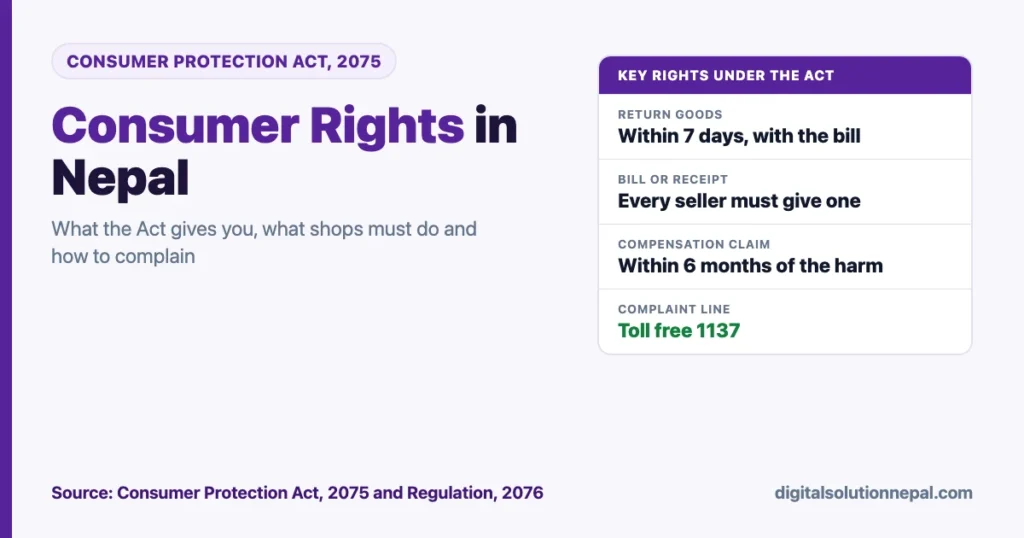
Most people know it exists. Few know what it actually gives them. You can return most goods within seven days if you are not satisfied. Every seller must give you a bill. A shop that refuses one can be fined Rs 2 lakh to Rs 3 lakh on the spot. And if a product or service harms you, you have six months to claim compensation.
This guide goes through the Act section by section: your rights, the seller’s duties, the banned practices, the fines, and exactly how to complain.
Quick answers
| Question | Answer under the Act |
|---|---|
| The law | Consumer Protection Act, 2075, Act No. 10 of 2075 |
| Return a purchase | Within 7 days, with the bill. Sealed goods with the seal intact, within 15 days |
| Bill or receipt | The seller must give one, section 11 |
| Where to complain | Department of Commerce, Supplies and Consumer Protection: toll free 1137 |
| Keep your name secret | Yes, on request, section 36 |
| Claim compensation | Within six months of the harm, section 50 |
| Consumer Court | Running since March 2025 in Tripureshwor, for Kathmandu Valley cases |
| Reward for a tip-off | 10% of the amount recovered or Rs 10 lakh, whichever is lower |
Who counts as a consumer
The Act defines a consumer as any person or institution that consumes or uses goods or services. Because the definition turns on use, in our reading you do not need to be the buyer: a family member who uses the product is covered too.
“Service” is defined widely. It names electricity, drinking water, telephone, information technology, health, education, consultation, transport, drainage and banking, and it expressly includes legal, medical and engineering services. That is why hospitals and doctors now appear in consumer cases.
The nine consumer rights in section 3
Section 3 starts with one general right: every consumer has the right to quality goods and services. It then lists nine specific rights.
| Right | In plain words |
|---|---|
| Easy access to goods and services | Sellers cannot block or ration supply without reason |
| Choice at a fair, competitive price | Quality goods at a price set by competition, not by a cartel |
| Information on price, quantity, purity and quality | You are entitled to know what you are paying for |
| Ingredient information for mixed products | The producer, importer or seller must tell you what is in it and in what share |
| Safety | Protection from goods and services that harm body, life, health or property |
| Legal action against unfair trade | You can ask the authorities to act |
| Compensation for harm | A claim for damage caused by goods or services |
| A hearing and remedy | From the competent authority |
| Consumer education | The right to learn about your rights |
Your right to return goods within seven days
Section 14 is the most useful line in the whole Consumer Protection Act 2075, and the least known.
If you are not satisfied with goods you bought, you may return them to the seller within seven days. You can take either similar goods of the same price or your money back. The seller may not cut the price or charge any fee for the return. You must show the bill or receipt from the purchase.
Sealed goods get longer. If the seal is unbroken, you may return them within fifteen days.
The right does not apply in five cases:
- You changed the quality or quantity of the goods after buying them.
- The goods had to be used by a set date, and that date has passed.
- The goods spoil quickly, such as milk, fruit, vegetables, fish or meat.
- You have already used the goods.
- The seal of sealed goods is broken.
A seller who will not take goods back or give equal goods in exchange commits an offence. The Act lets the Department’s Director General punish it with three to six months’ imprisonment, a fine of up to Rs 50,000, or both.
In our reading, a “no return, no exchange” sign cannot override section 14, and because the Act does not separate online shops from physical ones, any seller of goods is bound by it. Keep the bill, and keep the packaging until you are sure.
What every shop and service provider must do
Sections 11, 12 and 20 set out duties that apply to every seller and service provider.
| Duty | Section |
|---|---|
| Sell without discrimination | 11 and 12 |
| Store goods so their quality does not fall | 11 |
| Keep a price list that the public can see and understand | 11 and 20 |
| Serve customers first come, first served | 11 and 12 |
| Honour any guarantee or warranty on the goods | 11 |
| Give a bill or receipt for every sale | 11 |
| Service providers: display the nature of the service and its price | 12 |
| Service providers: give a bill after taking payment | 12 |
| Display the industry or business registration certificate at the place of sale | 20 |
Producers have their own duties under section 7: make quality goods, label them correctly, avoid defective products, recall defective goods from the market, avoid misleading advertising and pay reasonable compensation for damage their product causes.
Getting a bill matters beyond this Act too. It is how sales reach the tax system, and bills are the entries in the government’s taxpayer lucky draw.
What a label must show
Section 6 makes the producer label its goods, in Nepali or English, in words ordinary people can understand. For imported goods the importer is responsible. The label must show, among other things:
- the producer’s name, address and industry registration number;
- ingredients, quantity and weight for food, medicines and cosmetics;
- how to use the goods and any side effects;
- the use-by date where there is one;
- the retail price, batch number and date of manufacture;
- the maximum retail price including all taxes;
- the guarantee or warranty and its date for electronics, hardware, electrical goods, machinery and other long-life goods;
- safety precautions for flammable, hazardous or fragile goods.
Goods without a proper label may not be imported, sold or distributed in Nepal. Loose vegetables and fruit sold in the open are exempt, but imported vegetables and fruit still need labels.
Unfair trade practices the Act bans
Section 16 lists what counts as unfair trade. Sections 17 and 18 add practices that distort supply and price. The main ones:
- Misrepresentation: hiding or misstating the real quality, quantity, price, measurement or composition.
- Misleading advertising: false claims, or benefits that do not exist.
- Old sold as new: passing off reconditioned or old goods as new.
- Hidden costs: loading the cost of a contest, lottery or “free gift” into the price.
- Artificial shortage: hoarding goods to push up prices, or selling only at set times or places.
- No bill: refusing to give a bill or invoice, or charging extra for one.
- Relabelled expiry: putting a new label on expired goods.
- Fake goods: making, importing or selling counterfeits.
- Tie-in sales: forcing you to buy one item in order to get another.
- Syndicates in services: running a service by circle, quota, rotation, trip or token system agreed among operators.
- Overcharging on essentials: selling above the maximum price the government sets for essential goods and services under section 19.
Fines and punishment for sellers
The Act has three levels of penalty. Inspection Officers can fine on the spot. The Department’s Director General can punish less serious offences. The most serious cases go to court.
On-the-spot fines by an Inspection Officer, section 39
| Offence | Fine |
|---|---|
| Not keeping purchase bills or invoices for goods bought for resale | Rs 5,000 to Rs 20,000 |
| Misrepresenting quality, quantity or price; creating an artificial shortage; refusing a bill or charging extra for one; relabelling expired goods | Rs 2 lakh to Rs 3 lakh |
| Hoarding to create a shortage, or selling only at set times or places | Rs 50,000 to Rs 1 lakh |
| No price list, or registration certificate not displayed | Rs 50,000 to Rs 1 lakh |
| Not cooperating with an inspection | Up to Rs 20,000 |
A repeat offence doubles the fine each time. A business can ask the Director General to review an on-the-spot fine within seven days, but must deposit 50% of the fine to do so. The Director General decides within 21 days, and that decision is final.
Punishment by the Director General, section 40(1)
| Offence | Punishment |
|---|---|
| Labelling failures, or refusing to take back goods under section 14 | 3 to 6 months’ imprisonment, a fine up to Rs 50,000, or both |
| Section 18 acts, such as knowingly selling sub-standard goods, deception, goods harmful to health, tie-in sales or syndicates | 3 months to 1 year, Rs 1 lakh to Rs 3 lakh, or both |
| Selling above the government-fixed price, or against the price standards | 3 to 6 months, Rs 50,000 to Rs 1 lakh, or both |
An appeal against the Director General’s decision goes to the District Court within 35 days.
Punishment by the court, section 40(3) and (4)
| Offence | Punishment |
|---|---|
| A producer, importer, carrier, hoarder, seller or service provider failing the duties in sections 7 to 12 | 2 to 3 years, Rs 3 lakh to Rs 5 lakh, or both |
| Other unfair trade practices, such as misleading advertising, fake goods or harmful mixing | 2 to 5 years, Rs 4 lakh to Rs 6 lakh, or both |
| Excess profit, or restricting raw materials to affect supply and price | 2 to 3 years, Rs 3 lakh to Rs 5 lakh, or both |
| Any other breach of the Act or its rules | Up to 2 years, up to Rs 3 lakh, or both |
Where a company commits an offence, section 55 makes the person working as its chief administrative officer responsible.
How to file a consumer complaint in Nepal
Section 36 lets anyone who learns of a breach complain, in writing, orally or electronically, to the Central Market Monitoring Committee, the Department or an Inspection Officer. The Consumer Protection Regulation, 2076 sets out the process.
- Collect your evidence. The bill, photos of the product or label, the warranty card, screenshots of the advertisement or chat, and any reply from the seller.
- Choose a channel. The Department’s notice of 32 Asar 2083 lists three: toll free 1137, email gunaso.banijyabibhag@gmail.com, and its CRMIS portal at monitoring.doc.gov.np/ConsumerComplaint. You can also go to the Department at Babarmahal, Kathmandu.
- Include four things. Rule 29 asks for the name and address of the business, what went wrong and the loss it caused, your name, address and phone number, and the evidence.
- Ask for confidentiality if you need it. The Act says your name must be kept secret if you ask. The rule asks you to give the reason in the complaint.
- Get your receipt. Rule 30 says the Department registers a complaint immediately and gives the complainant a receipt. An oral complaint is written down in the prescribed format and signed.
- Follow up with the reference. The Director General orders an Inspection Officer to investigate. A complaint can be shelved if it is false, already dealt with or lacks evidence, so the evidence in step 1 matters.
Rule 31 also lets the Department treat a problem reported in the media or on social media as a complaint.
For regulated sectors the sector regulator also takes complaints. Our guides cover an NTA complaint about an internet overcharge, a digital payment or banking complaint to NRB and what to do when an insurance claim is rejected.
Claiming compensation and the Consumer Court
A complaint to the Department leads to fines and punishment. Money for you comes through a compensation claim.
What the Act allows
Under section 50, if goods or services sold against the Act cause you bodily, mental, financial, physical or other harm, you can claim compensation in court within six months of the harm. A consumer association can file on your behalf. If the consumer cannot act or has died, the heir can.
Section 51 covers treatment costs, interim relief for the family’s daily needs during treatment, and compensation for the harm. Section 52 tells the court to consider the pain suffered, treatment costs, lost earning capacity, the victim’s age and family responsibilities, dependants, and the business’s own financial position.
The Consumer Court
The Act allowed the government to set up Consumer Courts in 2018. It took a Supreme Court order, issued on 8 Falgun 2078, and three more years. The gazette notice came on 10 February 2025, and the court began work on 15 March 2025, World Consumer Rights Day, at Tripureshwor.
It hears cases from Kathmandu, Lalitpur and Bhaktapur only. According to eKantipur’s report of July 2026, no court had yet been set up in any province, although the new government’s policy and programme plans one for each province. Outside the Valley, in our reading, the route is the District Court: section 48 gives District Courts this power until a Consumer Court is set up, and the only one so far covers the Valley alone.
The court’s first year, as reported by eKantipur:
| Item | Figure |
|---|---|
| Cases registered up to fiscal year 2082/83 | 45 |
| Decided | 23 |
| Settled out of court | 4 |
| Most common subjects | Medical negligence 12, purchase of goods and services 12, vehicles 11, internet service and repairs 5 |
Some awards have been large. eKantipur reported Rs 2.62 crore against Qatar Airways for a passenger scalded by coffee in flight, and Rs 1.1 crore over an electric shock at a hotel swimming pool. A hospital was ordered to pay Rs 56.81 lakh in the court’s first registered case.
Jyoti Baniya, president of the Consumer Interest Protection Forum Nepal (उपभोक्ता हित संरक्षण मञ्च), told eKantipur that no fee is charged to file a case there. An appeal against the court’s decision goes to the High Court within 30 days.
A reward for reporting offences
Section 56 rewards the person whose information leads to a case. Once the case is finally settled, the informant gets 10% of the amount recovered or Rs 10 lakh, whichever is lower. The informant’s name, address and information are kept confidential.
Government employees, staff of public corporations, and the representatives or staff of consumer organisations involved in monitoring, and their family members, cannot claim the reward.
Who enforces the Act
| Body | Role |
|---|---|
| Consumer Protection Council | Chaired by the Minister for Industry, Commerce and Supplies; sets policy and meets at least twice a year |
| Central Market Monitoring Committee | Coordinates monitoring of supply, price, quality and purity |
| Department of Commerce, Supplies and Consumer Protection | Takes complaints, runs inspections, its Director General punishes offences |
| Inspection Officers | Inspect, take samples, fine on the spot, and investigate cases |
| Provincial and local market monitoring committees | Provinces and municipalities may form their own, for local monitoring |
An Inspection Officer may enter premises to inspect and, with the permission of the authority hearing the case, hold an offender for up to seven days.
A checklist before you pay
- Ask for the bill every time, and photograph it if it is thermal paper.
- Check the label for the maximum retail price, batch number, manufacture date and expiry.
- Match the warranty date on the card to the date of your purchase.
- Keep the box and seal for at least fifteen days on sealed goods.
- Screenshot the advertisement or the online listing you relied on.
- Complain in writing first to the seller, then to 1137 or the CRMIS portal if nothing happens.
Need help writing a consumer complaint?
We help with complaint letters, scans of bills and online submission. उपभोक्ता उजुरी लेख्न र पठाउन सहयोग चाहिए सम्पर्क गर्नुहोस्।
Frequently asked questions
What is the Consumer Protection Act 2075?
It is Nepal’s main consumer law, Act No. 10 of 2075, authenticated on 18 September 2018. It sets out consumer rights, duties of producers and sellers, banned trade practices, penalties, the Consumer Court and compensation.
Can I return goods in Nepal if I don’t like them?
Yes. Section 14 lets you return goods within seven days for a replacement of the same price or a refund, with the bill. Sealed goods with an unbroken seal can be returned within fifteen days. Used, altered, expired, perishable or unsealed goods are excluded.
What is the consumer complaint number in Nepal?
The Department of Commerce, Supplies and Consumer Protection lists toll free 1137. It also takes complaints by email at gunaso.banijyabibhag@gmail.com and through its CRMIS portal.
What is the fine for not giving a bill in Nepal?
Refusing to give a bill or invoice, or charging extra for one, is an unfair trade practice. An Inspection Officer can fine it Rs 2 lakh to Rs 3 lakh on the spot, doubled for repeat offences.
How long do I have to claim compensation?
Six months from the date of the harm, under section 50. Kathmandu Valley cases go to the Consumer Court. Elsewhere, in our reading, the claim goes to the District Court until a Consumer Court covers that area.
Do hospitals come under the Consumer Protection Act?
Yes. The Act’s definition of service includes health and medical services, and medical negligence is among the most common subjects at the Consumer Court.
Conclusion
The Consumer Protection Act 2075 gives you more than most shops let on: a seven-day return right, a bill for every purchase, honest labels and prices, and six months to claim compensation for harm. It also gives inspectors real fines to use, from Rs 5,000 to Rs 3 lakh on the spot.
The law works when consumers use it. Keep your bills, put complaints in writing, call 1137 when a seller refuses, and remember the six-month limit if a product or service has hurt you.
Sources
- Consumer Protection Act, 2075, Nepali text as published by the Nepal Law Commission, including the 2075 amendment to align Nepal Acts with the Constitution: https://www.lawcommission.gov.np/content/12167/12167-the-consumer-protection-act-2/
- The same Act as hosted by Nepal Rastra Bank: https://www.nrb.org.np/contents/uploads/2021/07/%E0%A5%A8%E0%A5%A9.%E0%A4%89%E0%A4%AA%E0%A4%AD%E0%A5%8B%E0%A4%95%E0%A5%8D%E0%A4%A4%E0%A4%BE-%E0%A4%B8%E0%A4%82%E0%A4%B0%E0%A4%95%E0%A5%8D%E0%A4%B7%E0%A4%A3-%E0%A4%90%E0%A4%A8-%E0%A5%A8%E0%A5%A6%E0%A5%AD%E0%A5%AB.pdf
- The Consumer Protection Act, 2075 (2018), English translation by the Nepal Law Commission, as hosted by the Asian Development Bank’s Law and Policy Reform portal: https://lpr.adb.org/resource/consumer-protection-act-2075-2018-nepal
- Consumer Protection Regulation, 2076, rules 29 to 32, as published by the Nepal Law Commission: https://lawcommission.gov.np/content/12452/12452-consumer-protection-regulation/
- Department of Commerce, Supplies and Consumer Protection, notice on complaint channels, 32 Asar 2083: https://doc.gov.np/content/439/a-request-to-all-consumers/
- The Kathmandu Post, “Consumer court, Nepal’s first, to begin operations today” (15 March 2025): https://kathmandupost.com/money/2025/03/15/consumer-court-nepal-s-first-to-begin-operations-today
- eKantipur, report on 41 cases in the Consumer Court’s first year (18 March 2026): https://ekantipur.com/business/2026/03/18/41-cases-in-the-consumer-court-in-a-year-6-verdicts-56-47.html
- eKantipur, report on the Consumer Court’s first year and its limits (19 July 2026): https://ekantipur.com/news/2026/07/19/one-year-of-the-consumer-court-progress-in-compensation-decisions-challenges-in-expanding-access-50-25.html
Digital Solution Pvt. Ltd. is an independent publisher and is not affiliated with the Department of Commerce, Supplies and Consumer Protection or the Consumer Court. Sections are summarised from the Act’s Nepali text and the Law Commission’s English translation; where they differ, the Nepali text prevails. Court figures are as reported by the newspapers named. This is general information, not legal advice.

Rabin Paudel
Rabin Paudel is the Founder of Digital Solution, a Content Creator, and an AI Trainer. He shares practical and easy-to-understand content on Artificial Intelligence, Digital Literacy, Online Services, FinTech, and Technology. His mission is to make technology simple, accessible, and useful for everyone.
View all posts by Rabin Paudel →