
Updated 12 August 2026. Download figures below were read from Google Play on this date. Company details come from Yarsa Labs’ own website and registration records.
The most-downloaded app ever built in Nepal was not made in Kathmandu. It was made in Pokhara — first from an office in Lakeside, later from Talchowk — by a company most Nepalis have never heard of, founded by a man who dropped out of engineering college.
Yarsa Labs was registered in Pokhara on 28 August 2016. Ten years later its Ludo game has passed 197 million installs on Google Play, and the whole catalogue sits above 234 million. Those are real numbers, pulled from the store today.
This is the story of NJ Subedi and what his company actually built — with the figures checked rather than repeated.
The Pokhara detail that matters most
Nepal’s technology industry is understood to live in Kathmandu. Almost every accelerator, investor meeting and IT conference happens there, and the assumption that a serious tech company must move to the capital is so common it barely gets questioned.
Yarsa Labs is the counter-example, and the details are on the record:
| Registered office | Pokhara 30, Kaski, Gandaki Province |
| Registration | Reg. No. 154745/073/074 · PAN 604314075 |
| Founded | 28 August 2016 |
| Head office today | Buddha Complex, Talchowk, Pokhara Metropolitan City Ward 29 |
| Second office | Shikali Marg, Lalitpur |
Note the order. The Pokhara office is the head office; Lalitpur came later and second. For a Nepali technology company at this scale, that is unusual enough to be the point of the whole story.
The company began, by Subedi’s account to Onlinekhabar, with a small team working out of Pokhara’s Lakeside — the tourist strip — and hiring interns from Pokhara Engineering College. It now runs from two buildings in Talchowk.
One small correction worth making, since it appears in coverage: the area is Talchowk, and it is not in Lekhnath. Lekhnath Municipality stopped existing in 2017 when it merged into Pokhara Metropolitan City. Talchowk is Pokhara Metro Ward 29.
What Yarsa actually built
Yarsa Labs is a holding company. Four subsidiaries sit under it, each started in a different year:
| Company | Started | What it does |
|---|---|---|
| Yarsa Games | 2017 | Mobile games — the business everyone knows |
| Yarsa Tech | 2021 | Hardware and electronics |
| Yarsa Bazar | 2023 | B2B marketplace connecting wholesalers and retailers |
| Yarsa Play | 2024 | Gaming backend infrastructure |
Yarsa Tech is the part that surprises people. It builds physical products: AudiQR, an audio payment notifier for shops; Nizi Power, a backup power unit for routers; NiziPOS; Nizi Scan; a motor controller; and Junkiri automatic light sensors. A Pokhara game studio that also makes hardware is not a common combination anywhere.
The download numbers, checked
Here is where published coverage and the app stores part company, so we went and read the store directly.
Every Yarsa game on Google Play, with actual install counts on 12 August 2026:
| App | Installs |
|---|---|
| Ludo | 197,152,794 |
| Callbreak, Ludo & 29 Card Game | 14,922,555 |
| Indian Rummy | 7,770,550 |
| Ludo Match | 7,684,127 |
| Call break | 4,126,609 |
| Callbreak Multiplayer | 1,621,626 |
| Block Match – Blast Game | 517,173 |
| Real Car Parking | 463,870 |
| Parchisi | 210,566 |
| Indian Driving School 3D | 156,915 |
| Gin Rummy | 15,764 |
| Total, 11 apps | 234,642,549 |
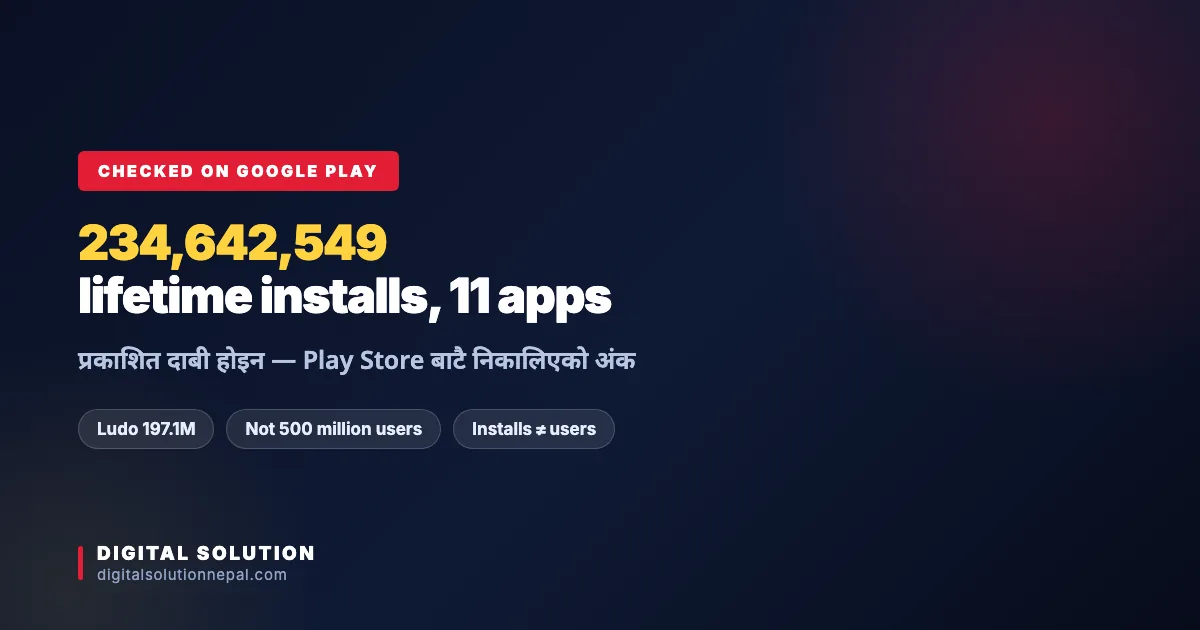
Ludo alone is at 197 million installs. Google Play’s public badge rounds this down to “100M+”, which understates it considerably. First released 11 February 2019, it is, as far as we can establish, the most-downloaded application ever built in Nepal.
That is a genuinely remarkable achievement for a company headquartered in Pokhara, and it does not need rounding up.
Three figures we are not repeating
The article that prompted this piece — an Onlinekhabar profile in its “Forty Under Forty” series — contains numbers we could not stand behind, so we are being explicit about them.
“500 million users.” The Nepali text says ५० करोड. We traced where that comes from: Yarsa Games’ own website carries a roadmap whose final line reads “2025 – Expecting 500M+ Users” — listed after “2022 – 100+ Million Users”. It is a projection, not an achievement. Yarsa’s own current claims elsewhere are “120M+ Players” on one site and “150M+ users” on another, and those two do not agree with each other either.
Installs are also not users. A lifetime install count includes reinstalls and people who deleted the app years ago. 234 million downloads is a real, verifiable number. 234 million active users is not the same claim.
“Ludo alone has passed 200 million.” Not yet — 197 million, and closing. What is defensible is the article’s actual wording: Ludo and Callbreak together are past 200 million.
And one trap worth flagging. If you search Play for “Callbreak”, the dominant app is Callbreak.com with 133 million installs — but that belongs to Teslatech, a different Nepali company based in Lalitpur, released back in 2014. Yarsa’s own Callbreak-branded apps total about 20.7 million between them. Nepal has two app companies in the 100-million tier, and they are not the same company.
The path there was not straight
Subedi’s route into this, as he told Onlinekhabar, is the part most useful to anyone in Gandaki thinking about building something.
He wanted to be a surgeon. He switched to computer engineering after meeting a cousin who programmed. He enrolled at Kathmandu University and left after four semesters, against his family’s wishes — they had wanted civil engineering at Pulchowk.
Before Yarsa existed he worked on things that paid little and taught a lot: the Health Nepal Network project, an offline Wikipedia for rural school e-libraries, the Ubuntu Nepali language pack, Nepali localisation for Google Maps and Facebook, and a feedback system for the constitution drafting process.
Then Yarsa’s first years were a run of failures. By his own account the company tried and abandoned food delivery, hotel booking, down jacket e-commerce, taxi booking and a dating platform before games worked.
His summary of what changed: “पैसा त नवीन सोचमा पो रहेछ” — the money turns out to be in original thinking.
The COVID period in 2020 was the turning point, when people stuck at home went looking for exactly the kind of casual multiplayer games Yarsa was making.
He is still studying. While running the company he is reading law at Gandaki University, on the reasoning that a founder should understand the legal side of the business himself.
What the company is, honestly, today
We should be equally careful here, because company size is where profiles most often inflate.
Yarsa’s own website states a team size of 50–99 people. LinkedIn shows 63 employees listed. Coverage describing “200+ engineers” is not supported by what the company itself publishes.
The company is unfunded — no venture capital raised. It grew on revenue from its games, which for a Nepali technology company is a harder and more unusual route than raising money.
That combination — Pokhara-based, self-funded, profitable enough to hire engineers from Itahari to Dhangadhi — is the real story, and it does not need a 500-million-user headline to be impressive.
Why this matters for Gandaki
Subedi’s argument, in his own words: “नेपालमै केही गर्न चाहने युवालाई उचित पारिश्रमिक दिन सकियो भने उनीहरू विदेशिनुपर्दैन” — if young people who want to build something in Nepal are paid properly, they do not have to go abroad.
That is easy to say and hard to demonstrate. Yarsa demonstrates it, in Pokhara, at a scale nobody else in the province has matched.
For anyone in Gandaki weighing whether a technology business can work from here, the practical lessons in this story are worth more than the download counts:
- The head office stayed in Pokhara through a decade of growth. The Lalitpur office is second, not first.
- The first engineers were local interns from Pokhara Engineering College, trained up rather than recruited from Kathmandu.
- The successful product was the sixth or seventh idea, not the first. Five businesses were abandoned before games worked.
- It grew on revenue, not investment — which meant the company answered to customers rather than to a funding round.
- The market was never Nepal alone. Ludo’s installs come overwhelmingly from outside the country. Building from Pokhara did not mean selling only to Pokhara.
Frequently asked questions
Who is NJ Subedi?
He is the founder and CEO of Yarsa Labs, a technology company headquartered in Talchowk, Pokhara. He is from Pokhara, left computer engineering at Kathmandu University after four semesters, and founded Yarsa Labs in 2016.
What is Yarsa Labs?
A Pokhara-based holding company registered in 2016, with four subsidiaries: Yarsa Games (mobile games), Yarsa Tech (hardware), Yarsa Bazar (B2B marketplace) and Yarsa Play (gaming infrastructure).
How many downloads does Yarsa Ludo have?
197,152,794 installs on Google Play as of 12 August 2026. The store’s public badge shows “100M+”, which rounds it down. It is the most-downloaded app built in Nepal that we could identify.
Is Yarsa Ludo really used by 500 million people?
No. That figure appears to come from a projection on Yarsa’s own website — “2025 – Expecting 500M+ Users” — rather than an achieved number. Across its entire Google Play catalogue Yarsa has about 234 million lifetime installs, and installs are not the same as active users.
Is Callbreak.com a Yarsa game?
No. Callbreak.com, with over 133 million installs, is made by Teslatech, a separate Nepali company based in Lalitpur. Yarsa publishes its own Callbreak-branded games, which are considerably smaller.
How many people does Yarsa Labs employ?
The company’s own website states a team of 50–99 people. Higher figures appear in some coverage but are not supported by what Yarsa publishes.
Has Yarsa Labs raised investment?
No. Startup databases record the company as unfunded. It grew on revenue from its games.
Building something from Gandaki?
The barrier to building a technology business from Pokhara was never the location — Yarsa proved that from a Lakeside office in 2016. It is usually the ordinary things: a website that works, a way to take payment, and being findable when someone searches.
Digital Solution works with businesses across Gandaki from our own office in Pokhara. If you are building something and need the digital groundwork done properly, WhatsApp us on +977 9766597181.
Related reading: domain and hosting deals from Nepal, how to receive international payments in Nepal — relevant if you sell abroad as Yarsa does — and courier charges for online sellers.
Sources: Google Play listings for all Yarsa Games titles, read 12 August 2026; Yarsa Labs’ own website (company registration, offices, subsidiaries, team size); Onlinekhabar’s “Forty Under Forty” profile by Amrit Subedi for biographical detail and quotes. Biographical claims sourced only to that interview are attributed as such. Install counts are lifetime downloads, not active users, and change daily.

Rabin Paudel
Rabin Paudel is the Founder of Digital Solution, a Content Creator, and an AI Trainer. He shares practical and easy-to-understand content on Artificial Intelligence, Digital Literacy, Online Services, FinTech, and Technology. His mission is to make technology simple, accessible, and useful for everyone.
View all posts by Rabin Paudel →