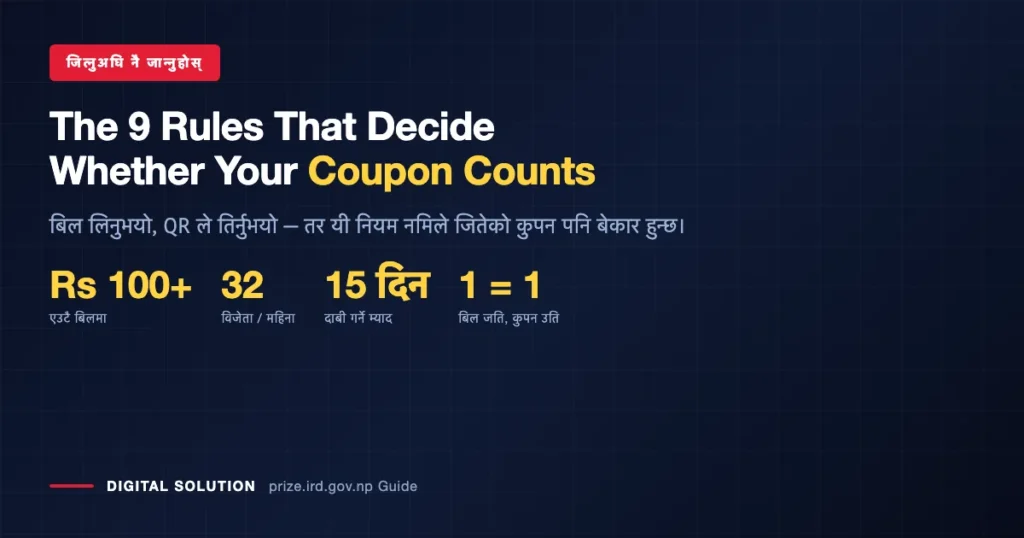
Updated August 2026. This guide answers the questions our comment sections filled up with after the first draw — based on the Taxpayer Incentive Gift Program Procedure 2083 and our full video explainer below. For the programme basics and the first winners, see our prize.ird.gov.np guide.
The taxpayer lucky draw sounds simple: buy something over Rs 100, take the bill, win up to Rs 10 lakh. Then the questions start — and our comment box proved it. Can a business bill win? Does a recharge count? What if I paid the shopkeeper’s personal QR? Each of those has a rule, and getting one wrong makes your coupon worthless — sometimes after you have already won.
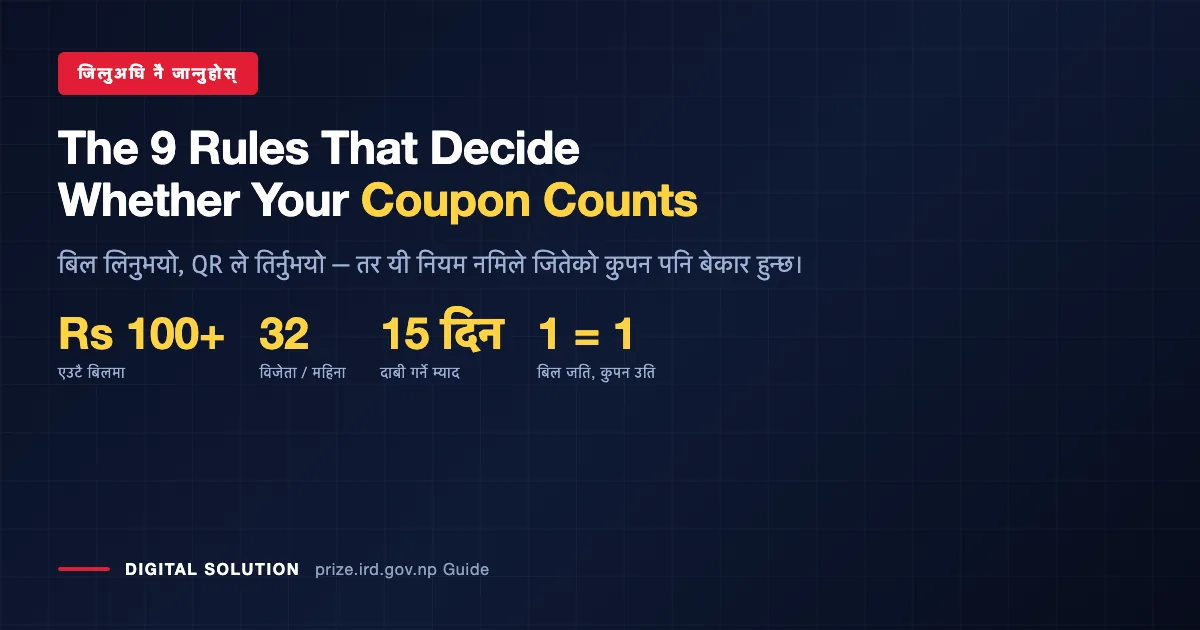
Here are the nine rules that actually decide eligibility, including two that almost nobody talks about.
First, the Programme in One Paragraph
Announced in the FY 2083/84 budget and run by the Inland Revenue Department from Shrawan 16, 2083, the programme borrows from Taiwan’s Uniform Invoice Lottery (running since 1951): make customers want bills, and tax compliance follows. Nepal tried it around FY 2064/65 and it fizzled — there was no digital payment integration then. Now there is, which is why this attempt is working. Every day one winner gets Rs 1,33,334 (Rs 1 lakh after the 25% windfall-gains tax under the Income Tax Act), and each fortnight one bumper winner gets Rs 10,00,000 (Rs 7,50,000 net) — 32 winners a month.
The 9 Rules That Decide Everything
1. One bill = one coupon — no matter the amount
A Rs 1 lakh purchase and a Rs 101 purchase earn exactly one coupon each. Ten separate Rs 1,000 purchases earn ten coupons. If you want better odds, frequency beats size — which is exactly the bill-taking habit the programme is designed to build.
2. Personal PAN is non-negotiable
No personal PAN, no prize — even if your coupon is drawn. If you hold a National ID, a PAN takes about a minute to generate, or use Nagarik App. Do it before you win, not after.
3. Keep the physical bill — even for digital payments
Imagine winning on a Rs 150 purchase and losing the prize because you left the paper at the counter. The original bill is mandatory at claim time regardless of how you paid. If the seller is VAT-registered, ask for the VAT bill; PAN-registered, the PAN bill.
4. The seller must be PAN- or VAT-registered
You can pay by QR and still be ineligible — if the shop itself is not registered. A bill from an unregistered merchant creates no coupon. The registration that matters is the seller’s, not just yours.
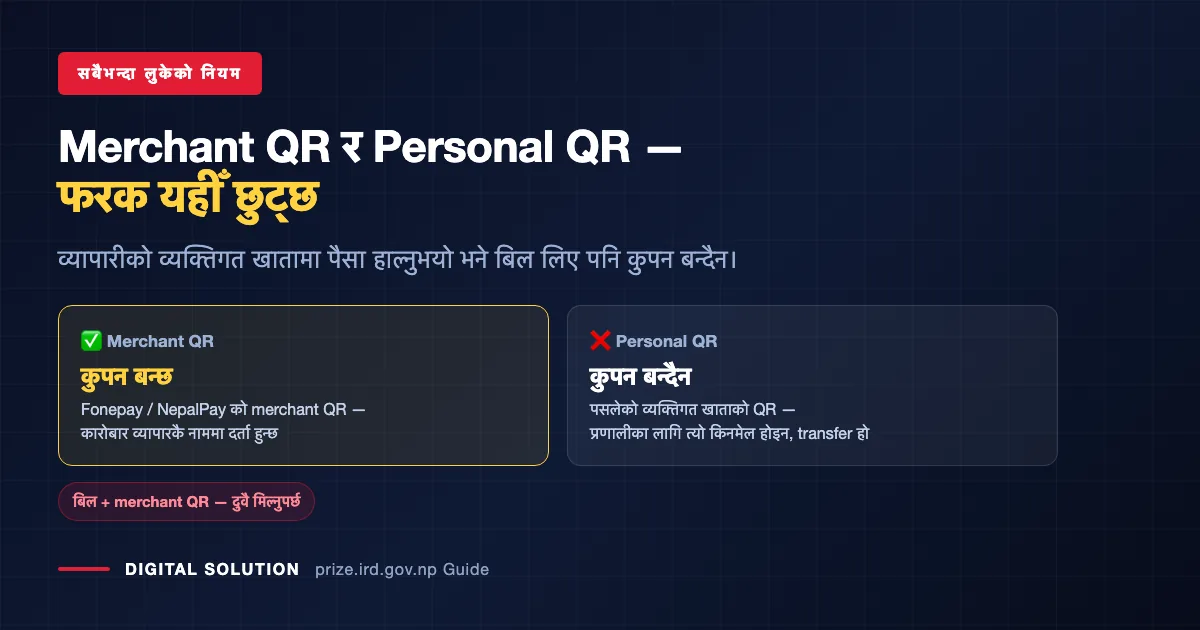
5. Merchant QR counts. Personal QR does not.
The rule almost nobody explains: paying into the shopkeeper’s personal QR — their private bank account — is a fund transfer, not a recorded sale. No coupon, even with a bill in hand. Look for the Fonepay or NepalPay merchant QR at the counter. (Merchant QR costs the shop nothing — our merchant QR guide covers that.)
6. Personal purchases only
Office khaja, business stock, anything bought for commercial use — excluded. The programme targets final consumers, not businesses.
7. These bills never count
Government or public-institution bills, telephone and internet, mobile recharge, electricity, vehicle fares, transport and airfare. Utilities and travel are structurally out — retail consumption is the target.
8. Online shopping usually does not count — with one exception
Pay a courier company cash-on-delivery and the courier is a middleman — no coupon. But pay the seller’s own merchant QR directly for a delivered product, and you are eligible like any retail purchase. Who receives the payment decides.
9. Never register the same bill twice
Big department stores (turnover above Rs 10 crore) sit on IRD’s Central Billing System — their bills enter the draw automatically, even cash ones. If you then upload that same bill yourself at prize.ird.gov.np, that is double counting, and it makes you ineligible. When in doubt at a big store, do not upload.
How Entry Actually Works
| How you paid | What you must do |
|---|---|
| Any digital channel — wallet, mobile banking, connectIPS, gateway | Nothing. The payment provider sends the transaction to IRD and your coupon generates automatically. Still take the bill. |
| Cash | Register the bill yourself at prize.ird.gov.np — बिल दर्ता → नगद — and keep bill + coupon together. |
| Cash at a CBMS store (Bhatbhateni-scale) | Nothing — the store’s system enters you automatically. Do not also self-upload (Rule 9). |
Coupons appear inside the app you paid from — eSewa was first, Khalti has followed, and banks like NIC Asia now show a “Taxpayer Incentive Program” section in their apps. Search the programme name inside your payment app.
Pay by QR — merchant QR — and the system does the paperwork. Pay cash and you become your own data-entry clerk.
If You Win: 15 Days, 4 Documents
Winners are drawn after each fortnight — on the 16th for purchases from the 1st–15th, and at month’s end for the 16th onward. You then have 15 days to appear at an Inland Revenue Office with:
- The original bill — digital payers included
- Official ID — citizenship, passport or National ID
- Your PAN — the card or shown in Nagarik App
- Bank account details — the net prize is deposited after the 25% deduction
Abroad when your number comes up? A family member can complete the claim on your behalf — the digital payment trail plus your documents make it workable. Fifteen days is enough time to arrange it, but not if you only find out on day twelve: check your coupons after each draw.
Watch: The Complete Explainer, in Nepali
From the Digital Solution YouTube channel — subscribe for more guides in Nepali.
No PAN yet? That is the first fix.
With a National ID it takes about a minute. Digital Solution helps with PAN registration, Nagarik App and government portals — in plain Nepali.
Frequently Asked Questions
Does paying a shopkeeper’s personal QR earn a coupon?
No. A personal QR routes money to a private account — the system records a transfer, not a sale. Only merchant QR payments (Fonepay/NepalPay merchant codes) generate coupons, even if you also hold the bill.
Do big purchases give better chances than small ones?
No — one bill is one coupon regardless of amount. Ten small qualifying purchases beat one large one, ten coupons to one.
Does mobile recharge or an internet bill count?
No. Telephone, recharge, internet, electricity, government payments, transport and airfare are all excluded. Retail goods and services are what count.
Does online shopping count?
Only when your payment goes directly to the seller’s merchant QR. Cash-on-delivery paid to a courier does not qualify — the courier is an intermediary, not the seller.
Where do I see my coupons?
Inside the platform you paid from — eSewa and Khalti show a Taxpayer Incentive Program section, and banks such as NIC Asia have added one to their apps. Cash payers see coupons at prize.ird.gov.np after registering the bill.
What if I registered a Bhatbhateni cash bill myself?
Large stores on the Central Billing System enter your bill automatically; uploading the same bill yourself is double counting and makes the entry ineligible. At CBMS-scale stores, keep the bill and do nothing else.
Can someone claim on my behalf if I am abroad?
Yes — a family member can complete the claim within the 15-day window with your bill, ID, PAN and bank details.
Related Reading

Rabin Paudel
Rabin Paudel is the Founder of Digital Solution, a Content Creator, and an AI Trainer. He shares practical and easy-to-understand content on Artificial Intelligence, Digital Literacy, Online Services, FinTech, and Technology. His mission is to make technology simple, accessible, and useful for everyone.
View all posts by Rabin Paudel →