
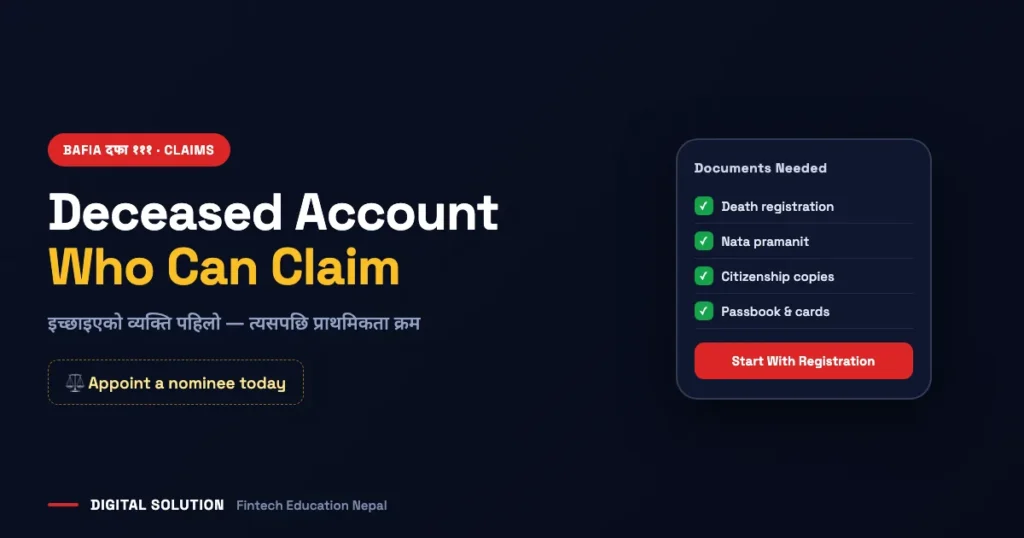
Updated August 2026. The priority order below is set out in the Bank and Financial Institution Act, 2073 (BAFIA). Document requirements are bank practice rather than a published national list, and inheritance questions can turn on the Civil Code — for anything disputed, take legal advice.
A family member has died and there is money in their bank account. Nobody at the bank will discuss it with you over the phone, and the paperwork sounds like it needs a court. Nepal’s law does set out exactly who has the right to claim — and in what order. Here is that order, what banks ask for, and the questions the law genuinely leaves open.
Who Has the Right to Claim
BAFIA Section 111 governs this. The starting point is strict: no claim over a deposit is entertained from anyone other than the actual depositor. On death, the right passes in a defined sequence.
If there is no nominee: the statutory priority order
| Priority | Who |
|---|---|
| 1 | Spouse living in the joint family |
| 2 | Son or daughter, adopted child, or widowed daughter-in-law in the joint family |
| 3 | Father, mother, grandson or granddaughter in the joint family |
| 4 | Spouse, child, parent, daughter-in-law or married daughter living separately |
| 5 and below | More distant relatives in the order the Act sets out — grandparents, siblings, nephews and nieces, uncle, widowed aunt, sister-in-law, married sisters |
The Question the Law Does Not Answer
Two further points we could not verify, and you should therefore ask your own bank about rather than assume:
- Whether a rupee threshold exists above which a court order is required instead of a ward-level relationship certificate. No published national rule sets one — banks appear to apply their own internal policy.
- What happens to a joint account when one holder dies. BAFIA’s deposit-claim provision does not address survivorship.
Documents Banks Ask For
There is no single published national checklist, so this reflects consistent practice rather than a rule:
Death registration certificate
मृत्यु दर्ता प्रमाणपत्र from the local registrar. Nothing starts without it — see our death registration guide.
Relationship certification
नाता प्रमाणित from the ward or local level, establishing your relationship to the deceased.
Citizenship documents
Of the deceased and of each claiming heir.
Written application
To the branch, setting out the claim and the basis for it.
Bank instruments
Passbook, cheque book, fixed deposit receipt and cards, for surrender.
For minor heirs
Birth registration certificate, plus whatever the bank requires for a guardian to act.
🤝 Dealing with a deceased family member’s account?
Tell us the situation — whether there was a nominee, who the heirs are, and what the bank has asked for. Digital Solution will help you assemble the file in the right order.
The Practical Sequence
- Register the death and obtain the certificate.
- Find out whether a nominee was appointed. Ask the bank in writing — it changes the entire route.
- Get the relationship certification from the ward for whoever will claim.
- Ask the branch for its written checklist for a deceased-account claim, rather than guessing.
- Agree among the heirs first, in writing, if more than one person has a claim. The bank cannot resolve a family dispute and will simply stop.
- Take legal advice if there is a nominee who is not the sole heir, a disputed relationship, or a substantial balance.
Frequently Asked Questions
Who can claim a deceased person’s bank balance in Nepal?
The nominee first, if one was appointed. Otherwise surviving relatives in the priority order set out in BAFIA Section 111, starting with a spouse living in the joint family.
What documents are needed?
Death registration certificate, relationship certification from the ward, citizenship documents of the deceased and the claimant, a written application, and the deceased’s bank instruments for surrender.
Does the nominee get to keep the money?
The law gives the nominee priority to claim but does not clearly state whether they hold it beneficially or for the estate. Where the nominee is not the sole heir, take legal advice.
Is a court order required?
Not necessarily — a ward relationship certification is the usual route. We found no published rule setting an amount above which a court order is mandatory; banks apply internal policy, so ask.
What happens to a joint account?
The deposit-claim provision does not address survivorship. Ask the bank what it applies to your specific account.
What if nobody claims the money?
It ultimately passes to Nepal Rastra Bank’s Banking Development Fund.
Can I use the account to pay the deceased’s bills?
No. Operating the account after death complicates the legitimate claim, whatever the intention.
How do I appoint a nominee on my own account?
Ask your branch. It is a short form, it costs nothing, and it removes almost all of this difficulty for your family.
Sources
- Bank and Financial Institution Act, 2073 — Section 111, right to make claims over deposits, including the nominee provision and the statutory priority order.
- Local-level (ward) relationship certification practice for deceased-account claims.
Related Reading
- Death registration in Nepal: process and deadline
- Late registration of a vital event
- Getting a duplicate certificate
Disclaimer: Digital Solution Nepal is an independent educational and digital-service assistance website — not a bank, not a government body, and not a law firm. Banking rules, fees and NRB directives change through circulars, and each bank sets its own tariff. Nothing here is financial or legal advice — your bank, Nepal Rastra Bank and a qualified professional are final.

Rabin Paudel
Rabin Paudel is the Founder of Digital Solution, a Content Creator, and an AI Trainer. He shares practical and easy-to-understand content on Artificial Intelligence, Digital Literacy, Online Services, FinTech, and Technology. His mission is to make technology simple, accessible, and useful for everyone.
View all posts by Rabin Paudel →