
Last updated: August 2026 (Shrawan 2083). Based on the National Identity Card and Civil Registration Act 2076, its Regulations 2077 (as amended to 2082) and DONIDCR guidance. Local citizen charters may differ — confirm with your ward before visiting.
In the days after a death, paperwork is the last thing a family wants to think about. But death registration (मृत्युदर्ता) is the document that unlocks everything else — pension, insurance, bank accounts, inheritance and property transfer. Here’s what it requires, who can do it, and the 35-day rule.
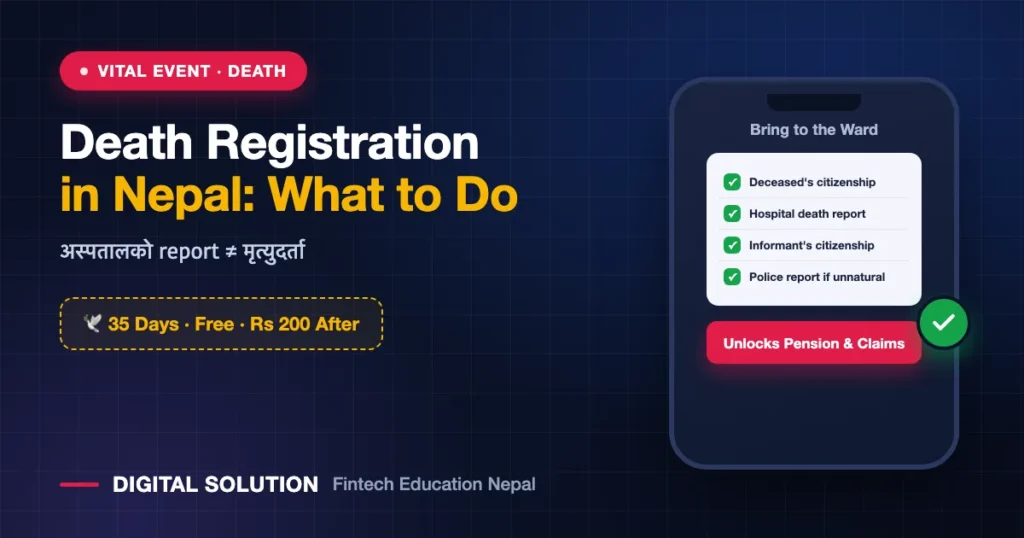
Hospital Death Report ≠ Death Registration
A hospital or doctor’s death report confirms the death and its medical details. The ward office’s death registration certificate places that event in the official civil record. Banks, pensions, insurance, inheritance and property transfer generally require the ward certificate.
Who Can Notify
The deceased’s father, mother, husband, wife, son or daughter are primary informants. If unavailable, an adult (18+) family member may notify. For deaths in institutions, unclaimed bodies or unnatural deaths, additional hospital, police, local-level and investigation documents may apply.
Documents Required
- Deceased’s citizenship, National ID, passport or other identity proof
- Informant’s citizenship or valid ID
- Hospital/health institution death report or medical evidence
- For a death at home: ward sarjamin or health-worker evidence per the local checklist
- For unnatural or accidental death: police report, post-mortem or investigation documents
- For a foreign national’s death: passport, visa/residence details and the relevant embassy’s recommendation
- For a Nepali who died abroad: the foreign death certificate and required diplomatic authentication
Step-by-Step
- Check the deceased’s name, date of birth, citizenship number and permanent address against old documents.
- Obtain the original death evidence from the hospital or police.
- An eligible informant notifies the permanent-address ward or the registrar where the death occurred, within 35 days.
- Submit originals and record the true date, place and available cause.
- Check the certificate — name, dates, address and informant details.
- Then submit copies to pension, social security, bank, insurance, land revenue and inheritance processes.
Deadline and Fee
Within 35 days registration is free; after that the current late fee is Rs 200. Late registrations may require extra sarjamin or evidence to establish identity and the fact of death. Straightforward cases follow the local citizen charter’s timeline; police investigation or foreign documents take longer.
If the Death Occurred Abroad
Designated Nepali missions may run death registration for Nepali citizens. Notification can be made at the mission within 35 days of the death, or to the local registrar within the applicable deadline after entry/documents reach Nepal. Foreign death certificates typically need issuing-country authentication plus Nepali mission/consular authentication. Registration within time at a mission is free; late registration currently costs USD 25 or the local-currency equivalent.
What the Certificate Is Used For
- Inheritance, succession and property transfer
- Pension, gratuity, social security and employee benefits
- Life and accident insurance and compensation claims
- Bank accounts, loans, demat and nominee processes
- Updating marital status and family records
- Cancelling the deceased’s citizenship/passport and closing related government records
FAQ
How long do we have to register a death in Nepal?
35 days — free within that window, Rs 200 after.
Can a neighbour register the death?
The law prioritises close family; an adult family member may act if primary informants are unavailable.
My relative died abroad — what do we do?
Use the designated Nepali mission where available, or register in Nepal with the authenticated foreign death certificate.
Official Basis
- Act 2076 and Regulations 2077 (as amended)
- DONIDCR death registration FAQ
🤝 Stuck with a registration problem?
Tell us your situation — late registration, missing documents, mismatched details or a ward office refusal — and Digital Solution will map the correct process for your case.
Disclaimer: Digital Solution Nepal is an independent educational/digital-service assistance website, not a government body. Vital event registration rules, fees and local checklists change through notices and vary between local levels — your ward office, local registrar and DONIDCR are final. For complex legal or identity disputes, consult a qualified lawyer.

Rabin Paudel
Rabin Paudel is the Founder of Digital Solution, a Content Creator, and an AI Trainer. He shares practical and easy-to-understand content on Artificial Intelligence, Digital Literacy, Online Services, FinTech, and Technology. His mission is to make technology simple, accessible, and useful for everyone.
View all posts by Rabin Paudel →