

Updated 12 August 2026. Limits and fees below are taken from NCHL’s own CORPORATEPAY documentation. Confirm current terms with your bank before relying on them.
Most Nepali businesses still pay people the slow way. Salaries go out as a stack of cheques or a branch visit. Vendor payments mean a trip to the bank. Tax and SSF are their own separate errands.
There is a system built specifically to end that, run by the same organisation that clears the country’s cheques — and a lot of businesses paying for expensive workarounds have never heard of it.
CORPORATEPAY Nepal is a business payment platform from Nepal Clearing House Ltd, launched in January 2021. In the last fiscal year it processed 8.8 million transactions worth NPR 1.87 trillion. This guide covers what it does, the limits, the fees, and whether it is worth your time.
What CORPORATEPAY actually is
In NCHL’s own words, it is “a business payment platform developed and hosted by NCHL that allows corporate clients to make digital payments from any of their connected bank accounts.”
The phrase that matters is “any of their connected bank accounts.” If your company banks with three different banks — and many Nepali companies do — CORPORATEPAY gives you one screen to pay from all of them, rather than three separate corporate banking logins.
What you can pay through it:
- Interbank and intra-bank fund transfers
- Salary payments
- Vendor and creditor payments
- Government tax and revenue payments
- Social Security Fund (SSF), Employees Provident Fund and customs payments
- Utility bills — electricity, internet, phone top-ups
- Foreign currency payments
- Bank statements and non-financial information
That list is the point. Payroll, tax, SSF and suppliers are the four things that eat a Nepali finance officer’s week, and they are all here.
The limits: real-time versus non-real-time
This is the part worth understanding properly, because choosing correctly is what unlocks the large numbers.
CORPORATEPAY can send your payment down two different rails, and they have very different ceilings:
| Route | To the same bank | To a different bank | Government payments |
|---|---|---|---|
| Real-time (connectIPS) | up to Rs 1 crore | up to Rs 20 lakh | up to Rs 5 crore (same bank) |
| Non-real-time (NCHL-IPS) | — | up to Rs 20 crore | up to Rs 30 crore |
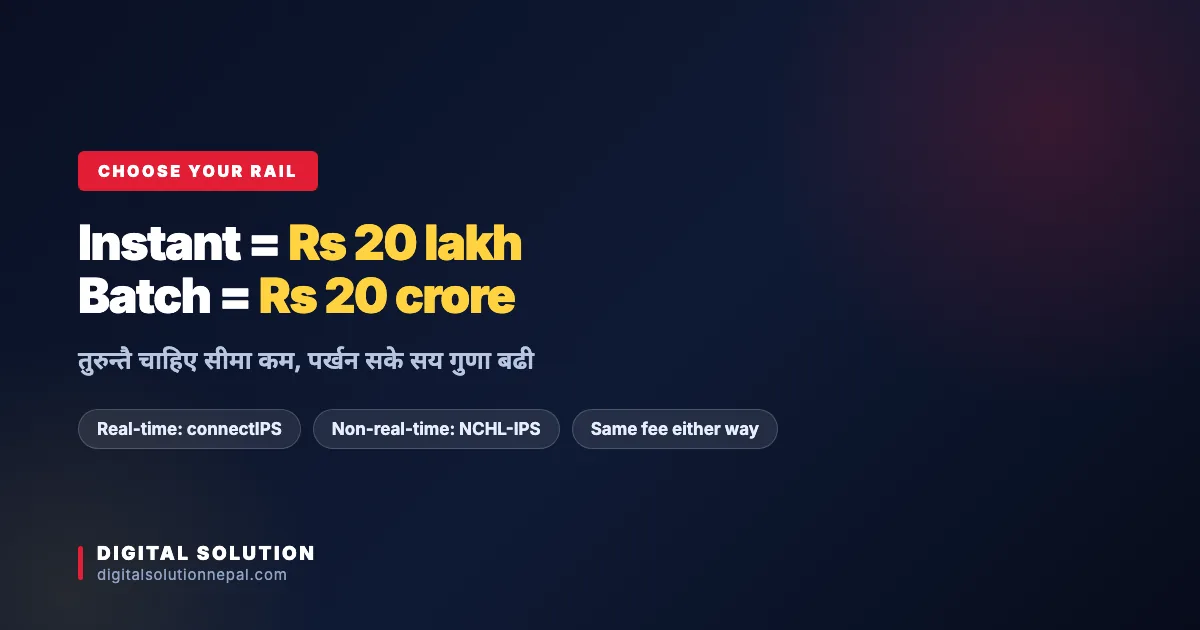
Read the difference across the row. If you need money to land instantly at another bank, you are capped at Rs 20 lakh. If you can wait for the batch to settle, the same transfer goes up to Rs 20 crore — a hundred times more.
For a business, that is a scheduling decision, not a banking limitation. An urgent supplier payment goes real-time. Monday’s payroll run, a large vendor settlement, or a tax deposit goes non-real-time and clears within the settlement cycle.
Government payments get the highest ceiling of all — Rs 30 crore. If you are paying a large customs or revenue bill, this is the route.
The fees are the surprising part
Here is what makes the maths work:
| Payment | Fee |
|---|---|
| Fund transfer up to Rs 500 | Rs 2 |
| Fund transfer Rs 50,001 – Rs 20 crore | Rs 10 |
| Government payment up to Rs 10,000 | Rs 2 |
| Government payment above Rs 10,000 | Rs 5 |
That is not a typo. The fee to move Rs 20 crore is Rs 10 — the same as moving Rs 50,001. The charge is flat, not a percentage.
Think about what that means against the alternatives. A manager’s half-day at a bank branch costs more than Rs 10. So does the fuel. So does a single cheque book. For a company doing even fifty payments a month, the entire transaction cost is Rs 500.
The real cost of CORPORATEPAY is not the fee. It is the setup — and that is a one-time job.
How a business signs up
The process is short, and deliberately split between online and in-person:
- Self-register on the CORPORATEPAY platform
- Visit your nearest branch of your bank with the required documents to complete enrolment
- Your bank links the company accounts you want to pay from
- Start with a small test payment before moving payroll onto it
The branch visit is not optional and it is not bureaucracy for its own sake — it is the bank verifying that the people authorised to move company money are who they say they are. Take your company registration, PAN, board authorisation and the identity documents of the authorised signatories, and ask the branch for their specific checklist before you go.
Ask your bank two questions while you are there: whether your company will get maker-checker approval — one person prepares a payment, another approves it — and whether bulk file upload is enabled for payroll. NCHL’s documentation refers to both individual and bulk payment forms, but the exact workflow available to you is configured by your bank.
Who this actually suits
A strong fit if you:
- Run payroll for more than a handful of staff
- Pay SSF or EPF contributions monthly — our guide to the SSF employer payment process explains that obligation in detail
- Bank with more than one institution
- Make regular large vendor payments above the ordinary mobile banking ceiling
- Pay significant tax, revenue or customs bills
Probably not worth it yet if you:
- Are a sole trader or two-person business making a few payments a month — ordinary mobile banking will cover you, and the current limits are generous enough
- Have no registered company yet, since enrolment runs through corporate banking
One honest caveat. Your bank has to support it, and your bank configures what you actually get. NCHL builds and hosts the platform, but the account linking, the approval workflow and the documents required are your bank’s side of the arrangement. Two companies at two different banks can have quite different experiences of the same system.
Where it sits in the bigger picture
CORPORATEPAY is one of several systems run by Nepal Clearing House Ltd, which is owned by Nepal Rastra Bank together with 47 banks and financial institutions. If you want the wider context — who clears the country’s cheques, why real-time payments just overtook cheques by value, and why you pay a transaction fee at all — see our guide to what NCHL is and what it runs.
The scale here is not trivial. CORPORATEPAY moved NPR 1.87 trillion across 8.8 million transactions in fiscal year 2082/83. Those are Nepali businesses that have already made this switch.
Frequently asked questions
What is the maximum amount I can send through CORPORATEPAY?
Up to Rs 20 crore per transaction to another bank on the non-real-time route, and up to Rs 30 crore for government payments. Real-time transfers are capped lower — Rs 1 crore within the same bank and Rs 20 lakh to a different bank.
How much does CORPORATEPAY cost per transaction?
Fund transfers cost between Rs 2 and Rs 10 depending on the amount, with Rs 10 covering everything from Rs 50,001 up to Rs 20 crore. Government payments cost Rs 2 up to Rs 10,000 and Rs 5 above that. Your bank may apply its own charges on top, so confirm before you enrol.
Can I pay salaries through CORPORATEPAY?
Yes — salary payments are one of its core functions, and NCHL’s documentation refers to bulk as well as individual payment forms. Ask your bank whether bulk file upload is enabled on your account.
Can I pay SSF and tax through it?
Yes. Social Security Fund contributions, provident fund, customs, and government tax and revenue payments are all supported, and government payments carry the lowest fees and the highest limits.
How do I register my company?
Self-register on the CORPORATEPAY platform, then visit your bank branch with your company documents to complete enrolment. The branch step is required.
Is CORPORATEPAY the same as connectIPS?
No, though they are related. connectIPS is the retail platform individuals use. CORPORATEPAY is the business platform, and it can route payments over connectIPS for real-time transfers or over NCHL-IPS for large non-real-time ones. Both are operated by NCHL.
Can I use it with more than one bank?
Yes — that is one of its main advantages. CORPORATEPAY lets a company pay from any of its connected bank accounts through a single platform.
Getting your business payments organised
Most of the businesses we work with in Pokhara and across Nepal are not short of tools — they are short of someone showing them which tool applies to their situation, and then setting it up properly once.
If you want help getting your company onto digital payments — payroll, SSF, vendor payments, or collecting from customers online — Digital Solution does this work with Nepali businesses every week.
WhatsApp us on +977 9766597181 with what your business does, how many staff you pay, and which banks you use. We will tell you what is worth setting up and what you can skip.
Related reading: what NCHL is and what it runs, SSF employer monthly payment process, and SWIFT codes for Nepali banks if you also pay suppliers abroad.
Sources: NCHL CORPORATEPAY documentation for limits, fees, payment types and enrolment; NCHL published transaction statistics to Ashadh end 2083 for volume and value. Limits and fees are as published by NCHL and may be varied by your own bank — confirm before enrolling. Checked 12 August 2026.

Rabin Paudel
Rabin Paudel is the Founder of Digital Solution, a Content Creator, and an AI Trainer. He shares practical and easy-to-understand content on Artificial Intelligence, Digital Literacy, Online Services, FinTech, and Technology. His mission is to make technology simple, accessible, and useful for everyone.
View all posts by Rabin Paudel →