
Updated 20 October 2026 (4 Kartik 2083). Checked against the Contribution-based Social Security Act 2074 (as amended in 2082), the Social Security Scheme Operation Procedure 2075 (fifth amendment), SSF’s online retirement claim manual, SSF’s citizen charter published in 2026, and the minimum wage notice effective 17 July 2025.
Registering with the Social Security Fund (SSF) is a one-time job. The monthly contribution cycle is where most employers slip: the wrong salary base, a late deposit, or a worker who left but was never closed in the system. This guide sets out the monthly routine, the deadline, what a late deposit costs, and the records that protect you. Registration itself is covered in our employer registration guide.
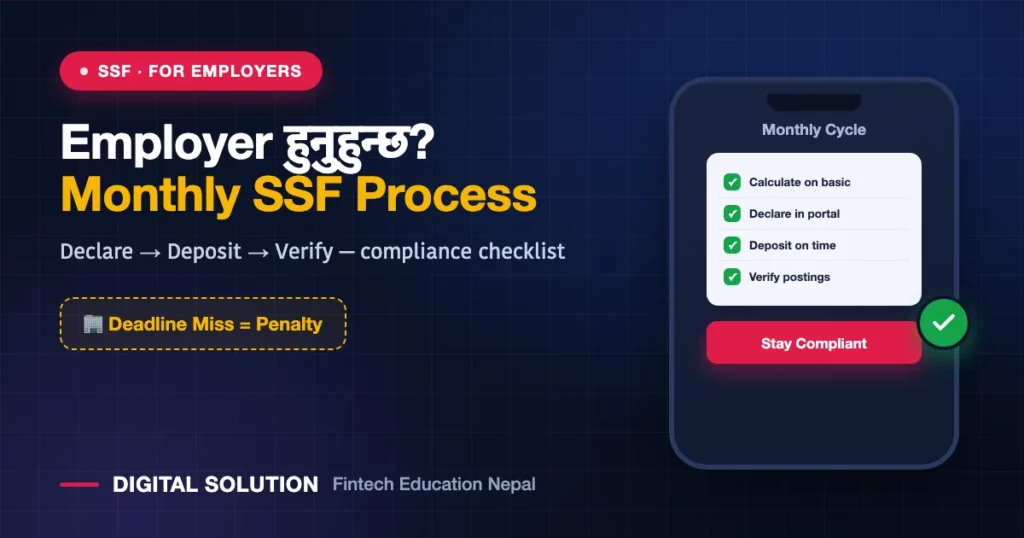
The monthly cycle at a glance
| Step | What happens | Rule |
|---|---|---|
| Calculate | 31% of each listed worker’s basic salary | 11% deducted from the worker, 20% added by the employer |
| Declare | Enter the month’s contribution details for each worker in the employer portal | Monthly, pro rata for part months |
| Deposit | Pay the total through the payment options in the employer portal | Must reach SSF within 25 days after the month ends |
| Verify | Confirm the amount is posted to every worker | Keep the payment reference |
Step 1: Calculate on the right base
Section 25 of the Social Security Scheme Operation Procedure says the employer deducts 11% of the worker’s basic salary (आधारभूत पारिश्रमिक), adds 20% of basic salary, and deposits the total 31%. SSF splits it as follows:
| Scheme | Share of basic salary |
|---|---|
| Medical, health and maternity | 1.20% |
| Accident and disability | 0.80% |
| Dependent family | 0.67% |
| Old age (20% to pension, 8.33% to retirement benefit) | 28.33% |
Three points cause most errors:
- Basic salary, not gross. Allowances, overtime and bonuses are outside the base.
- Respect the minimum wage. The minimum wage effective 17 July 2025 is Rs 19,550 a month, with Rs 12,170 as the basic wage. For a worker on exactly the minimum basic, the 31% contribution is Rs 3,772.70 (Rs 1,338.70 from the worker and Rs 2,434 from you, our calculation). A basic salary set below the legal floor is a compliance problem.
- Part months. Section 4(3) of the Act says contributions are monthly, and a part month is calculated proportionately. Section 4(2) says contributions run from the worker’s listing date to the last day of employment.
Step 2: Declare and deposit before the deadline
Section 4(4) of the Act, as amended in 2082, says the contribution must reach SSF within 25 days after the end of the month for which salary is payable. Treat the 25th day as the outer limit, not the target.
- Lock the month’s payroll and confirm each worker’s basic salary.
- Log in at sosys.ssf.gov.np through Employer Login.
- Check that every new joiner has been listed and every leaver has been closed.
- Enter or confirm each worker’s contribution for the month.
- Check that the portal total matches your payroll register.
- Pay the total using the payment options the portal shows.
- Save the payment receipt or reference number.
Step 3: Verify the deposit
A payment is not finished until it shows against each worker. Check the posting in the employer portal and ask workers to report any month missing from their own statement. SSF’s citizen charter lists verification of deposit details as a service handled by its collection section on application with proof of regular contributions. For collection questions SSF lists collection@ssf.gov.np, and for reconciliation reconcsupport@ssf.gov.np.
New joiners and leavers
- Joiners: list each new worker before their first payroll. SSF’s citizen charter says online listing and SSF number issue take up to 3 days.
- Leavers: close the worker with the correct exit date through the employer portal. SSF’s retirement claim manual says a worker cannot withdraw retirement money until the employer has terminated them in the system. Leaving exits open blocks your former staff (what happens to SSF money after leaving a job).
- Unpaid months: section 8 of the Act says that if a worker receives no salary for a time, the employer must deposit the worker’s contribution for up to three months and may recover it later from the worker’s pay.
What a late or missed deposit costs
The Act is specific:
- 10% interest. Section 9(1) lets SSF recover unpaid contributions from the employer with 10% interest.
- Relief only for genuine emergencies. Under section 9(2), an employer that could not deposit because of circumstances beyond its control can apply within 30 days, giving reasons. If SSF accepts them, it may waive the interest in part or in full.
- Enforcement. Section 9(4) lets SSF’s executive director ask authorities to freeze the employer’s bank accounts or property, suspend concessions, suspend licences, or withhold the passport of the person responsible.
- Paying benefits yourself. Section 9(6) says that if a worker has an accident or dies during a period when you failed to deposit, you must pay the worker the benefit SSF would have paid.
If money was deducted from salaries but not deposited, workers can complain (worker-side complaint guide).
Common mistakes and how to fix them
| Mistake | What goes wrong | Fix |
|---|---|---|
| Contributions on gross salary or on a reduced “basic” | Over- or under-payment, and disputes later | Use the contract’s basic salary, never below the minimum basic |
| New joiner not listed before payroll | That month’s contribution has nowhere to go | List the worker first, then run payroll |
| Leaver not closed | The former worker cannot claim or withdraw | Close with the correct exit date the same month |
| Deposit paid after day 25 | 10% interest and a gap in workers’ cover | Fix one deposit date well before the deadline |
| Portal total differs from payroll | Some workers miss a month | Reconcile line by line before paying |
If you have fallen behind
- Work out the unpaid months for each worker.
- If the delay was caused by circumstances beyond your control, apply to SSF within 30 days with reasons, under section 9(2).
- Deposit the arrears with the interest SSF calculates.
- Confirm that every month now shows in each worker’s record.
Correcting the record yourself is far better than waiting for a worker complaint or an inspection.
Your monthly checklist
- Payroll locked and basic salaries checked against contracts and the minimum wage
- New hires listed with an SSN before their first payroll
- Leavers closed with the correct exit date
- Portal total matches the payroll register
- Deposit made well inside 25 days of month end, receipt saved
- Posting confirmed for every worker
Records to keep
Keep, for each month, the payroll register, the declaration, the payment receipt and proof of posting. These win disputes with workers, auditors and the labour office, and they also protect your workers, because claims often fail on gaps in the employer’s record.
Need help with SSF registration, KYC or claims?
Digital Solution helps with SSF registration, KYC updates, contribution records and claim documents, online and step by step. SSF सम्बन्धी काममा सहयोग चाहिए सम्पर्क गर्नुहोस्।
Frequently asked questions
What percentage does an employer pay to SSF?
20% of each worker’s basic salary, on top of the 11% deducted from the worker, for a total of 31%.
What is the deadline for the monthly SSF deposit?
The contribution must reach SSF within 25 days after the end of the salary month, under section 4(4) of the Act as amended in 2082.
What happens if we deposit late?
SSF can recover the contribution with 10% interest under section 9(1). If the delay was beyond your control, apply within 30 days to ask for interest relief.
Can we pay quarterly instead of monthly?
Section 4(3) says deposits are monthly unless SSF decides otherwise. Pay each month to avoid interest and gaps in workers’ records.
An employee does not want SSF deductions. Can we skip them?
No. Coverage follows the law, not personal preference (is SSF mandatory?). List every covered worker and deduct as required.
Conclusion
The monthly SSF routine is simple when it is the same every month: calculate 31% on basic salary, declare, deposit well inside 25 days of month end, and confirm the posting for every worker. The cost of slipping is 10% interest and, in the worst case, paying a worker’s benefit yourself.
Sources
- Social Security Fund, Contribution-based Social Security Act 2074 (as amended in 2082): https://ssf.gov.np/list/act_regulation/contribution-based-social-security-act-2074
- Social Security Fund, Social Security Scheme Operation Procedure 2075 with fifth amendment: https://ssf.gov.np/list/act_regulation/social-security-operation-procedure-2075-with-5th-ammendment
- Social Security Fund, Online retirement claim process manual: https://ssf.gov.np/pages/withdraw-claim-process
- Social Security Fund, Citizen charter (2026): https://ssf.gov.np/pages/citizen-charter
- Social Security Fund, Contact details (accessed 20 October 2026): https://ssf.gov.np/contact
- Pradhan & Associates, Minimum Remuneration Notice 2082 (24 July 2025): https://pradhanlaw.com/publications/minimum-remuneration-notice-2082-2025-ad
Digital Solution Pvt. Ltd. is an independent publisher and is not affiliated with the Social Security Fund; confirm deadlines and amounts with SSF (ssf.gov.np, hotline 1116).

Rabin Paudel
Rabin Paudel is the Founder of Digital Solution, a Content Creator, and an AI Trainer. He shares practical and easy-to-understand content on Artificial Intelligence, Digital Literacy, Online Services, FinTech, and Technology. His mission is to make technology simple, accessible, and useful for everyone.
View all posts by Rabin Paudel →