
Updated 12 August 2026. Card details below come from NCHL’s own specifications and issuer announcements. Foreign-exchange rules come from Nepal Rastra Bank’s Unified Circular 2082, issued 7 April 2026, read directly.
Nepal now has its own card scheme. The NEPALPAY Card is a domestic card — Nepal’s answer to Visa and Mastercard — and because it runs on an international network, it works outside the country too.
That has produced a very appealing claim, repeated widely: get a NEPALPAY card and you will not need a separate international dollar card any more.
We went and read the actual foreign-exchange rules. The claim does not hold, and the reason is worth understanding, because it protects you from planning a trip around a card that will not do what you expect.
What the NEPALPAY Card actually is
NEPALPAY Card is Nepal’s domestic card scheme, built by Nepal Clearing House Ltd (NCHL) as part of the National Payment Switch that Nepal Rastra Bank mandated. It sits alongside the National Card Switch, which does the switching, issuing and acquiring inside Nepal.
The point of a domestic scheme is simple: when a Nepali pays a Nepali merchant with a Visa card, fees flow to an international network. A domestic scheme keeps that switching — and the fees — inside the country.
The international part is real. NCHL’s own technical documentation states that NEPALPAY Card operates on the Discover Global Network, which includes Discover Network, Diners Club International and PULSE. That is what gives the card acceptance outside Nepal.
There are two card profiles in the specification: one configured for Nepali rupees, one for US dollars. And NCHL’s brand guidelines distinguish a domestic card — which must carry the text “Valid Only in Nepal, India & Bhutan” on the front — from an international card, where that text is optional.
That distinction tells you most of what you need to know. Not every NEPALPAY card is an international card.
Where the rollout actually stands
This is newer than the coverage suggests, and worth being precise about.
| Milestone | Status |
|---|---|
| Readiness announced | 31 March 2025 |
| Commercial go-live | Closed user group, December 2025 |
| Issuing banks at go-live | 2 |
| Acquiring banks at go-live | 12 |
| Citizens Bank International — first bank live | 11 February 2026 |
| Banks subscribed | 34+ |
At Citizens Bank’s launch, 168 ATMs and 491 POS terminals were activated for the scheme. So this is a real product with real cards in real wallets — but it is an early-stage rollout, not something every Nepali bank hands you today.
One genuinely useful rule. NRB normally forbids issuing more than one card of the same type against a single account. It has explicitly waived that rule for domestic-scheme cards — meaning you can hold a NEPALPAY card in addition to your existing Visa or Mastercard debit card on the same account.
The catch: your ATM and POS ceilings apply in aggregate per account, not per card. A second card gives you a second piece of plastic, not a second allowance.
Now the important part: what it does not change
Here is where the popular claim breaks down.
Neelesh Man Singh Pradhan, CEO of NCHL, put the appeal plainly in a recent podcast interview — that once you have a NEPALPAY card, you would not need to take a separate international dollar card when going abroad.
The card network genuinely does travel. But NRB’s foreign-exchange rules do not care which network your card runs on.
We searched the full 373-page Unified Circular 2082 — the current governing document for foreign exchange, issued 7 April 2026. The words NEPALPAY, NCHL, Discover, National Card Switch and “domestic card scheme” appear zero times in a foreign-exchange context. The only mention of a card network anywhere is a column heading in a reporting template, listing “Visa, Mastercard etc.” as a descriptive field.
What NRB actually regulates is the facility and the issuer, not the brand on the card. Any card that settles in foreign currency requires a board-level policy decision by the bank plus specific permission from NRB’s Foreign Exchange Management Department. A NEPALPAY card is caught by exactly that rule, the same as any other.
So the Discover co-badge gives you acceptance. It does not give you an entitlement. You still need one of the existing foreign-exchange doors below to have anything to spend.
The four ways a Nepali can actually spend foreign currency
This is the part most articles get wrong, and the numbers get mixed up constantly. All four are current as of the April 2026 circular.
| Facility | Limit | What it is for |
|---|---|---|
| Prepaid dollar card | USD 500 per year | Online purchases only |
| Ordinary debit/credit card, holder in Nepal | USD 2,000 per year | Online foreign purchases |
| Passport / travel facility | USD 3,000 per trip | Actual travel, non-India |
| Credit card against an FX account | up to USD 25,000 | Requires a convertible-currency account |
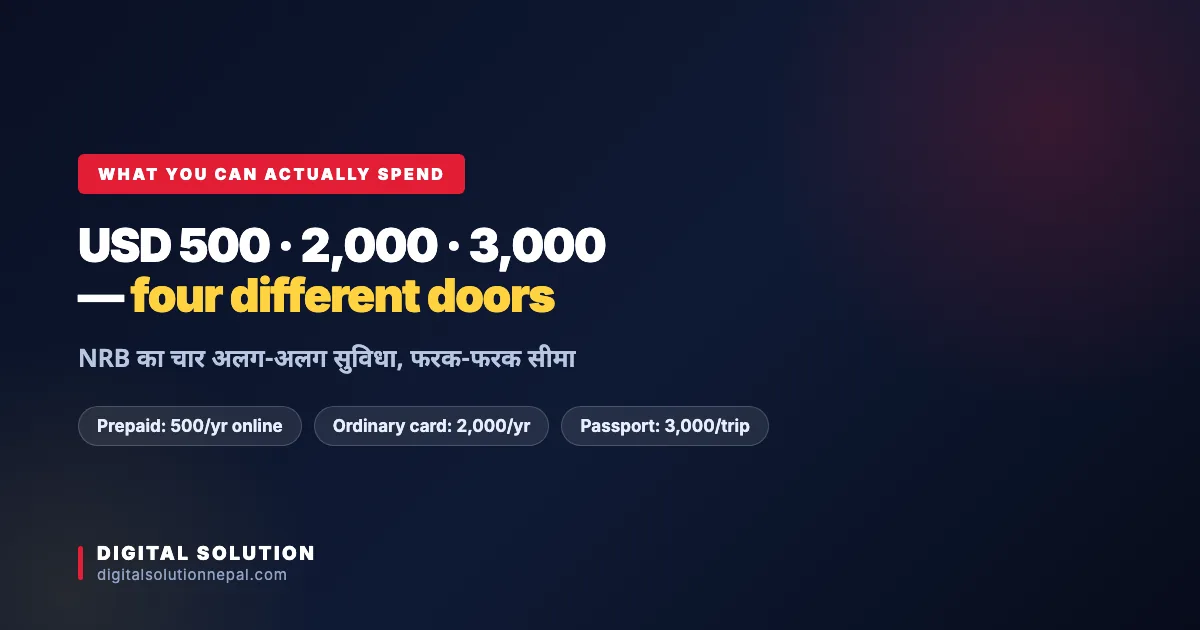
Three things follow from that table, and each one corrects a common misunderstanding.
1. The USD 500 dollar card cannot be used abroad at all. NRB’s rule is explicit: these cards must be configured so they cannot be used for ATM cash withdrawal or POS transactions. They are for online purchases only. So “replacing your dollar card for travel” is comparing against something that was never a travel card.
2. Most people’s real online allowance is USD 2,000, not USD 500. If you hold an ordinary debit or credit card from a Nepali bank and you are sitting in Nepal, the circular permits USD 2,000 a year of online purchases from abroad. That is four times the prepaid-card figure and far less well known. Our dollar card guide covers the prepaid route in detail; this is the alternative most people already have in their pocket.
3. The travel money comes from your passport, not your card scheme. The USD 3,000 per trip facility is granted against your passport and a confirmed air ticket, and it is endorsed in the passport. Only USD 500 of it may be given as cash — the rest must be loaded onto a card or draft issued in the passport holder’s name. That is the mechanism that actually funds a trip abroad, whichever network the card runs on.
A widely repeated figure that is wrong
You will see claims that NRB “raised the limit to USD 3,000” for individuals. It did not. The USD 3,000 figure in the circular applies to information technology, communications and broadcasting industries buying software and IT services online — rising to USD 5,000 if the industry earns foreign currency by exporting services.
For an individual, the annual prepaid-card figure is still USD 500, counted from the date the card was activated, not from the fiscal year.
What we could not find out
We think this matters more than a confident guess, so we are stating it plainly.
No Nepali bank publishes NEPALPAY card fees. We checked the published fee schedules of all eighteen banks reported as issuers or subscribers. There is no verified issuance fee, annual fee, replacement fee, or card-specific limit anywhere. Several banks’ fee pages are themselves years out of date.
No first-party document connects NEPALPAY to a foreign-exchange entitlement. NCHL does not publish what a cardholder may spend abroad. NRB has issued no circular naming the scheme. The technical specification defines a US-dollar card profile, but that is a chip configuration parameter — it is not a customer allowance, and we could not confirm that any bank issues that profile today.
The Discover partnership has no standalone announcement. It is documented in NCHL’s technical specification and referenced in Citizens Bank’s launch, but there is no published agreement or date.
If a bank tells you its NEPALPAY card gives you a foreign-currency allowance, ask which NRB facility it is issued under and get the answer in writing.
So should you get one?
Yes, if you want a domestic card that works everywhere in Nepal, keeps switching fees in the country, and can sit alongside your existing card thanks to NRB’s waiver. It is a genuinely good thing for Nepal’s payment system.
No, if you are getting it specifically to spend abroad on the assumption that it comes with its own foreign-currency quota. It does not. Sort out the facility first — passport endorsement for travel, or your existing card’s USD 2,000 online allowance — and then the card network is simply the rail that carries it.
The honest summary: NEPALPAY changes the rails, not the rules. That is still a meaningful change, just not the one being advertised.
Frequently asked questions
What is the NEPALPAY Card?
It is Nepal’s domestic card scheme, operated by Nepal Clearing House Ltd as part of the National Payment Switch. It works within Nepal and, through the Discover Global Network, is accepted internationally where that network is accepted.
Can I use a NEPALPAY Card abroad?
The network is accepted abroad, but acceptance is not the same as permission. You still need a valid NRB foreign-exchange facility — a passport travel endorsement, a foreign-currency account, or your card’s annual online allowance. The card scheme itself grants no foreign-currency entitlement.
Does NEPALPAY replace the dollar card?
No. The USD 500 prepaid dollar card is restricted by NRB to online purchases and is explicitly blocked from ATM and POS use, so it was never a travel card. NEPALPAY does not change the underlying foreign-exchange limits either way.
How much foreign currency can I spend on a Nepali card?
As of the April 2026 circular: USD 500 a year on a prepaid dollar card (online only); USD 2,000 a year of online foreign purchases on an ordinary debit or credit card while in Nepal; USD 3,000 per trip under the passport travel facility; and up to USD 25,000 on a credit card backed by a convertible foreign-currency account.
Which banks issue the NEPALPAY Card?
Citizens Bank International was the first to go live, on 11 February 2026. NCHL reports more than 34 banks subscribed to the scheme, with a wider rollout in progress. Ask your own bank whether it is issuing yet.
Can I have a NEPALPAY card as well as my Visa debit card?
Yes. NRB’s rule against issuing more than one card of the same type per account is expressly waived for domestic-scheme cards. But your ATM and POS limits apply per account in total, so the extra card gives you no extra spending headroom.
What does NEPALPAY cost?
No Nepali bank publishes fees for it. Ask your bank directly for the issuance fee, annual fee and any transaction charges before you apply.
Need help making sense of this?
Payment rules in Nepal change often, and the versions circulating on social media are frequently a year out of date or copied from another country. If you need to move money abroad legitimately — for a purchase, a subscription, a trip, or a business payment — it is worth getting the route right the first time.
WhatsApp us on +977 9766597181 and tell us what you are trying to pay for and from where. We will point you at the right facility.
Related reading: dollar card fees and limits at Nepali banks, what NCHL is and what it runs, and receiving international payments in Nepal.
Sources: NCHL NEPALPAY Card brand guidelines and EMV specification; NCHL and Citizens Bank International announcements; Nepal Rastra Bank Unified Circular 2082 (इ.प्रा. परिपत्र ११/२०८२-८३, 7 April 2026), particularly एकीकृत इ.प्रा. परिपत्र १४/२०८२ on electronic cards and ७/२०८२ on the passport facility; NRB Payment Systems Unified Directive 2082. The statement about not needing a separate international dollar card is the NCHL CEO’s, made in a podcast interview; we could find no NRB provision supporting it. All checked 12 August 2026 — confirm current limits with your bank before relying on them.

Rabin Paudel
Rabin Paudel is the Founder of Digital Solution, a Content Creator, and an AI Trainer. He shares practical and easy-to-understand content on Artificial Intelligence, Digital Literacy, Online Services, FinTech, and Technology. His mission is to make technology simple, accessible, and useful for everyone.
View all posts by Rabin Paudel →