Updated 12 August 2026. Figures below come from NCHL’s own annual report, its published transaction statistics to mid-July 2026, and Nepal Rastra Bank’s payment systems oversight reports.
You have used this company today, or at least this week. If you paid a bill through connectIPS, scanned a NEPALPAY QR, received your salary by bank transfer, or deposited a cheque, your money passed through Nepal Clearing House Ltd (NCHL).
Almost nobody in Nepal can name it. That is normal for payment infrastructure — you notice it only when it breaks. But if you run a business, work in banking, or simply want to understand why a cheque now clears the same day when it once took weeks, this is the organisation to know about.
Who owns NCHL
NCHL was incorporated on 23 December 2008 (8 Poush 2065) as a public limited company, set up under the leadership of Nepal Rastra Bank.
It is not a government body and not a private company in the ordinary sense. It is owned by the banking system itself:
| Shareholder group | Stake |
|---|---|
| Nepal Rastra Bank | 9.45% |
| 47 banks and financial institutions | 90.55% |
There are 48 shareholders in total — the central bank, 20 commercial banks, 10 development banks and 17 finance companies. NCHL is unlisted, so there are no public shares and you cannot buy into it. Its paid-up capital stood at NPR 1.46 billion as of mid-January 2026.
The chief executive is Neelesh Man Singh Pradhan, who has led the organisation since 2011 and was named Manager of the Year 2025 by the Management Association of Nepal. The board is chaired by an executive director of Nepal Rastra Bank.
That ownership structure explains a lot about how NCHL behaves. It is a shared utility built by the banks, for the banks — which is why it can impose one standard on all of them, and why it is not chasing profit the way a fintech would.
Before NCHL: when a cheque took weeks
To understand what changed, it helps to know what the old system looked like.
Before electronic clearing, every cheque had to physically travel. In Mr Pradhan’s account of the period, a bank collected the cheques deposited with it, carried them in bundles to a Nepal Rastra Bank branch, and exchanged them by hand with the bank that had issued them. That bank then took them away, checked the signature and the balance, and physically returned the rejected ones.
The result, as he described it: inside Kathmandu a cheque deposited today cleared tomorrow or the day after. Outside the valley — or from a town with no NRB branch — it could take one to three weeks. Inside the same country.
NCHL’s first mandate from the banks and the central bank was blunt: automate cheque clearing.
How NCHL fixed it
The system is NCHL-ECC, the Electronic Cheque Clearing system, and the milestones are precise:
| Date | Milestone |
|---|---|
| 22 December 2010 | ECC project initiated |
| 3 February 2012 | Live for foreign currency cheques |
| 9 April 2012 | Live for Nepali rupee cheques |
| 16 December 2012 | Manual clearing in Kathmandu fully migrated |
| 9 April 2014 | Nationwide rollout completed |
The technical trick is cheque truncation. In NCHL’s own words, the cheque is truncated at the presenting bank — meaning “the cheque does not physically travel to the clearing house or to the paying branch as it used to do in manual clearing process.” An image and the data travel instead.
Today the cycle is same-day. NCHL states that cheques presented before the cut-off are cleared and settled on the same day (T+0); after the cut-off, the next working day (T+1). The daily rhythm, Sunday to Thursday:
- Presentment cut-off 15:00
- Paying bank must respond by 17:00 (16:45 in winter)
- Settlement 17:15
- Customer’s account credited by 17:30
There is also express clearing, which runs four sessions a day on a two-hour presentment-to-settlement window, and separate high-value sessions. Express accounted for about 15% of cheque volume in FY 2081/82. ECC handles four currencies: NPR, USD, GBP and EUR.
One honest caveat. Clearing is not fully electronic even now. Nepal Rastra Bank’s own oversight report notes that cheques of NPR 300 million and above are still cleared manually through NRB. The very largest payments still move the old way.
What NCHL actually runs
Cheques are only the beginning. NCHL now operates most of the plumbing behind Nepali digital payments:
| System | Live since | What it does |
|---|---|---|
| NCHL-ECC | Feb 2012 | Electronic cheque clearing and settlement |
| NCHL-IPS | Aug 2016 | Bulk and one-to-one interbank transfers — direct credit and direct debit |
| connectIPS | Oct 2018 | The retail app, web portal and payment gateway you use directly |
| connectRTGS | Dec 2019 | Connects bank systems to NRB’s large-value settlement system |
| NPI (National Payments Interface) | Mar 2020 | The API layer that lets wallets and non-banks plug in |
| CORPORATEPAY | Jan 2021 | Business and corporate bulk payments |
| Retail Payment Switch (RPS) | Nov 2021 | The real-time switch that routes most retail payments |
| NEPALPAY QR | Mar 2022 | Nepal’s national interoperable QR standard |
| EFT Card Services | Jun 2024 | Card switching, issuing and acquiring |
A common error worth avoiding: NCHL does not operate Nepal’s RTGS system. Nepal Rastra Bank does. connectRTGS is only the gateway that connects banks’ core systems to it.
NCHL-IPS is worth understanding if you run payroll. It handles batches of up to 10,000 transactions in a single file on deferred net settlement, with 28 direct-credit and 6 direct-debit purpose codes. That is how salaries, dividends and bulk vendor payments actually move.
The numbers: how big this is now
In fiscal year 2082/83 — roughly mid-July 2025 to mid-July 2026 — NCHL’s clearing and settlement systems processed:
| System | Transactions | Value |
|---|---|---|
| connectIPS / RPS | 144.7 million | NPR 9.33 trillion |
| NCHL-ECC (cheques) | 14.8 million | NPR 7.87 trillion |
| NCHL-IPS | 36.6 million | NPR 3.49 trillion |
| EFT Card | 42.0 million | NPR 0.32 trillion |
| Total | over 238 million | NPR 21.02 trillion |
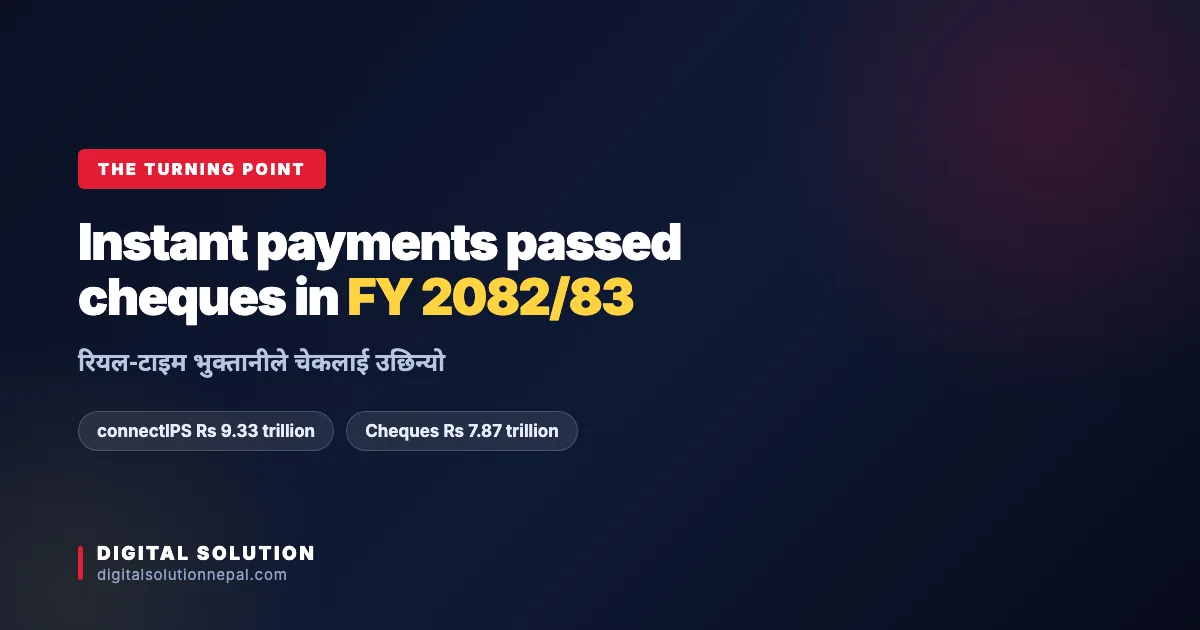
Look at the top two rows again, because that is the story of Nepali finance in one comparison.
Real-time retail payments have overtaken cheques by value. NPR 9.33 trillion against NPR 7.87 trillion. NCHL confirmed the milestone itself in August 2026, noting that RPS “crossed the transaction value of cheques transactions during the year.” In a single month — Ashadh 2083 — RPS alone moved more than NPR 1.2 trillion.
A country where a cheque once took three weeks to cross a district now moves more money instantly than it does on paper.
Separately, connectRTGS carried another NPR 9.05 trillion across just 331,692 transactions — an average of roughly NPR 27 million each, which tells you what that system is for.
NCHL has 54 direct member banks and financial institutions, plus more than 100 indirect or technical members — the wallets, PSPs and businesses that connect through its APIs. Its cheque network covers over 6,400 bank branches.
Why you pay a transaction fee
This is the complaint that shows up most in app reviews, so it is worth explaining what the fee actually pays for.
When you send money, two separate things happen. The first is the transaction — your account is debited, the recipient sees the money. That part feels instant.
The second is settlement, and it is the part nobody sees. Your bank has debited you, but the receiving bank has not yet actually received anything. Somebody has to move real money between the two banks and prove it happened. That reconciliation is done through the banks’ accounts held at Nepal Rastra Bank — NCHL calculates what each bank owes each other, and the positions are settled at the central bank.
The fee covers running that machinery: the switch, the settlement cycle, the reconciliation, the dispute handling and the guarantees that sit behind it. It is not a charge for pressing a button.
Whether the specific amounts are fair is a reasonable argument to have. But “why is there a fee at all when it’s just digital” has a real answer, and this is it.
What this means for you
If you run a business: NCHL-IPS and CORPORATEPAY are the systems your bank uses for bulk salary and vendor payments. If you are still writing cheques for payroll, ask your bank about direct credit — the batch systems exist and your bank is already a member.
If you take payments from customers: NEPALPAY QR is the national interoperable standard, which means one QR sticker can accept payment from any participating app rather than forcing customers onto a particular wallet.
If you are choosing between channels: the limits differ by instrument for reasons of risk, not technology. We explain that logic, and the full current ceilings, in our guide to mobile banking transaction limits in Nepal.
If a payment goes wrong: the dispute path runs through your own bank first, not through NCHL. Our guide to complaining about a digital payment sets out the escalation order.
Frequently asked questions
Who owns connectIPS?
connectIPS is operated by Nepal Clearing House Ltd (NCHL), which is owned 9.45% by Nepal Rastra Bank and 90.55% by 47 Nepali banks and financial institutions. It is not a private fintech and it is not a government department.
Is NCHL a government organisation?
No. It is a public limited company established under NRB’s leadership in 2008 and owned by the central bank together with the banking industry. It is unlisted, so its shares are not traded.
How long does a cheque take to clear in Nepal now?
Same day, if it is presented before the 15:00 cut-off — your account is credited by around 17:30 on Sunday to Thursday. Cheques presented after the cut-off clear the next working day. Cheques of NPR 300 million and above are still cleared manually through NRB.
What is the difference between connectIPS and NEPALPAY QR?
connectIPS is the platform you log into to move money between accounts and pay bills. NEPALPAY QR is the national QR standard used at merchants. Both run on NCHL’s Retail Payment Switch, which is why they interoperate across banks and apps.
Does NCHL run Nepal’s RTGS system?
No. RTGS is implemented and hosted by Nepal Rastra Bank. NCHL provides connectRTGS, which connects banks’ core systems to it.
How much money moves through NCHL?
In fiscal year 2082/83, its clearing and settlement systems processed over 238 million transactions worth NPR 21.02 trillion, with a further NPR 9.05 trillion through connectRTGS.
Need help with digital payments for your business?
Most Nepali businesses use a fraction of what this infrastructure already offers — still paying salaries by cheque, still collecting only in cash, still without a QR at the counter.
If you want help setting up digital collection, understanding which payment channel fits your business, or fixing an online payment flow that is losing you customers, Digital Solution does this work from our office in Pokhara and remotely across Nepal.
WhatsApp us on +977 9766597181 with what your business does and how you currently take payment.
Related reading: mobile banking transaction limits, cross-border QR and UPI with India, and what to do when a digital payment fails.
Sources: NCHL Annual Report 2081/82; NCHL published transaction statistics to Ashadh end 2083; NCHL Annual Report 2071/72 for early ECC milestones; NCHL FAQ and press releases; Nepal Rastra Bank Payment Systems Oversight Report 2081/82. The description of pre-2012 manual cheque clearing is drawn from NCHL CEO Neelesh Man Singh Pradhan’s account in a podcast interview; NCHL does not publish a before-and-after clearing-time comparison. All figures checked 12 August 2026.

Rabin Paudel
Rabin Paudel is the Founder of Digital Solution, a Content Creator, and an AI Trainer. He shares practical and easy-to-understand content on Artificial Intelligence, Digital Literacy, Online Services, FinTech, and Technology. His mission is to make technology simple, accessible, and useful for everyone.
View all posts by Rabin Paudel →