
As of 13 October 2026 (27 Asoj 2083). Every rate on this page is from the province’s own Finance Act for 2083, as published by its finance ministry. Sudurpashchim’s figures are from its Finance Bill, the only text its ministry had published. The lookups by engine size and all totals are our arithmetic.
To renew a bluebook in Nepal you pay two things each year: the vehicle tax and a small fee to renew the registration certificate. Since 2075 both have been set by the provinces, not by the federal government, so the amount depends on where the vehicle is registered.
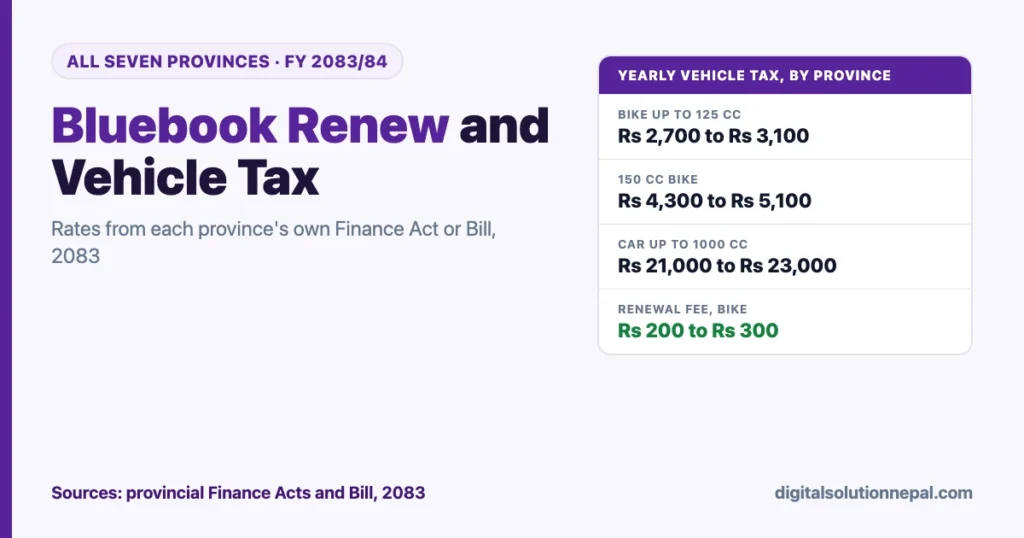
For fiscal year 2083/84 the tax on a 150 cc motorcycle is Rs 5,000 in five provinces, Rs 5,100 in Koshi and Rs 4,300 in Karnali. A car up to 1000 cc pays Rs 22,000 in five provinces, Rs 23,000 in Koshi and Rs 21,000 in Karnali. The gaps widen on bigger bikes and on electric vehicles.
This page puts all seven provinces side by side, then sets out each province’s deadline, fine, discount and relief for old dues. Bluebook is the everyday name for the vehicle registration certificate. Renewal is called nabikaran (नवीकरण).
Quick answers
| Question | Answer |
|---|---|
| Bike up to 125 cc | Rs 3,000 in five provinces, Rs 3,100 in Koshi, Rs 2,700 in Karnali |
| 150 cc bike | Rs 5,000 in five provinces, Rs 5,100 in Koshi, Rs 4,300 in Karnali |
| Car up to 1000 cc | Rs 22,000 in five provinces, Rs 23,000 in Koshi, Rs 21,000 in Karnali |
| Renewal fee, private bike | Rs 300, or Rs 200 in Koshi and Karnali |
| Renewal fee, private car | Rs 500, or Rs 400 in Koshi, Madhesh and Lumbini |
| Cheapest province overall | Karnali |
| Late fine printed in the Act | Found only in Karnali’s: 20%, then 30% |
| Discount for paying years ahead | Gandaki, Koshi and Lumbini |
Vehicle tax for cars, jeeps, vans and microbuses
All seven provinces use the same engine-size bands for private cars.
| Engine size | Koshi | Madhesh | Bagmati | Gandaki | Lumbini | Karnali | Sudurpashchim |
|---|---|---|---|---|---|---|---|
| Up to 1000 cc | Rs 23,000 | Rs 22,000 | Rs 22,000 | Rs 22,000 | Rs 22,000 | Rs 21,000 | Rs 22,000 |
| Above 1000 to 1500 cc | Rs 25,000 | Rs 25,000 | Rs 25,000 | Rs 25,000 | Rs 25,000 | Rs 23,000 | Rs 25,000 |
| Above 1500 to 2000 cc | Rs 32,000 | Rs 27,000 | Rs 27,000 | Rs 27,000 | Rs 27,000 | Rs 26,000 | Rs 27,000 |
| Above 2000 to 2500 cc | Rs 38,000 | Rs 37,000 | Rs 37,000 | Rs 37,000 | Rs 37,000 | Rs 35,000 | Rs 37,000 |
| Above 2500 to 3000 cc | Rs 46,000 | Rs 50,000 | Rs 50,000 | Rs 50,000 | Rs 50,000 | Rs 40,000 | Rs 50,000 |
| Above 3000 to 3500 cc | Rs 63,000 | Rs 60,000 | Rs 65,000 | Rs 60,000 | Rs 60,000 | Rs 56,000 | Rs 65,000 |
| Above 3500 cc | Rs 70,000 | Rs 60,000 | Rs 70,000 | Rs 65,000 | Rs 65,000 | Rs 62,000 | Rs 70,000 |
Madhesh has one rate for everything above 3000 cc.
Vehicle tax for motorcycles and scooters
The provinces do not cut their bike bands at the same points, so a direct band table would mislead. This table looks up the tax for common engine sizes in each province’s own bands.
| Engine size | Koshi | Madhesh | Bagmati | Gandaki | Lumbini | Karnali | Sudurpashchim |
|---|---|---|---|---|---|---|---|
| Up to 125 cc | Rs 3,100 | Rs 3,000 | Rs 3,000 | Rs 3,000 | Rs 3,000 | Rs 2,700 | Rs 3,000 |
| 150 cc | Rs 5,100 | Rs 5,000 | Rs 5,000 | Rs 5,000 | Rs 5,000 | Rs 4,300 | Rs 5,000 |
| 160 cc | Rs 6,500 | Rs 5,000 | Rs 6,500 | Rs 6,500 | Rs 6,500 | Rs 5,500 | Rs 6,500 |
| 200 cc | Rs 6,500 | Rs 6,500 | Rs 6,500 | Rs 6,500 | Rs 6,500 | Rs 5,500 | Rs 6,500 |
| 220 cc | Rs 8,000 | Rs 6,500 | Rs 6,500 | Rs 6,500 | Rs 6,500 | Rs 5,500 | Rs 6,500 |
| 250 cc | Rs 8,000 | Rs 6,500 | Rs 12,000 | Rs 11,000 | Rs 11,000 | Rs 5,500 | Rs 6,500 |
| 350 cc | Rs 11,000 | Rs 11,000 | Rs 12,000 | Rs 11,000 | Rs 11,000 | Rs 10,000 | Rs 11,000 |
| 500 cc | Rs 20,000 | Rs 20,000 | Rs 25,000 | Rs 20,000 | Rs 20,000 | Rs 16,000 | Rs 20,000 |
| 800 cc | Rs 20,000 | Rs 20,000 | Rs 35,000 | Rs 30,000 | Rs 30,000 | Rs 20,000 | Rs 30,000 |
Two sizes show how much the province matters. A 160 cc bike pays Rs 5,000 in Madhesh and Rs 6,500 in most others. A 250 cc bike pays Rs 5,500 in Karnali and Rs 12,000 in Bagmati.
Where each province cuts its bands
| Province | Band limits, in cc |
|---|---|
| Koshi | 125, 150, 200, 250, 400 |
| Madhesh | 125, 160, 250, 400 |
| Bagmati, Gandaki and Lumbini | 125, 150, 225, 400, 650 |
| Karnali and Sudurpashchim | 125, 150, 250, 400, 650 |
If your engine size sits exactly on a limit, it falls in the lower band. Engine sizes for current models are in our bike price list.
Vehicle tax for electric cars
Six provinces tax electric four-wheelers by motor power. Madhesh taxes them by price.
| Motor power | Koshi | Bagmati | Gandaki | Lumbini | Karnali | Sudurpashchim |
|---|---|---|---|---|---|---|
| 45 kilowatt | Rs 7,000 | Rs 6,500 | Rs 12,000 | Rs 11,000 | Rs 10,000 | Rs 12,000 |
| 100 kilowatt | Rs 15,000 | Rs 15,000 | Rs 17,000 | Rs 17,000 | Rs 15,000 | Rs 18,000 |
| 150 kilowatt | Rs 20,000 | Rs 20,000 | Rs 22,000 | Rs 22,000 | Rs 15,000 | Rs 24,000 |
| 250 kilowatt | Rs 30,000 | Rs 30,000 | Rs 32,000 | Rs 35,000 | Rs 30,000 | Rs 35,000 |
Lumbini’s schedule also gives private electric vehicles 20% off the vehicle tax, so its figures come to Rs 8,800, Rs 13,600, Rs 17,600 and Rs 28,000.
The bands behind that table:
| Province | Bands for electric cars, jeeps, vans and microbuses |
|---|---|
| Koshi | Up to 50 kW Rs 7,000. Above 50 to 125 kW Rs 15,000. Above 125 to 200 kW Rs 20,000. Above 200 kW Rs 30,000 |
| Bagmati | Up to 50 kW Rs 6,500. Above 50 to 125 kW Rs 15,000. Above 125 to 200 kW Rs 20,000. Above 200 kW Rs 30,000 |
| Gandaki | Up to 50 kW Rs 12,000. 51 to 100 kW Rs 17,000. 101 to 150 kW Rs 22,000. 151 to 200 kW Rs 27,000. Above 200 kW Rs 32,000 |
| Lumbini | Up to 50 kW Rs 11,000. Above 50 to 125 kW Rs 17,000. Above 125 to 225 kW Rs 22,000. Above 225 kW Rs 35,000 |
| Karnali | Above 20 to 50 kW Rs 10,000. Above 50 to 150 kW Rs 15,000. Above 150 to 200 kW Rs 20,000. Above 200 kW Rs 30,000 |
| Sudurpashchim | Up to 50 kW Rs 12,000. Above 50 to 125 kW Rs 18,000. Above 125 to 200 kW Rs 24,000. Above 200 kW Rs 35,000 |
Madhesh, by price:
| Value of the electric car, jeep, van, microbus or bus | Yearly tax |
|---|---|
| Up to Rs 30 lakh | Rs 11,000 |
| Above Rs 30 lakh to Rs 50 lakh | Rs 15,000 |
| Above Rs 50 lakh to Rs 1 crore | Rs 25,000 |
| Above Rs 1 crore | Rs 40,000 |
Madhesh defines the value as the customs value with all duties for an imported vehicle, or the invoice value with VAT for one sold in Nepal. For current models, see our electric car price list.
Vehicle tax for electric scooters and motorcycles
| Motor power | Koshi | Bagmati | Gandaki | Lumbini | Karnali | Sudurpashchim |
|---|---|---|---|---|---|---|
| 1,000 watt | Rs 2,000 | Rs 2,000 | Rs 2,000 | Rs 2,500 | Rs 1,500 | Rs 1,700 |
| 1,500 watt | Rs 2,500 | Rs 2,500 | Rs 2,500 | Rs 3,000 | Rs 2,000 | Rs 2,500 |
| 3,000 watt | Rs 4,000 | Rs 3,000 | Rs 3,000 | Rs 3,500 | Rs 3,000 | Rs 3,500 |
- Lumbini exempts electric two-wheelers up to 500 watt, and its 20% discount for private electric vehicles applies to the rest.
- Madhesh taxes them by price: Rs 2,000 up to a value of Rs 2,50,000, Rs 3,000 above that up to Rs 3,50,000, and Rs 5,000 above Rs 3,50,000.
- Bagmati, Gandaki and Sudurpashchim start lower for very small motors, from Rs 500 or Rs 1,000 up to 50 watt.
The bluebook renewal fee
On top of the tax, each province charges a fee for renewing the registration certificate. These are the figures for private vehicles.
| Vehicle | Koshi | Madhesh | Bagmati | Gandaki | Lumbini | Karnali | Sudurpashchim |
|---|---|---|---|---|---|---|---|
| Motorcycle or scooter | Rs 200 | Rs 300 | Rs 300 | Rs 300 | Rs 300 | Rs 200 | Rs 300 |
| Car, jeep or van | Rs 400 | Rs 400 | Rs 500 | Rs 500 | Rs 400 | Rs 500 | Rs 500 |
Public and hire vehicles pay more in most provinces. Gandaki’s and Sudurpashchim’s schedules give one set of figures without a private and public split.
What you will pay: worked examples
Tax plus renewal fee for a private vehicle, by our arithmetic. Insurance, and a pollution test where it applies, are separate.
| Vehicle | Koshi | Madhesh | Bagmati | Gandaki | Lumbini | Karnali | Sudurpashchim |
|---|---|---|---|---|---|---|---|
| 125 cc scooter | Rs 3,300 | Rs 3,300 | Rs 3,300 | Rs 3,300 | Rs 3,300 | Rs 2,900 | Rs 3,300 |
| 150 cc motorcycle | Rs 5,300 | Rs 5,300 | Rs 5,300 | Rs 5,300 | Rs 5,300 | Rs 4,500 | Rs 5,300 |
| 1200 cc car | Rs 25,400 | Rs 25,400 | Rs 25,500 | Rs 25,500 | Rs 25,400 | Rs 23,500 | Rs 25,500 |
| 1800 cc car | Rs 32,400 | Rs 27,400 | Rs 27,500 | Rs 27,500 | Rs 27,400 | Rs 26,500 | Rs 27,500 |
For the two vehicles most households own, six provinces come out at Rs 3,300 and Rs 5,300. Only Karnali is lower.
Deadlines, fines and discounts by province
This is where the provinces differ most. “Not found” means we did not find it in the schedule we read. It does not prove the rule is absent from the province’s other laws.
| Province | Time allowed after the bluebook date | Late fine printed in the Act | Discount for paying years ahead |
|---|---|---|---|
| Koshi | Not found | Not found | 10% off tax and renewal fee, for up to 5 years, or 10 years for two-wheelers |
| Madhesh | Not found | Not found | Not found |
| Bagmati | Not found | Not found | Not found |
| Gandaki | 90 days | Not found | 15% for 2 years, 20% for 3, 25% for 5 |
| Lumbini | 90 days, or Ashadh end if that comes first | Not found | 10% off the tax when 3 years are paid together |
| Karnali | 90 days after the bluebook date, or after Chaitra end if that comes first | 20% within the fiscal year, 30% after it ends | Not found |
| Sudurpashchim | Pay by Chaitra end. If the bluebook date is later, by Ashadh end with no extra fine | Not found | Not found |
Karnali’s is the only text in which we found the fine printed. For the others the rate sits in the province’s standing transport or tax law, and we did not find it in an official text we could read. Ask the Transport Management Office for the figure on your vehicle.
Relief for old unpaid tax
| Province | What the 2083 text offers | Deadline |
|---|---|---|
| Koshi | With dues of more than three years, pay the last three years’ tax, renewal fee and fine. The fine on the older years is waived | Jestha end 2084 |
| Koshi | To scrap a vehicle with more than five years of dues, pay only the 2083/84 tax. Everything else is waived | Jestha end 2084 |
| Madhesh | For a vehicle damaged in the Bhadra 2082 movement and being scrapped, the 2082/83 tax is waived | Apply by Mangsir end 2083 |
| Bagmati | Fines waived when a two-wheeler that no longer exists or is beyond use is scrapped, and for hire vehicles twenty years old or more | Poush end 2083 |
| Gandaki | Fines on earlier years’ tax and renewal waived for anyone who comes to pay. The Act calls this the last time | Baisakh end 2084 |
| Lumbini | For a vehicle with unpaid tax and no renewal, half of the total fine on the vehicle tax is waived when the owner pays and renews | Chaitra end 2083 |
| Karnali | To scrap a vehicle that no longer exists or is beyond use, pay the last three fiscal years. Fines up to 2082/83 are waived | Jestha end 2084 |
| Sudurpashchim | With dues of more than three years, pay the last two years’ tax and renewal fee. Earlier tax, fee and fine are not charged | Chaitra end 2083 |
Jestha ends in mid-June, Baisakh in mid-May, Chaitra in mid-April and Poush in mid-January.
Other rules worth knowing
- Older vehicles pay more in Bagmati and Lumbini. For a vehicle more than fifteen years past its date of manufacture, 5% is added to the tax for each year beyond fourteen. The total cannot be more than double the normal tax.
- A newly imported vehicle pays for part of a year. Koshi, Bagmati, Gandaki and Lumbini charge the tax in proportion where less than a year has passed since import.
- Renewing in another province. Gandaki, Lumbini, Karnali and Sudurpashchim let the owner of a vehicle registered elsewhere renew there. Karnali charges the home province’s rate, or its own if that is higher.
- Renewing early in Gandaki costs nothing. The next renewal date is still counted from the original date.
- Koshi rewards a switch to electric. A petrol or diesel vehicle converted to electric pays no vehicle tax in 2083/84.
- Only one discount in Gandaki and Lumbini. Where more than one could apply, the owner gets one.
- Moving a vehicle into Lumbini. If Lumbini’s tax is higher than the province the vehicle comes from, the difference is waived.
Who pays no vehicle tax
The schedules of Koshi, Bagmati, Gandaki and Lumbini exempt fire engines, ambulances and hearses. They also exempt scooters up to 150 cc adapted for use by persons with disabilities. Koshi and Gandaki add electric scooters up to 1000 watt for the same use.
Bagmati, Gandaki and Lumbini exempt vehicles more than twenty years old kept on display in a public museum. Sudurpashchim exempts electric bicycles.
Can you renew a bluebook online?
Two Acts speak to this directly, and they do not say the same thing.
- Bagmati. Where a payment is made through an electronic channel connected to the transport ministry’s online system, shows in the vehicle registration system and produces a receipt in the name of the vehicle or its owner, the Act says the renewal does not need to be entered in the registration book. Online payment began there in 2021, as The Himalayan Times reported, and ShareSansar reported Khalti’s “Bluebook Renew” service in February 2022.
- Koshi. An owner who pays through the revenue portal or online must pay within the deadline and must still have the registration book renewed. If the tax was paid online in time but the book was not renewed, there is no fine on the tax, but the fine on renewal applies.
- Other provinces. We did not find a statement in their schedules. Ask your Transport Management Office which payment methods it accepts.
So in Bagmati a payment that appears in the system does the job of the stamp. In Koshi the stamp is still required. Keep the payment receipt on your phone in either case.
What to take to the office
The Finance Acts list rates, not documents. As practical advice from our side:
- The original bluebook.
- Your current third-party insurance paper. Our guide to vehicle insurance in Nepal explains the cover.
- Last year’s tax receipt, if you have it.
- A copy of the owner’s citizenship certificate.
Ask your office whether it needs anything else. Since 12 October 2026 the owner does not have to attend in person for insurance-related work, as our note on the new vehicle namsari rule explains.
For penalties on the road, see our guide to traffic fines and rules. If your licence is due as well, the driving licence renewal guide covers that.
Need help with vehicle paperwork?
Sale deeds, applications and form filling for vehicle work. सवारी सम्बन्धी कागजात तयार गर्न सम्पर्क गर्नुहोस्।
Frequently asked questions
How much is the bike tax in Nepal for 2083/84?
For a bike up to 125 cc it is Rs 3,000 in five provinces, Rs 3,100 in Koshi and Rs 2,700 in Karnali. For 150 cc it is Rs 5,000 in five provinces, Rs 5,100 in Koshi and Rs 4,300 in Karnali.
How much is the car tax in Nepal for 2083/84?
Up to 1000 cc it is Rs 22,000 in five provinces, Rs 23,000 in Koshi and Rs 21,000 in Karnali. From 1000 to 1500 cc it is Rs 25,000 everywhere except Karnali, where it is Rs 23,000.
What is the bluebook renewal fee?
For a private motorcycle or scooter, Rs 300 in five provinces and Rs 200 in Koshi and Karnali. For a private car, Rs 500 in four provinces and Rs 400 in Koshi, Madhesh and Lumbini. It is paid in addition to the vehicle tax.
What is the fine for late vehicle tax?
We found it printed only in Karnali’s Finance Act: no fine for 90 days after the bluebook date, or after Chaitra end if that comes first, then 20% within the fiscal year and 30% after it ends. For other provinces, ask the Transport Management Office.
Which province has the lowest vehicle tax?
Karnali. It is the lowest, or equal lowest, on every bike and car size we compared. A 150 cc bike with the renewal fee comes to Rs 4,500 there, against Rs 5,300 in the other six.
Can I renew my bluebook online in Nepal?
In Bagmati, the Finance Act says an online payment shown in the registration system does not need to be entered in the registration book. In Koshi, an online payer must still have the book renewed. Other provinces’ schedules do not say.
Conclusion
To renew a bluebook in Nepal, find your vehicle in your own province’s table, add the renewal fee and pay inside the time your province allows. For a 150 cc motorcycle that is Rs 5,300 in six provinces and Rs 4,500 in Karnali. For a 1200 cc car it is between Rs 23,500 and Rs 25,500.
If you are behind, check the relief table. Every province has something for old dues this year, and each has its own deadline.
Sources
- Koshi Province Government, Koshi Province Finance Act, 2083, Province Gazette, 30 Ashadh 2083, Schedule 2. Ministry of Economic Affairs and Planning: https://moeap.koshi.gov.np/content/327/koshi-province-economic-act–2083/
- Madhesh Province Government, Madhesh Province Finance Act, 2083, Province Gazette, 32 Ashadh 2083, Schedule 2, and the ministry’s notice of 2083/04/12 on section 14. Ministry of Finance: https://mof.madhesh.gov.np/content/85/madhesh-province-economic-act–2083/
- Bagmati Province Government, Province Finance Act, 2083, certified 31 Ashadh 2083, sections 3 and 18, Schedule 2. Ministry of Economic Affairs and Planning: https://moeap.bagamati.gov.np/content/13440/state-economic-bill–2083/
- Gandaki Province Government, Gandaki Province Finance Act, 2083, Province Gazette, 26 Ashadh 2083, sections 3 and 14, Schedules 2 and 3. Ministry of Economic Affairs: https://mof.gandaki.gov.np/list/act-rules/economic-act-2083
- Lumbini Province Government, Province Finance Act, 2083, Schedule 2. Ministry of Economic Affairs and Planning: https://moeap.lumbini.gov.np/publications/155
- Karnali Province Government, Karnali Province Finance Act, 2083, Province Gazette, 31 Ashadh 2083, Schedule 2. Ministry of Economic Affairs and Planning: https://moeap.karnali.gov.np/content/22/karnali-province-economic-act–2083/
- Sudurpashchim Province Government, Finance Bill for fiscal year 2083/84, Schedule 2. Ministry of Economic Affairs: https://moea.sudurpashchim.gov.np/content/12621/economic-bill-for-the-financial-year-2083-84/
- The Himalayan Times, “Vehicle tax payment system switches online in Bagmati” (23 July 2021): https://thehimalayantimes.com/nepal/vehicle-tax-payment-system-switches-online-in-bagmati
- ShareSansar, report on Khalti’s Bluebook Renew service (17 February 2022): https://www.sharesansar.com/newsdetail/bluebook-renew-facility-available-on-khalti-app-no-more-hassles-at-government-offices-2022-02-17
Digital Solution Pvt. Ltd. is an independent publisher and is not affiliated with any transport office. Rates are translated from the Nepali text of each Act or Bill; the lookups by engine size, the examples and the totals are our own arithmetic. Sudurpashchim’s figures are from a Bill and may differ from the Act as passed. Confirm the amount for your vehicle with your Transport Management Office before you pay.

Rabin Paudel
Rabin Paudel is the Founder of Digital Solution, a Content Creator, and an AI Trainer. He shares practical and easy-to-understand content on Artificial Intelligence, Digital Literacy, Online Services, FinTech, and Technology. His mission is to make technology simple, accessible, and useful for everyone.
View all posts by Rabin Paudel →