As of October 2026 (Asoj 2083). Based on the directive approved by the Department of Transport Management on 31 Bhadra 2083 (16 September 2026). Fees and eligibility are set by separate law; confirm them with your transport office.
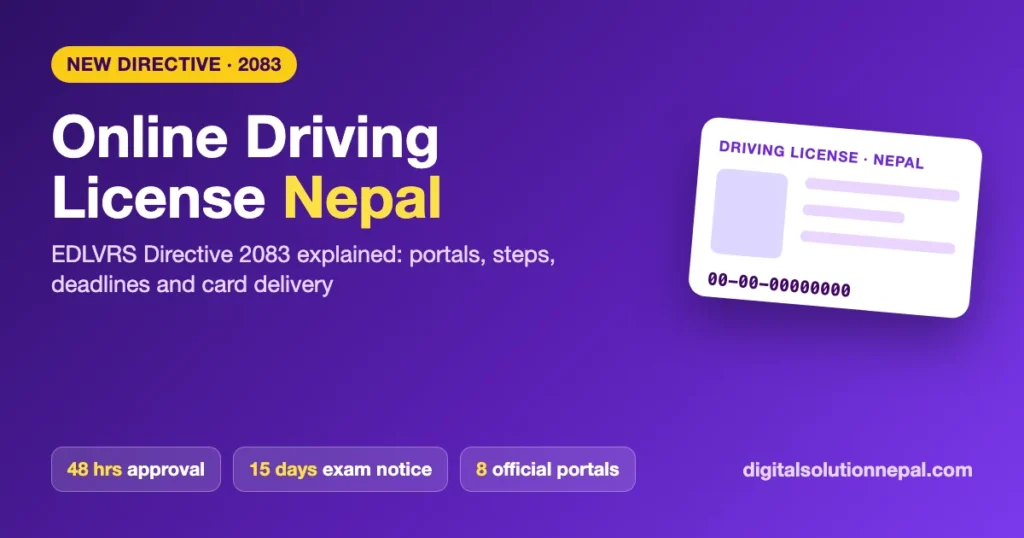
Applying for an online driving license in Nepal now runs under a new rulebook. On 31 Bhadra 2083, the Department of Transport Management (DoTM) approved the “विद्युतीय माध्यमबाट सवारी चालक अनुमतिपत्र सम्बन्धी सेवा प्रवाह गर्ने निर्देशिका, २०८३” (Directive on Delivering Driving License Services through Electronic Means, 2083).
It replaces the 2080 directive and covers every licence service: new licence, category add, renewal, duplicate, retrial, correction and card delivery. It also does something applicants will care about more than any portal redesign. It puts time limits on transport offices.
We read all 17 pages. This guide explains what the directive says, what it means for you, and which official portal to use for your province.
Key takeaways
- One system, eight doors. Services run on EDLVRS (Electronic Driving License and Vehicle Registration System), entered through a DoTM portal or one of seven provincial portals.
- Identity is checked digitally by scanning a QR code in the Nagarik App or using your National ID. Physical biometrics are the fallback.
- Offices should approve online applications within 48 hours, and must tell you the reason if they reject.
- Expected exam dates, venues and capacity must be published 15 days ahead, and results entered within 48 hours.
- Every fee is paid electronically. There is no cash step in the process.
- Card printing and distribution is a provincial responsibility, with delivery to an address of your choice possible for a fee.
- You must clear unpaid traffic fines and use a mobile number registered in your own name.
Related: not every step is online. See what you can do online and what still needs an office visit.
What is the EDLVRS Directive 2083?
The directive is issued by DoTM under the Motor Vehicles and Transport Management Act, 2049 and the Motor Vehicles and Transport Management Rules, 2054. It took effect on the date it was approved: 31 Bhadra 2083.
Its stated purpose is to make driving license services “simpler, faster, transparent, secure and service-seeker friendly” by running them through an electronic system.
It formally repeals the earlier 2080 directive on the same subject. Work already done under the old directive is treated as done under the new one, so pending applications are not cancelled by the change.
One point matters throughout: in the directive, “office” means a transport management office under a provincial government. Driving license services are now a provincial function, with DoTM setting technical standards and keeping the system connected.
Official EDLVRS portals for an online driving license in Nepal
The directive lists the official portals in its Annex 1. Use the one for the province where you want to take the service.
| Authority | Official portal |
|---|---|
| Department of Transport Management | edlvrs.dotm.gov.np |
| Koshi Province | edlvrs.koshi.gov.np |
| Madhesh Province | edlvrs.madhesh.gov.np |
| Bagamati Province | edlvrs.bagamati.gov.np |
| Gandaki Province | edlvrs.gandaki.gov.np |
| Lumbini Province | edlvrs.lumbini.gov.np |
| Karnali Province | edlvrs.karnali.gov.np |
| Sudurpashchim Province | edlvrs.sudurpashchim.gov.np |
All eight addresses responded when we checked them on 8 October 2026.
A safety note. These are the only portals named in the directive. Every one ends in .gov.np. If a link sent to you by message or shown in an advertisement does not, do not enter your details. The directive also tells applicants not to share their OTP, password or Application ID with anyone.
How identity verification works now
This is the biggest practical change. The system pulls your details from government records instead of asking you to type them.
For Nepali citizens:
- Verify yourself by scanning a QR code with the Nagarik App, or by using your National ID (राष्ट्रिय परिचयपत्र).
- Once verified, your official details are filled into the application form automatically.
- If digital verification is not possible, you can use your citizenship certificate, passport or another government document, and give biometrics in person at the office.
You must use a mobile number registered in your own name and currently active. The system may send an OTP to your mobile or email to confirm it is you.
For foreign nationals and diplomats: passport, the driving license issued by your own country, and a Nepal visa. Diplomatic staff submit documents through the transport office at Ekantakuna.
For Indian citizens: an identity or recommendation letter from the Indian Embassy, your driving license, and a residence recommendation from the ward office where you live.
Foreign and Indian applicants must attend the office in person for biometric verification.
New driving license: the process step by step
The directive sets out the sequence for a new licence. In plain order:
- Open your province’s EDLVRS portal and choose New License Application.
- Verify your identity through the Nagarik App QR scan or National ID.
- Check the auto-filled details and complete anything else the system asks for.
- Choose the licence category you are applying for.
- Pick a doctor from the list of recognised doctors in the system and get your health examination done.
- The doctor enters the result (Fit or Unfit) directly into EDLVRS.
- Choose your transport office and submit the application.
- The office approves or rejects it (the “Office Approval” stage).
- Pay the application fee electronically.
- Choose a written exam date from the dates available, and sit the exam at the chosen place.
- After passing, pay the practical exam fee if a separate fee applies, choose a trial date, and take the trial.
- After passing the trial, pay the licence fee set by your province’s law.
- The system issues your driving license number, and your details are sent automatically for smart card printing.
Categories that are exempt from the written exam under existing law go straight to the practical exam stage.
For what to expect on the day itself, see our driving license trial day checklist.
Renewal, category add, duplicate, retrial and correction
Every other service follows the same pattern: choose the option, verify, get office approval, pay online.
| Service | Portal option | What the directive says |
|---|---|---|
| Add a category | Add Category Application | Enter your National ID number and licence number. Then health check, office approval, fee and exams follow the new-licence process. |
| Renewal | Renew License Application | Enter licence number, get a health check from a listed doctor, office approval, then pay online. |
| Duplicate copy | License Copy application | For the reasons allowed under the Act. The office checks, you pay the duplicate fee, and the copy is issued. |
| Retrial | Retrial | Pay the retrial fee, pick a new date, attend, then pay the final licence fee once you pass. |
| Correction | License Correction Application | Details are corrected on the basis of your National ID record. |
| View or download | License Details | After OTP verification you can view and download your licence details. |
Three details are easy to miss.
Category add can be blocked. The system may stop a category-add application if your licence is suspended, is due for renewal, or is otherwise ineligible. Renew first, then add. Our category add guide covers the categories.
Your National ID wins. If the details on your licence differ from those in the National ID system, the National ID record is the one that is kept. If your National ID itself is wrong, fix that first.
Retrial limits are unchanged. How many attempts you get, and within what period, is still governed by the Act, the Rules and provincial law, not by this directive.
Late on your renewal? Check the penalties in our guide to driving license renewal fines.
The deadlines transport offices must now meet
For anyone who has waited weeks without an answer, this section is the most useful part of the directive. It writes specific timeframes into the office’s responsibilities.
| What | Timeframe in the directive |
|---|---|
| Decide on online applications (new, category add, duplicate, renewal) | Normally within 48 hours; if rejecting, inform the applicant with the reason |
| Publish expected written and practical exam dates, venue and capacity | 15 days in advance |
| Enter exam results into the system | Within 48 hours |
| Exams disrupted by disaster or technical failure | Must be rescheduled |
If results cannot be entered within 48 hours, the office has to record the reason and inform the provincial ministry.
Offices are also told to help applicants with complaints and system problems, and to set up a help desk where needed.
A fair caution: the directive says “normally” for the 48-hour approval. It is a standard to hold an office to, not a guarantee. But it gives you something concrete to cite when you follow up.
Health examination: what changes
The medical step is now inside the system.
- Recognised doctors are listed in EDLVRS with their name, location and contact details, so you can choose one near you.
- The doctor verifies your identity by biometrics before examining you.
- The doctor enters the Fit or Unfit result directly into the system and uploads a medical report where required.
- A doctor found to have given a false report through negligence can be referred to the regulatory body for action.
- The examination fee is whatever the federal or provincial government sets.
In practice this closes the old gap where a paper medical form could be filled in without the applicant being examined.
Fees and payment: everything is electronic
The directive does not set any fee amounts. Application, exam, renewal, duplicate and retrial fees are fixed by provincial law, and the provincial ministry is responsible for keeping them updated in the system.
What the directive does fix is the method:
- All fees are paid electronically, through digital wallets or banks, via the government’s revenue gateway.
- The system must give you electronic proof of payment.
- If your payment succeeds but the system does not update, it can be verified using the EBP (Electronic Bill Payment) number. Keep that number.
- Double payments and payment problems are to be resolved under existing law.
For current amounts, see our province-wise driving license fee guide, and confirm with your office.
Smart card printing and delivery
Once your licence number is issued, or a renewal, category add or duplicate makes a new card necessary, your details go into the card-printing process.
The directive is clear about who is responsible: card printing and distribution belongs to the provincial ministry, or the body designated by law.
Three provisions matter to anyone waiting for a card:
- You must be notified when printing is complete, by SMS, Application Tracking or another electronic channel.
- Cards are distributed from the transport office, with a record of who collected them.
- If you want the card at an address other than the issuing office, you can request it. For a fee, delivery is arranged in coordination with the printing body and the Department of Postal Services.
That third point is the legal footing for the home-delivery service DoTM has been preparing. We covered the plan in driving license home delivery in Nepal, and the printing backlog in why smart license printing is stuck.
What the directive does not do is set a deadline for printing. It assigns responsibility, but gives no number of days.
Three special provisions worth knowing
Old paper licences. Offices are to update “Paper Card” details into the new system, following written direction from the provincial ministry.
Licences with a number but missing records. Some licences exist in the system with a number but incomplete details. The directive allows a one-time fix: the office can rebuild the record from the details the holder has, the office’s own records, or the holder’s self-declaration, and then renew the licence. This does not apply to licences held up in a regulatory investigation. The self-declaration format is attached to the directive, and it makes you responsible if the details you declare are false.
Licence number format. New licence numbers follow a set format built from province code, district code and office code, followed by a serial number. The annex prints the sample as 00-00-00000000.
Your responsibilities as an applicant
The directive lists duties for applicants too. Ignoring them is the fastest way to get rejected.
- Use correct personal details and upload only genuine documents.
- Use a mobile number registered in your own name and your own email.
- Check everything before you submit.
- Do not share your OTP, password or Application ID.
- Attend exams on the date and at the place you selected.
- Pay fees on time.
- If your licence details are wrong, correct them through the portal or at the office.
- Clear any outstanding traffic fines in your name. This is mandatory.
If your application is rejected
An office can reject an application, or ask for more proof, if the details look wrong, incomplete or doubtful. The directive adds safeguards:
- The office must state the reason for rejection in the system, as far as possible.
- You can correct and resubmit where the system allows.
- The office may ask to see original documents or call you in person.
You can follow all of this through Application Tracking: enter your Application ID to see the current status, the steps completed and the steps remaining. A status link is also sent by SMS.
What the directive does not change
Anything not covered here stays as it was under federal and provincial law. That includes eligibility, minimum age, licence categories, fee amounts, number of exam attempts, renewal periods and fines.
So this directive changes how you apply, not who qualifies. For those basics, see our EDLVRS FAQ and the guide to Nepali licence categories.
Need help with the form or an International Driving Permit?
The online process is straightforward if your National ID, mobile number and documents are in order. It gets difficult when one of them is not.
Digital Solution helps applicants in Nepal and abroad with licence-related paperwork and with the International Driving Permit (IDP). You can order online through our Order Portal or message us on WhatsApp.
Need help with licence paperwork or an International Driving Permit?
Order online or message us. फारम भर्न वा IDP का लागि सम्पर्क गर्नुहोस्।
Frequently asked questions
Which website do I use to apply for a driving license online in Nepal?
Use the EDLVRS portal for your province, for example edlvrs.bagamati.gov.np or edlvrs.gandaki.gov.np, or the DoTM portal edlvrs.dotm.gov.np. The full list of eight official portals is in Annex 1 of the directive.
Do I need the Nagarik App to apply?
Not strictly. Identity can be verified by Nagarik App QR scan or by National ID. If neither works, you can use citizenship or another government document and give biometrics in person at the office.
How long does the transport office take to approve an online application?
The directive says offices should normally approve online applications within 48 hours, and must inform the applicant with the reason if they reject it.
Can I get my driving license card delivered to my home?
The directive allows delivery to an address other than the issuing office, on request and for a fee, arranged with the printing body and the Department of Postal Services. Check with your office whether the service is running in your area.
Does the 2083 directive change driving license fees?
No. It does not set fee amounts. Fees are fixed by provincial law. The directive only requires that they be paid electronically.
Can I renew a licence if I have unpaid traffic fines?
The directive makes it the applicant’s responsibility to pay any outstanding traffic fines in their name. Clear them before applying.
Conclusion
The new directive turns the online driving license process in Nepal into one consistent system: verify through the Nagarik App or National ID, choose a listed doctor, get office approval, pay online, book your exam, and track everything with your Application ID.
Its real value is accountability. A 48-hour approval standard, exam schedules published 15 days ahead and results within 48 hours give applicants something specific to hold an office to. What it still lacks is a deadline for printing the card, which is where the longest waits are.
Start with the right portal for your province, use your own mobile number, and keep your Application ID and payment reference safe.
Source
- Department of Transport Management, Government of Nepal: “विद्युतीय माध्यमबाट सवारी चालक अनुमतिपत्र सम्बन्धी सेवा प्रवाह गर्ने निर्देशिका, २०८३”, approved 2083/05/31. Full text (17 pages, including Annexes 1–3): https://giwmscdnone.gov.np/media/pdf_upload/%E0%A4%A8%E0%A4%BF%E0%A4%B0%E0%A5%8D%E0%A4%A6%E0%A5%87%E0%A4%B6%E0%A4%BF%E0%A4%95%E0%A4%BE_s5er0dt.pdf
Digital Solution Pvt. Ltd. is an independent publisher, not affiliated with the Department of Transport Management or any transport office. This is a plain-language summary of the directive, not legal advice. The original Nepali text prevails.

Rabin Paudel
Rabin Paudel is the Founder of Digital Solution, a Content Creator, and an AI Trainer. He shares practical and easy-to-understand content on Artificial Intelligence, Digital Literacy, Online Services, FinTech, and Technology. His mission is to make technology simple, accessible, and useful for everyone.
View all posts by Rabin Paudel →
Pingback: eDLVRS FAQ 2026: 25 License Questions Answered