
Last updated: July 31, 2026 (Shrawan 2083). Based on publicly available NRB classifications and the published tariffs of the service providers named. Tariffs and tax treatment change — always check the current official fee schedule.
Make a digital payment in Nepal and the charges you see for essentially the same transaction can differ completely. Pay government revenue, school fees, an EMI or a broker through eSewa or Khalti and you may see a service charge plus 13% VAT. Do something similar through connectIPS and only a transaction fee is deducted — no separate VAT line. Pay through the Fonepay network and most customers never see VAT at all.
That raises an obvious question: why does VAT apply to eSewa and Khalti payment charges but appear absent on connectIPS and Fonepay? And is Fonepay Gateway treated as a clearing house service and therefore VAT-exempt? Answering this properly requires understanding the difference between a Payment Service Provider, a Payment System Operator, a clearing service and a payment gateway.
eSewa, Khalti, Fonepay and connectIPS Are Not the Same Type of Institution
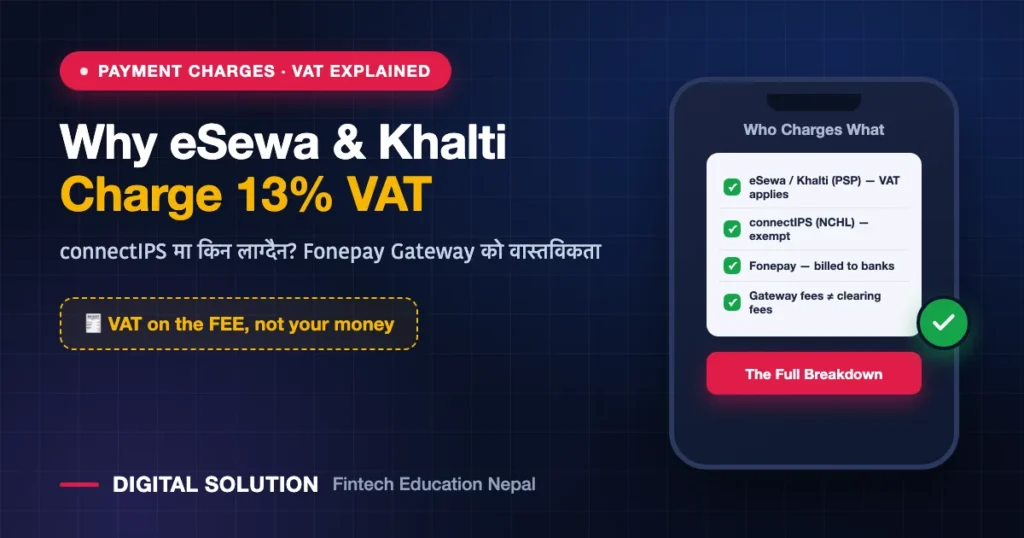
According to Nepal Rastra Bank’s latest published list, Nepal Clearing House Limited (NCHL) and Fonepay Payment Service Limited are licensed as Payment System Operators (PSO), while eSewa and IME Khalti are listed as Payment Service Providers (PSP). (NRB, list of PSO/PSP)
| Category | What it generally does | Examples here |
|---|---|---|
| PSP — Payment Service Provider | Provides wallets, payment accounts or direct payment services to customers | eSewa, IME Khalti |
| PSO — Payment System Operator | Operates payment network, switching, routing, clearing or settlement infrastructure between banks, financial institutions, wallets and merchants | NCHL (connectIPS), Fonepay |
Being a PSO does not automatically make every service that institution provides VAT-free. Tax treatment depends not only on the licence category but on what service is actually being supplied and how it is classified.
Why connectIPS Doesn’t Add VAT
Nepal Clearing House Limited, which operates connectIPS, states clearly in its published transaction fee schedule that clearing house services fall within the VAT exemption list under Finance Ordinance 2082, and that VAT therefore does not apply. That fee schedule has been effective since 30 May 2025. (NCHL fee schedule)
In practical terms on connectIPS:
- Some transfers up to Rs 500 may be free.
- Transactions above Rs 500 may attract a defined transaction fee.
- No additional 13% VAT is applied on top of that clearing transaction fee, per the published schedule.
So for connectIPS the basis is explicit and documented: the relevant transaction service is treated as a clearing house service, and the official fee disclosure itself states that VAT does not apply.
Why eSewa Adds VAT to Its Service Charge
eSewa’s published tariff describes various service charges as “exclusive of VAT” or “plus VAT”, and eSewa has publicly stated that 13% VAT applies on applicable service charges. (eSewa tariffs)
A simple example:
| Component | Amount |
|---|---|
| Service charge | Rs 10.00 |
| VAT at 13% | Rs 1.30 |
| Total deducted from the customer | Rs 11.30 |
Crucially, VAT applies to the service charge — not to the transaction amount. If you pay Rs 10,000 in government revenue, VAT is not charged on the Rs 10,000; it may only apply to the payment service charge on top of it.
eSewa is licensed by Nepal Rastra Bank as a PSP. There is no public evidence that the wallet or payment service charges it collects directly from customers are automatically classified the same way as NCHL’s clearing house fees.
Why Khalti Adds VAT to Its Service Charge
Khalti’s public Service Rates and Charges page lists fees for wallet services, gateway services, government payments, EMI and other services, and its tariff notes state that VAT applies to the applicable charges. (Khalti charges)
So when you use a Khalti service, you may see three separate lines: the base service charge, the applicable VAT, and the total payable amount.
Khalti is also a PSP, so it can charge customers directly for the wallet or payment facility it provides. But the VAT is not applied merely because it is a PSP — what matters is how that charge is classified as a service for tax purposes.
Why VAT Isn’t Visible on Fonepay
Fonepay’s structure differs from eSewa’s and Khalti’s. According to Fonepay’s public fee schedule, the listed charges are levied primarily on member banks and financial institutions, and Fonepay advises customers to check with their own bank regarding charges the bank applies. (Fonepay fees and charges)
Fonepay’s tariff indicates that:
- Merchant QR payments are free for customers;
- Interbank fund transfers and certain online payments carry defined charges;
- Those charges are collected from member banks and financial institutions;
- The published charges are “exclusive of applicable taxes, if any.”
That means the reason you don’t see VAT in your mobile banking app could be any of the following:
- Fonepay invoices the bank rather than charging the customer directly.
- The bank absorbs the charge itself.
- The bank shows the customer a single consolidated transaction charge.
- The relevant transaction-processing component is treated as a clearing service.
But the absence of a visible VAT line on your screen does not prove that all Fonepay services are VAT-free.
Is Fonepay Gateway Treated as a Clearing Service and Made VAT-Free?
The careful, evidence-based answer: there is no clear public evidence that all Fonepay Gateway services and charges are treated as clearing house services and granted blanket VAT exemption.
Fonepay is licensed by NRB as a PSO. But a PSO can supply payment switching, routing, settlement, gateway, API integration and other technical services. Its charges therefore need to be separated by service type:
Services that may fall within the exemption
Where the core clearing-related charge for processing, clearing and settling transactions between banks or financial institutions is classified as a clearing house service, the VAT exemption may apply.
Services that cannot automatically be called VAT-free
The following can be technical or commercial services distinct from a clearing transaction:
- Gateway integration fee
- API setup fee
- Annual maintenance charge
- Software or platform fee
- Merchant onboarding fee
- Technical support charge
- Customized payment solution fee
No public ruling or explicit tariff disclosure establishes that all of these automatically qualify as “clearing house service” for VAT exemption. Fonepay’s own fee disclosure does not declare its charges VAT-free — it states charges are exclusive of “applicable taxes, if any.” (Fonepay)
Fonepay and connectIPS Should Not Be Read the Same Way
Both are PSOs, but their disclosures differ materially:
| Provider | Type | What the public tariff says about VAT |
|---|---|---|
| connectIPS (NCHL) | PSO | Explicitly states clearing house services are in the VAT exemption list; VAT not applied |
| Fonepay | PSO | No blanket VAT-free declaration; charges are “exclusive of applicable taxes, if any” |
| eSewa / Khalti | PSP | Applicable customer service charges are stated as subject to VAT |
Why the Same Payment Can Carry Different Charges
From the outside, the user sees one action — a bill payment or a bank transfer. In the backend, the service model can be entirely different. In one transaction a wallet may charge the customer a convenience fee; in another the bank charges a network fee; in another the merchant absorbs the cost; in another a clearing house charges a transaction-processing fee.
So even when the purpose of the transaction is identical, the billing party, service classification and tax treatment can differ — and that is what produces the inconsistent charges customers notice.
The Real Problem Is Disclosure, Not Just Tax
At minimum, a payment confirmation screen should clearly show:
- The base transaction amount
- The service charge
- VAT or other taxes
- Which institution is collecting the charge
- Whether the bank, wallet or merchant set that charge
- The total the customer pays
Today, some platforms show service charge and VAT separately while others display a single combined figure. That inconsistency is what makes customers believe one platform “charges VAT” while another does not. A standardized fee disclosure format mandated across all digital payment platforms by Nepal Rastra Bank and the relevant authorities would resolve most of this confusion.
Until then, keep your own records: if a payment charge ever looks wrong or a transaction fails mid-way, our digital payment and banking complaint guide explains exactly who to contact and in what order.
Frequently Asked Questions
Is VAT charged on the money I send, or only on the fee?
Only on the applicable service charge. Sending Rs 10,000 does not attract VAT on Rs 10,000 — VAT may apply to the payment service charge levied on top of it.
Why does connectIPS not show VAT?
NCHL’s published fee schedule states that clearing house services are within the VAT exemption list under Finance Ordinance 2082, so no VAT is added to the clearing transaction fee.
Does that mean Fonepay Gateway is completely VAT-free?
No. There is no public evidence of a blanket exemption for all Fonepay Gateway services. Some transaction-clearing components may fall under the exemption, but gateway integration, API, maintenance and similar technical or commercial charges cannot automatically be assumed VAT-free.
Why do eSewa and Khalti charge VAT when they are also licensed by NRB?
Licence category alone does not determine tax treatment. Both are PSPs whose published tariffs present certain customer-facing service charges as VAT-applicable, and their tariffs state that VAT applies to those charges.
How can a merchant or business confirm its own VAT position?
Read the actual service agreement, the invoice description and the tax classification applied to each line item — and where the amounts are material, obtain written clarification from the service provider or a tax professional / the Inland Revenue Department. For general business tax context, see our Nepal payment, invoice, PAN and tax guide.
Conclusion
eSewa and Khalti appear to add 13% VAT to applicable payment service charges because their published tariffs present certain customer-facing wallet and payment service charges as VAT-applicable. (eSewa) (Khalti)
connectIPS does not add VAT to its transaction fee because NCHL’s official fee schedule explicitly places clearing house services in the VAT exemption list. (NCHL)
For Fonepay, the absence of a visible VAT line does not mean all Fonepay Gateway services are VAT-free. Because Fonepay’s charges are levied primarily on member banks and financial institutions, the tax structure simply may not appear on the customer’s screen. (Fonepay)
The most accurate summary: connectIPS’s clearing fee is clearly VAT-exempt. Some Fonepay transaction-clearing components may fall under the exemption, but the entire Fonepay Gateway service cannot be assumed automatically VAT-free. The actual tax position can only be confirmed by examining the relevant service agreement, invoice description and tax classification.
This same lack of standardized disclosure runs through Nepal’s wider digital-finance shift — from NRB making National ID mandatory for wallet KYC to bank accounts opening through the Nagarik App. Rules are modernizing fast; consumer-facing transparency needs to keep pace.
🤝 Confused about a payment charge or a merchant gateway agreement?
Digital Solution publishes practical explainers on Nepal’s digital-finance rules and helps businesses understand their payment setup.
Author: Rabin Paudel · Published by: Digital Solution
Disclaimer: This is public-awareness content based on analysis of publicly available Nepal Rastra Bank classifications and the published tariffs and fee schedules of the service providers named. It is not tax or legal advice. For a binding conclusion on any specific merchant agreement or tax invoice, obtain written clarification from a tax professional, the Inland Revenue Department, or the relevant service provider.

Rabin Paudel
Rabin Paudel is the Founder of Digital Solution, a Content Creator, and an AI Trainer. He shares practical and easy-to-understand content on Artificial Intelligence, Digital Literacy, Online Services, FinTech, and Technology. His mission is to make technology simple, accessible, and useful for everyone.
View all posts by Rabin Paudel →